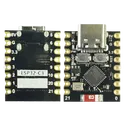
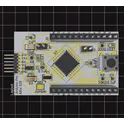
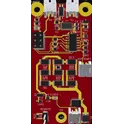
Mixed Voltage Arduino Nano Integration Example on a 4 Layer PCB Changelog/TODO: -Breakout the SPI Bus in a 2.54mm header in a snap off manner -add an IMU -Reorder the rows of the LEDs Tutorials: https://circuitdigest.com/microcontroller-projects/interfacing-max7219-led-dot-matrix-display-with-arduino
6 Stars
Check out the winning project at the SF climate hardware hack! This project intends to bring smart IoT capabilities to homes for native bees so that more people can provide them housing and we can all participate in citizen science to gather more information about the bees! Requirements: -Daytime Operation Only -Track Bee Input/Output Directionality -Connects to House via WiFi Features: -MPPT Solar Power Conditioning -96% efficient IR LED Drive Next Version Feature Wants: Microphone!
6 Stars
Overview: BME280 Sensor data -> uSD card Click on the bubble comments to see copilot design this project! Very impressed copilot routed all the SPI buses accurately for me. TODO: Just realized that there is no footprint for the SD Card holder, gotta add that Also, there needs to be a way to program the ATTINY841, Probably over UART?
6 Stars
This Weather Station Logger project employs the versatile ESP32 microcontroller board, integrated with an SD card slot for data storage. It features a USB interface for easy programming and is efficiently powered by a single 18650 battery, complete with a protection circuit for safe operation. #iot #esp32 #lora #weather #edgecomputing
5 Stars
Use this template if you're planning to get your board manufactured in OSHPARK. It has the via min/max and trace width constraints already baked as global rules. #project-template #template #manufacturer-design-rules OSHpark 4-layer stackup specs: Top overlay or silkscreen: 1 mil thick Top solder mask or solder resist: 1 mil thick Top copper: 1.7 mil thick on 1 oz copper Dielectric: 7.96 mil thick FR408HG 2113 Mid layer 1: 0.68 mil thick on 0.5 oz copper Dielectric core: 39 mil thick FR408HR Mid layer 2: 0.68 mil thick on 0.5 oz copper Dielectric: 7.96 mil thick FR408HG 2113 Bottom copper: 1.7 mil thick on 1 oz copper Bottom solder mask or solder resist: 1 mil thick Bottom overlay or silkscreen: 1 mil thick
5 Stars
A buck boost converter that can be powered from a Li-Ion battery and output 3.3V @ 500mA. Powered by the TPS63051YFFR and in the same package as a standard Adafruit buck converter. Expect to squeeze around 5-10% SoC from a typical Li-Ion battery. Input Voltage Range: 2.5V to 5.5V Assembled at pcbway.com
5 Stars
quiero que de las siguientes instrucciones lo plasmes en un protoboard: Transformador: Convierte la tensión de CA de la red eléctrica (120 V) en una tensión de CA de menor voltaje (por ejemplo, 12 V). Puente rectificador: Convierte la tensión de CA de bajo voltaje en una tensión de CC pulsante. Filtro: Compuesto por condensadores y resistencias, elimina la ondulación de la tensión de CC pulsante y produce una tensión de CC más estable. Circuito regulador: Mantiene la tensión de CC a un nivel constante, incluso si la tensión de entrada o la carga varían. Este circuito puede ser un circuito integrado (CI) regulador de voltaje o un circuito discreto con transistores. Carga: Dispositivo que consume la energía eléctrica proporcionada por la fuente de alimentación, como una bombilla, un motor o un circuito electrónico. Conexiones: La entrada de CA se conecta al transformador. La salida de CA del transformador se conecta al puente rectificador. La salida de CC del puente rectificador se conecta al filtro. La salida de CC del filtro se conecta al circuito regulador. La salida de CC del circuito regulador se conecta a la carga.
5 Stars
This project is a Pulse Width Modulation (PWM) Controller, built around an LM555 timer IC. It controls a load connected to a MOSFET, with adjustments via a potentiometer, and uses capacitors, resistors and diodes for various functions. #PWM #controller #project #Template #projectTemplate
5 Stars
First in the world hands-free Otherside communication device! You need only the board, spirit or ghost don't need to move the ouija anymore. Symbols will light up from the inside so you will be able to read your messages and spirit or ghost just need to turn on a red bottom entry LED. Two MEMS microphones allow your interlocutor to clearly hear your questions. WiFi connectivity gives you an opportunity to "dial" without a Medium anytime anywhere. And it has Bluetooth as well, because: "Everything is better with Bluetooth"! This board is powered by a single 10440(AAA) LiFePO4 battery that gives you up to 2 hours of seance. Designed by Vasyl Skral
5 Stars
This project is a 6-output irrigation control board with pump and other device support. It features 8 connectors, 2 GPIO pins each, and a GC9A01A display. The board is powered by an STM32L073V8T6 microcontroller and has 6 LEDs connected to GPIO pins. #irrigationcontrol #STM32 #GPIO #GC9A01A #LEDs.
5 Stars
A 83 key keyboard, Norwegian QWERTY/DVORAK ISO style. It's of course possible to use other languages, as the MX cherry switches will accept keycaps with whatever language you need. It uses 83 1N4148 diodes and three LED's for caps lock,scroll lock, and QWERTY/DVORAK. It also needs pin headers that accepts the pins from a Teensy++2.0
5 Stars
This is a reference design for TJA1059TKJ Dual high-speed CAN transceiver with Standby mode. It offers advanced features, such as wake-up capability and high-speed data rates, making it suitable for automotive and industrial applications. #MCP25612FD #CANbus #transceiver #highspeed #automotive #referenceDesign #project #CANbus #interface #transceiverCircuit #TJA1059TKJ #referenceDesign #canbus #nxp #template #reference-design
4 Stars
This project is a reference design for an ESP32-S2-MINI-1U based device. It features USB-C for power and data transfer, onboard voltage regulation, and multiple peripheral connections. It also includes a CH340C for USB to serial conversion #referenceDesign #project #ESP32 #ESP32S2 #RF #WIFI #MCU #referenceDesign #simple-embedded #espressif #template #reference-design
4 Stars
Template for Raspberry Pi 5 Model Shield. Include an official pinout so you will always know Raspberry Pi names, the alternative roles of pins, which one is SDA, or SCL, etc. On PCB you can find the 3D model of the Raspberry Pi itself along with the board outline on the silkscreen. #RaspberryPi #Raspberry #RaspberryPi5 #raspberry #Pi #RPi #Shield #template #project #project-template
4 Stars
Use this template if you plan to get your 1-4 layer boards manufactured with HQ NextPCB (nextpcb.com). This template is designed for generic designs to minimize unnecessary costs and complications where possible. https://www.nextpcb.com/pcb-capabilities #project-template #template #manufacturer-design-rules
4 Stars
sEMG-DAQ is a wearable 6 channel data acquisition unit for capturing surface electromyographic (sEMG) signals from human arm muscles using SJ2-3593D jack connectors while conditioning, digitizing, processing and transmitting them as sEMG data to an external AI accelerated board through an SM12B-SRSS IDC connector where AI models are run for various applications including robotic control, muscle signals medical assessment and gesture recognition. The board leverages an INA125P instrumentation amplifier together with filter stages utilizing LM324QT op-amps for conditioning and an STM32G4A1VET6 microcontroller for the digitization, processing and data transmission of the signals. Since AI models can only be as good as the data, the design of such a DAQ is necessary to ensure clean, reliable and real-time data for AI applications requiring sEMG data. The board also has USB-FS and JTAG to cater for debugging. The power (5V) is fed through a screw terminal and is regulated by two LDK320AM LDO regulators to offer 5V, 3.3V and 1.8V to meet the requirements of various components on the board.
4 Stars
Project Overview: This project is an enhanced LED blinking circuit that goes beyond a simple 555 timer-based design. It incorporates additional features such as random blinking patterns, speed control, and a start/stop function. The project utilizes a microcontroller, such as an Arduino or Raspberry Pi, to control the blinking patterns, speed, and start/stop functionality. LED Blinking: The board features a total of 8 LEDs that blink in various random patterns. When the board is powered on, even before user interaction, the LEDs start blinking randomly, creating an eye-catching display. Each LED has its own current-limiting resistor to ensure proper current flow and prevent damage. The microcontroller is programmed to generate random blinking patterns for the LEDs, ensuring that the LEDs do not blink in a predictable or sequential order. This random blinking adds an element of unpredictability and visual interest to the project. Speed Control: The board includes two speed control buttons that allow the user to adjust the blinking speed of the LEDs. Button 1 is designated as the "fast" button, increasing the blinking speed when pressed, while Button 2 is designated as the "slow" button, decreasing the blinking speed when pressed. The speed control provides a range of blinking speeds, from a slow, gradual blink to a rapid, strobe-like effect. The microcontroller monitors the state of the speed control buttons and adjusts the blinking speed accordingly. Start/Stop Functionality: A third button serves as a start/stop control. When pressed, it toggles the blinking of the LEDs on or off. This allows the user to freeze the blinking pattern at any desired moment or resume the blinking when desired. The microcontroller handles the start/stop functionality by turning the LEDs on or off based on the state of the start/stop button. Manual Speed Adjustment: In addition to the speed control buttons, the board includes a potentiometer or variable resistor. This component allows the user to manually adjust the blinking speed of the LEDs by turning the knob or sliding the control. The manual speed adjustment provides more precise and customizable control over the blinking speed compared to the preset speeds of the buttons. The microcontroller reads the analog value from the potentiometer and adjusts the blinking speed accordingly. Power and Connectivity: The board is powered through a USB-C or USB-micro B connector, allowing it to be easily connected to a power source such as a computer or wall adapter. A voltage regulator may be included to ensure a stable and appropriate voltage supply to the components. A power switch is incorporated to conveniently turn the board on or off.
4 Stars
A simple 1-to-3 buffered mult - Eurorack-talk for an audio/CV distributor The board itself is a 3U 4hp rack-mountable module This circuit was designed by https://www.skullandcircuits.com/utilities-buffered-multiple/ and their T&Cs apply to commercial use (I built these for myself)
4 Stars
A simple 1-to-3 buffered mult - Eurorack-talk for an audio/CV distributor The board itself is a 3U 4hp rack-mountable module This circuit was designed by https://www.skullandcircuits.com/utilities-buffered-multiple/ and their T&Cs apply to commercial use (I built these for myself)
4 Stars
Build your own Modular LED Sign! This design prioritizes accessibility which means that the BoM can be ordered on Amazon and that everything was designed with solder-ability in mind. NOTE: This board is still an unfinished prototype that has not been built and verified. Operating Instructions: 1. [Important!] Power your buck converter and adjust the output voltage to 1.5V output before attempting to power the LEDs. If you cannot power the buck converter, just turn the potentiometer counterclockwise to its maximum setting.
4 Stars
This project is a LoRa data logger implementing the i.MX RT1010 microcontroller. It collects and logs data through the LoRa-E5 module and stores the data via a TF card. Capacitors and resistors are used to construct the necessary circuits, ensuring proper functionality. This system is ideal for long-distance, low-power IoT applications. #project #LoRa #RT1010 #SDCARD
4 Stars
I wanted to create a business card that has some functionality and shows off a bit of my portfolio IRL: -NFC to my flux page -here's the awesome [instructables](https://www.instructables.com/PCB-Business-Card-With-NFC/) -Put a bunch of modules on it Find the BoM [here](https://www.digikey.com/short/2db2vnmp)
4 Stars
IMPORTANT NOTICE: Hey, I opened editing permissions and this doc is broken, see the frozen version here: https://www.flux.ai/markwuflux/on-air-markwu2001-remix-r1-backup-freeze-0b49 R1 changes: -Changed LED part to Red LEDs -adjusted resistor value of buck converter -Changed source for USB-C Connector -Removed exposed soldermask on buck converter with negative soldermask expansion -Order with black soldermask Modified by markwu2001: - Adjustable Brightness, - 85-90% Drive Efficiency - <5W Operation (Can use 5V 1A Plug) This project can be purchased from LCSC Original Description: Daddy's second circuit board. A sign to let my wife know when I'm on a call. Activates with a slide switch and is powered by USB-C.
4 Stars