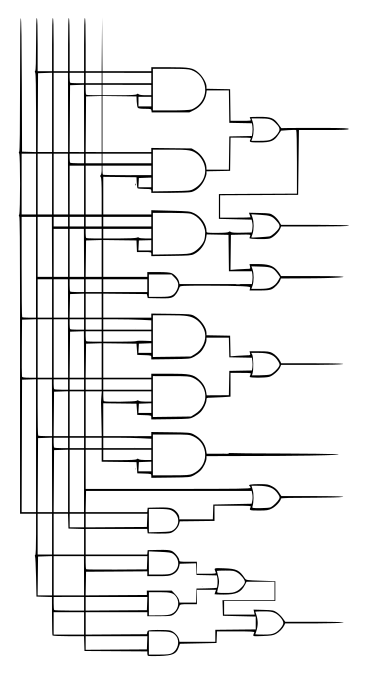
7-Segment PCB
This is a simulation of a 7-segment counter using digital logic gates (and, or, not). Three pulsed sources are required at A,B,C and should count out the binary 000-111. This is manufacturable and has a PCB design for it!... show more3 Comments
7 Stars
7 Seg 3-Bit Counter
A 3-bit counter showcasing digital logic simulation. Input is a sequence of pulses which pass through a logic block to determine the segments.... show more6 Stars
On Air Modular V1
Build your own Modular LED Sign! This design prioritizes accessibility which means that the BoM can be ordered on Amazon and that everything was designed with solder-ability in mind. NOTE: This board is still an unfinished prototype that has not been built and verified. Operating Instructions: 1. [Important!] Power your buck converter and adjust the output voltage to 1.5V output before attempting to power the LEDs. If you cannot power the buck converter, just turn the potentiometer counterclockwise to its maximum setting.... show more16 Comments
4 Stars
7-Segment Controller Rev B
This is a 7-segment controller. It runs on a 3-bit counter so the count is from 0-7. Buttons to toggle reset, pause, increment. Knobs to control speed and lighting configuration. Try the simulation here: https://www.flux.ai/jbreidfjord-dev/7-seg-3-bit-counter... show more38 Comments
2 Stars
4017 Chaser
Running LED circuit that utilizes a 555 clock output and a decade counter. It runs when the push-button is held down and then slowly stops once it is released.... show more2 Stars
7 Seg 3-Bit Counter
A 3-bit counter showcasing digital logic simulation. Input is a sequence of pulses which pass through a logic block to determine the segments.... show more15 Comments
1 Star
7 Seg 3-Bit Counter
A 3-bit counter showcasing digital logic simulation. Input is a sequence of pulses which pass through a logic block to determine the segments.... show more1 Comment
1 Star
7-Segment Controller
This is a 7-segment controller. It runs on a 3-bit counter so the count is from 0-7. Buttons to toggle reset, pause, increment. Knobs to control speed and lighting configuration. Try the simulation here: https://www.flux.ai/jbreidfjord-dev/7-seg-3-bit-counter... show more57 Comments
1 Star
Point Counter v1
A bidirectional, 3 digit counter for keeping track of points. Includes RC network + Schmitt Trigger for input de-bounce. Made for 9V power supply. Supports Common Cathode displays. 2 layer design... show moreRF Frequency Counter Buffer for HF
Welcome to your new project. Imagine what you can build here.
7-Segment Controller For Performance Testing
This is a 7-segment controller. It runs on a 3-bit counter so the count is from 0-7. Buttons to toggle reset, pause, increment. Knobs to control speed and lighting configuration. Try the simulation here: https://www.flux.ai/jbreidfjord-dev/7-seg-3-bit-counter... show more27 Comments
7-Segment PCB
This is a simulation of a 7-segment counter using digital logic gates (and, or, not). Three pulsed sources are required at A,B,C and should count out the binary 000-111. This is manufacturable and has a PCB design for it!... show more3 Comments
Evil Maroon Battle Mech
Design of a 7-Bit Up Counter with T Flip-Flop Preset for Event Tracking... show more2 Comments
7-Segment Controller
This is a 7-segment controller. It runs on a 3-bit counter so the count is from 0-7. Buttons to toggle reset, pause, increment. Knobs to control speed and lighting configuration. Try the simulation here: https://www.flux.ai/jbreidfjord-dev/7-seg-3-bit-counter... show more1 Comment
ESPRSSO32 Smart Scale AI Auto Layout [Example] ki4D
I want to make the hardware and software for a 5.2 inch diameter capacitive touch screen display. Please give me all of the information the enable me to do this, I have NO experience of code or PCB design or manufacture. I want to measure a battery voltage and amps used via a coulomb counter to indicate a fuel level indicator icon I just want two connections + and - Its not single cell, its a battery of 20 cells LIFEPO4 each cell is 3.2v nominal and 100a I also want to include a can bus controller to read and display motor rpm And can bus temperature Also a GPS speedometer, odometer and trip. Toggle between knots, mph and kmh by touchscreen, Also toggle between nautical miles, km and miles with a Trip meter reset. Startup screen animation, Speed Incremental bar Plus a digital reading, And an animated compass heading STM32 or ESP32 Please recommend all hardware, I have the can protocol for the motor controller but not with me right now Connection via a 4 pin military connector can high can low +v and –v Top middle of screen incremental speed bar that fills 120 degrees with 60 degrees being top dead centre in an arc Dead middle of screen DIGITAL SPEED To the left of dead middle a Compass To the right of dead centre DIGITAL RPM Next line with a space between dead centre will be the ODOMETER, Trip and Battery level Below those are the Toggle buttons Heading compass by GPS, no WiFi or Bluetooth Write full GPS parsing code for my firmware Can you write the code with all of your recommendations for smoother bug free operation Can a FRAM replace the sd card ALL components must fit onto one board into an enclosure directly behind the screen that measures 5.0 inches diameter x 13mm deep inside dimensions... show moreSecret Crimson Hoverboard
Circuit Overview The circuit you're describing is a digital counter that uses an LDR (Light-Dependent Resistor) and a transistor to detect wheel rotations. The counter's output is then displayed on a seven-segment LED display. Here's a breakdown of the components and their roles: 1. Wheel Rotation Detection (LDR and Transistor) * LDR: The LDR acts as a sensor to detect changes in light intensity. You can mount it on the wheel' or near it, with a reflective or non-reflective surface attached to the wheel. As the wheel rotates, the LDR will be exposed to alternating light and dark conditions, causing its resistance to change. * Transistor: The transistor (e.g., a 2N2222 NPN BJT) is used as a switch or amplifier. The changing resistance of the LDR is used to control the base current of the transistor. When the LDR's resistance drops (more light), the transistor turns on, and when the resistance increases (less light), the transistor turns off. This converts the analog change in light into a digital ON/OFF signal (a pulse). 2. Counter (7490) * 7490 IC: This is a decade counter, meaning it can count from 0 to 9. The output of the transistor (the pulses) is fed into the clock input of the 7490. Each pulse represents one rotation of the wheel, and the 7490 increments its count accordingly. The 7490 has four outputs (Q0, Q1, Q2, Q3) that represent the BCD (Binary-Coded Decimal) equivalent of the count. 3. BCD to Seven-Segment Decoder (7446) * 7446 IC: The 7446 is a BCD-to-seven-segment decoder/driver. Its job is to take the 4-bit BCD output from the 7490 and convert it into a signal that can drive a seven-segment LED display. It has seven outputs (a, b, c, d, e, f, g), each corresponding to a segment of the LED display. 4. Seven-Segment LED Display * Seven-Segment Display: This display is used to show the count. The 7446's outputs are connected to the corresponding segments of the display. 5. Power Supply and Other Components * Power Supply: A regulated DC power supply (e.g., 5V) is needed to power all the ICs and components. * Resistors: Resistors are used for current limiting (e.g., for the LDR and the LED display) and biasing the transistor. * Capacitors: A capacitor might be used for debouncing the signal from the transistor to prevent multiple counts for a single rotation. Conceptual Connections Here is a step-by-step breakdown of how the components would be connected: * LDR and Transistor: * The LDR and a current-limiting resistor are connected in series across the power supply. * The junction between the LDR and the resistor is connected to the base of the NPN transistor. * The emitter of the transistor is connected to ground. * The collector of the transistor, with a pull-up resistor, becomes the output for the pulse signal. * Transistor to 7490: * The output from the transistor's collector is connected to the clock input of the 7490 IC. * The 7490's reset pins (MR and MS) should be connected to ground for normal counting operation. * 7490 to 7446: * The BCD outputs of the 7490 (Q0, Q1, Q2, Q3) are connected to the BCD inputs of the 7446 (A, B, C, D). * 7446 to Seven-Segment Display: * The outputs of the 7446 (a, b, c, d, e, f, g) are connected to the corresponding segments of the seven-segment display. * Crucially, you need to use current-limiting resistors (e.g., 330Ω) in series with each segment to protect the LEDs from high current. * The common terminal of the seven-segment display is connected to the power supply (for a common anode display) or ground (for a common cathode display). This setup creates a chain reaction: wheel rotation changes light, which changes LDR resistance, which turns the transistor on/off, generating a pulse. This pulse increments the 7490, and the 7490's output is decoded by the 7446, which then displays the count on the seven-segment LED.... show moreAmazing Turquoise Carbonite Freezer
This project features a two-stage counter and LED blinking system utilizing key electronic components: 555 timer, CD4029, CD4511, a 7-segment display, and CD4017. In the first stage, the system executes a countdown from 3 to 7, with each number changing every 1.5 seconds to ensure precise timing. Once the countdown completes, the second stage is activated, triggering an LED to blink at 1Hz continuously for 5 seconds. This innovative design offers a seamless transition between functionalities, making it ideal for sophisticated digital electronics applications. #TwoStageCounter #LEDBlinking #555Timer #CD4029 #CD4511 #7SegmentDisplay #CD4017 #DigitalElectronics #TechInnovation #ElectronicsDesign... show moreCD4017BE kGWZ
Counter IC Counter, Decade 1 Element 10 Bit Positive Edge 16-PDIPCD4017BE mRjs
Counter IC Counter, Decade 1 Element 10 Bit Positive Edge 16-PDIPCD4017BE bcYs
Counter IC Counter, Decade 1 Element 10 Bit Positive Edge 16-PDIPCD4017BE exFE
Counter IC Counter, Decade 1 Element 10 Bit Positive Edge 16-PDIPCD4017BE iUZB
Counter IC Counter, Decade 1 Element 10 Bit Positive Edge 16-PDIPCD4017BE wHp5
Counter IC Counter, Decade 1 Element 10 Bit Positive Edge 16-PDIPCD4017BE 69ec
Counter IC Counter, Decade 1 Element 10 Bit Positive Edge 16-PDIPCD4017BE jGB7
Counter IC Counter, Decade 1 Element 10 Bit Positive Edge 16-PDIPCD4017BE 4qcw
Counter IC Counter, Decade 1 Element 10 Bit Positive Edge 16-PDIPCD4017BE cKnN
Counter IC Counter, Decade 1 Element 10 Bit Positive Edge 16-PDIPCD4017BE m3AG
Counter IC Counter, Decade 1 Element 10 Bit Positive Edge 16-PDIP