USB Security Token
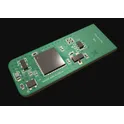
This design implements a USB security token powered by an STM32 microcontroller. The device is engineered for compactness and efficient PCB integration while ensuring robust security features. Key elements of the design include: - **Microcontroller Core:** A STM32F103T8U6 serves as the primary processing unit, handling USB communication and security protocols. - **USB Interface:** A USB-A plug provides connectivity to the host. Dedicated net portals ensure proper routing of the VBUS, D+, D–, and ground signals. - **Power Regulation:** A low-dropout regulator supplies a stable 3.3V operating voltage, ensuring low noise and proper current supply to the microcontroller and peripherals. - **Signal Conditioning and EMI Filtering:** An EMI filter is used to maintain signal integrity and reduce interference while preserving the security token’s functionality. - **Synchronous Elements:** A ceramic resonator is incorporated to provide a precise clock source for USB data transfer and microcontroller operations. - **Additional Components:** Surface-mount resistors, capacitors, and LED indicators are deployed to ensure proper conditioning, decoupling, and status feedback. Their compact 0402 packages facilitate a highly integrated design. - **Connectivity and Net Portals:** Custom net portals are used throughout the schematic to streamline connectivity and PCB layout, keeping the design modular and easy to modify. This USB security token is designed with industry-standard components and robust connectivity to ensure secure, reliable operation in portable security applications. #USBToken #STM32 #PCBDesign #SecurityTechnology #PortableSecurity #Microcontrollers #USBInterface #PowerRegulation #EMIProtection #CompactDesign... show more0 Uses
255 Comments
30 Stars

Strangest LED Blinker TestSite
Project Overview: This project is an enhanced LED blinking circuit that goes beyond a simple 555 timer-based design. It incorporates additional features such as random blinking patterns, speed control, and a start/stop function. The project utilizes a microcontroller, such as an Arduino or Raspberry Pi, to control the blinking patterns, speed, and start/stop functionality. LED Blinking: The board features a total of 8 LEDs that blink in various random patterns. When the board is powered on, even before user interaction, the LEDs start blinking randomly, creating an eye-catching display. Each LED has its own current-limiting resistor to ensure proper current flow and prevent damage. The microcontroller is programmed to generate random blinking patterns for the LEDs, ensuring that the LEDs do not blink in a predictable or sequential order. This random blinking adds an element of unpredictability and visual interest to the project. Speed Control: The board includes two speed control buttons that allow the user to adjust the blinking speed of the LEDs. Button 1 is designated as the "fast" button, increasing the blinking speed when pressed, while Button 2 is designated as the "slow" button, decreasing the blinking speed when pressed. The speed control provides a range of blinking speeds, from a slow, gradual blink to a rapid, strobe-like effect. The microcontroller monitors the state of the speed control buttons and adjusts the blinking speed accordingly. Start/Stop Functionality: A third button serves as a start/stop control. When pressed, it toggles the blinking of the LEDs on or off. This allows the user to freeze the blinking pattern at any desired moment or resume the blinking when desired. The microcontroller handles the start/stop functionality by turning the LEDs on or off based on the state of the start/stop button. Manual Speed Adjustment: In addition to the speed control buttons, the board includes a potentiometer or variable resistor. This component allows the user to manually adjust the blinking speed of the LEDs by turning the knob or sliding the control. The manual speed adjustment provides more precise and customizable control over the blinking speed compared to the preset speeds of the buttons. The microcontroller reads the analog value from the potentiometer and adjusts the blinking speed accordingly. Power and Connectivity: The board is powered through a USB-C or USB-micro B connector, allowing it to be easily connected to a power source such as a computer or wall adapter. A voltage regulator may be included to ensure a stable and appropriate voltage supply to the components. A power switch is incorporated to conveniently turn the board on or off.... show more0 Uses
224 Comments
4 Stars

Biskuit AI: Project Showcase
Kitchen LED Strip Motion & Ambient-Light Controller with 12 V PWM Dimming, PIR Sensor, Ambient Light Sensor, MCU Control, Buck Regulator, and Protection Circuits (TVS, PTC Fuse, Reverse-Polarity Diode) #KitchenLEDController #MotionDetection #AmbientLightSensor... show more0 Uses
56 Comments
4 Stars
ESP32 RS485 (Modbus) Controller Reference Design
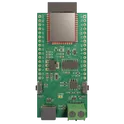
This project is a controller module that uses the ESP32-WROOM-32E and the MAX3485 to communicate with Modbus devices. It has a USB-C port for power and data, a voltage regulator for stable operation, and headers for connecting sensors and actuators. It also has a CH340C chip for USB to serial conversion. #referenceDesign #project #ESP32 #ESP32WROOM #RF #WIFI #MCU #referenceDesign #simple-embedded #espressif #template #MAX3485 #RS485 #maximintegrated #reference-design #polygon... show more0 Uses
22 Comments
4 Stars
sEMG_DAQ
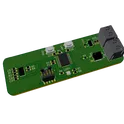
sEMG-DAQ is a wearable 6 channel data acquisition unit for capturing surface electromyographic (sEMG) signals from human arm muscles using SJ2-3593D jack connectors while conditioning, digitizing, processing and transmitting them as sEMG data to an external AI accelerated board through an SM12B-SRSS IDC connector where AI models are run for various applications including robotic control, muscle signals medical assessment and gesture recognition. The board leverages an INA125P instrumentation amplifier together with filter stages utilizing LM324QT op-amps for conditioning and an STM32G4A1VET6 microcontroller for the digitization, processing and data transmission of the signals. Since AI models can only be as good as the data, the design of such a DAQ is necessary to ensure clean, reliable and real-time data for AI applications requiring sEMG data. The board also has USB-FS and JTAG to cater for debugging. The power (5V) is fed through a screw terminal and is regulated by two LDK320AM LDO regulators to offer 5V, 3.3V and 1.8V to meet the requirements of various components on the board.... show more0 Uses
39 Comments
4 Stars
L7805 Fixed output regulator
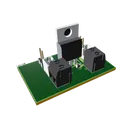
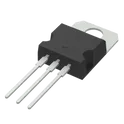
Linear Voltage Regulator with 1 Positive Fixed Output 5.0V. Input voltage 35V max With JST connectors(Vin and +5V) and with block terminal connectors(Vin and +5V) #project-template #voltageregulator #project... show more0 Uses
59 Comments
3 Stars
Gesture Light Switch Relay Reference Design
This project is a Gesture Light Switch Relay Reference Design. It involves an STM32 microcontroller (STMicroelectronics) that interacts with an APDS-9960 sensor (Broadcom) to detect hand gestures. The gesture data is used to control a Toshiba TLP175A relay and an Everlight tri-color LED to switch the light and change colors, respectively. Power is supplied by a Diodes Incorporated's AP2112K-3.3TRG1 regulator. #referenceDesign #edge-computing #edgeComputing #stm #relay #sensors #reference-design... show more0 Uses
21 Comments
2 Stars
Picobuck Led Driver (AL8805W5)
(AL8805W5) The PicoBuck LED Driver is an economical and easy to use driver that will allow you to control and blend three different LEDs on three different channels. By default, each channel is driven at 330mA; that current can be reduced by either presenting an analog voltage or a PWM signal to the board. Version 12 of the board adds a solderable jumper that can be closed to increase the maximum current to 660mA. The new voltage regulator also increased the voltage rating on the various components on the board, allowing it to be used up to the full 36V rating of the AL8805 part.... show more0 Uses
13 Comments
2 Stars
Interruptor de luz con control gestual
This project is a Gesture Light Switch Relay Reference Design. It involves an STM32 microcontroller (STMicroelectronics) that interacts with an APDS-9960 sensor (Broadcom) to detect hand gestures. The gesture data is used to control a Toshiba TLP175A relay and an Everlight tri-color LED to switch the light and change colors, respectively. Power is supplied by a Diodes Incorporated's AP2112K-3.3TRG1 regulator. #referenceDesign #edge-computing #edgeComputing #stm #relay #sensors #reference-design... show more0 Uses
5 Comments
2 Stars
L7805 Fixed output regulator wring airwires for devs
Linear Voltage Regulator with 1 Positive Fixed Output 5.0V. Input voltage 35V max With JST connectors(Vin and Vout) and with block terminal connectors(Vin and Vout) #project-template #voltageregulator #project... show more0 Uses
3 Comments
1 Star
3V3 Regulator with LED
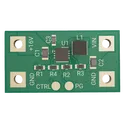
A simple fixed linear voltage regulator board that can provide 3.3V up to 1A output and could operate down to 1V input-to-output differential. #firstpcbFlux... show more0 Uses
1 Comment
1 Star
3V3 Regulator with LED - old
A simple fixed linear voltage regulator board that can provide 3.3V up to 1A output and could operate down to 1V input-to-output differential. #firstpcbFlux... show more0 Uses
1 Comment
1 Star
REGULATOR 1203
Welcome to your new project. Imagine what you can build here.... show more0 Uses
1 Comment
1 Star
3V3 Voltage Regulator
A sublayout based on AMS1117-3.3 with all of its needed filtering capacitors.... show more0 Uses
0 Comments
1 Star

1_27 PCB Module Voltage Regulator
Welcome to your new project. Imagine what you can build here.... show more0 Uses
0 Comments
1 Star
Adjustable Regulator
Welcome to your new project. Imagine what you can build here.... show more0 Uses
0 Comments
1 Star
ESP32-WROOM-32E Reference Design
This project involves designing a versatile IoT sensor hub using the ESP32-WROOM-32E module. The main objective is to create a platform that enables seamless data collection and transmission from various environmental sensors over a WiFi network. The device will feature USB-C for power and data transfer, and will utilize on-board voltage regulation to ensure stable operation. A CH340C chip is employed for USB to serial conversion, facilitating easy programming and communication with a host computer. Key Features: Wireless Connectivity: Leverage the ESP32's built-in WiFi capabilities for real-time data transmission to cloud-based platforms or local servers. USB-C Interface: Utilize a modern USB-C connector for power and data transfer, providing flexibility and future-proofing the design. On-board Voltage Regulation: Include an AMS1117-3.3 voltage regulator to maintain a stable 3.3V output from the USB input, protecting sensitive components. Support for Multiple Sensors: Integrate various GPIOs to connect multiple sensor types ( temperature, humidity, air quality ) (temperature, humidity, air quality) for comprehensive environmental monitoring. Expandability: Design with additional headers for future expansion, enabling users to customize and extend the hub's capabilities with additional sensors or modules. Applications: Smart Home Automation: Integrating with home systems to monitor and respond to environmental changes. Environmental Monitoring: Providing data for ecological studies or urban environment monitoring. Industrial IoT: Enhancing systems within a factory or industrial setting to track conditions in real-time. With this setup, the device aims to be a robust and adaptable piece of technology, suitable for hobbyists, researchers, and developers interested in the expanding world of IoT.... show more0 Uses
22 Comments
1 Star
WiFi Door and Window Sensor
A compact battery-powered door/window sensor built around the ESP32-C3-MINI-1-N4 module. The design uses a single non-rechargeable AA cell with a TPS613221A 3.3 V boost regulator, reed switch magnetic contact sensing, low-power wake/report/sleep firmware strategy, RGB status LED for setup feedback, BOOT/EN controls, programming header, and input polarity protection. It is intended for smart-home security and automation applications, supporting WiFi or Bluetooth LE hub reporting with emphasis on low idle current, reliable RF burst power delivery, and field-replaceable battery operation. #ESP32-C3 #BLE #WiFi #DoorSensor #WindowSensor #ReedSwitch #LowPower #BatteryPowered #SmartHome #IoT... show more0 Uses
18 Comments
1 Star
MGM240P Template
This is the MGM240P template with minimal configuration for operation. There is a 3.3V regulator, a connector for UART and SWD #MGM240P #IoT #template #uart #3V3 #arduino-matter... show more0 Uses
10 Comments
1 Star
MLX90640 Reference Design
This project is a IR camera sensor module based on the TSL25911FN sensor, equipped with I2C communication technique. The module features a 3.3V regulator, I2C level shifter, LEDs, capacitors, resistors, and JST connectors for easy interfacing. #project #Template #projectTemplate #sensor #IR #industrialSensing #referenceDesign #template #reference-design #polygon... show more0 Uses
5 Comments
1 Star
TMF8801-1BM Reference Design
This is a reference design of a PCB utilizing the TMF8801-1BM time-of-flight (ToF) sensor from ams-OSRAM. It comprises electronic components such as resistors, capacitors, voltage regulators, and GPIO connectors. The logic signals are managed via Mosfets BSS138 while the Sensor IC is powered & controlled by a 3.3V AP2112K Voltage Regulator. #industrialSensing #referenceDesign #lzer #I2C #osramusa #template #reference-design... show more0 Uses
5 Comments
1 Star
LT3473 Reference Design
This LT3473-based reference design is a step-up voltage regulator, converting a lower input voltage to a stable 16V output. Ideal for applications requiring a regulated 16V supply. #referenceDesign #project #stepUp #voltageRegulator #16V #LT3473 #LT3473EDD#PBF #referenceDesign #powermanagement #analogdevices #template #reference-design #polygon... show more0 Uses
4 Comments
1 Star
ESP32 RS485 (Modbus) Controller Module 02e3 8a70 11db
This project is a controller module that uses the ESP32-WROOM-32E and the MAX3485 to communicate with Modbus devices. It has a USB-C port for power and data, a voltage regulator for stable operation. It also has a CH340C chip for USB to serial conversion. #referenceDesign #project #ESP32 #ESP32WROOM #RF #WIFI #MCU #reusable #module #simple-embedded #espressif #template #MAX3485 #RS485 #maximintegrated... show more0 Uses
1 Comment
1 Star
L7805CV
Linear Voltage Regulator IC Positive 5V Fixed 1 Output 1.5A TO-220-3 #CommonPartsLibrary #IntegratedCircuit #PowerManagement #LinearRegulator #VoltageRegulator... show more0 Uses
1 Comment
1 Star
ThirstIQ Cap
High-level recreation of the ThirstIQ Cap wiring diagram using an ESP32-WROOM-32 with AMS1117-3.3 regulated battery input, inline ON/OFF switch, four touch input headers on IO32/IO33/IO25/IO26, shared I2C OLED and RTC on IO21/IO22, UART debug/programming header on TXD0/RXD0, BOOT and RESET pushbuttons on IO0 and EN, buzzer on IO4, common 3V3/GND distribution, and PCB preparation for a 160 mm x 100 mm 4-layer layout. Layout intent includes clean 3.3 V power distribution, local decoupling for regulator and ESP32, accessible external headers/buttons, short clean BOOT/EN traces, shared I2C routing, touch-signal separation from noisy power and buzzer traces, and ESP32 antenna keepout.... show more0 Uses
0 Comments
1 Star


Page 1 of 59
Next