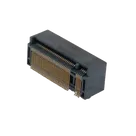
Part Information Review and Datasheet Extraction
Thought for 7 mins 22 sec
Here’s a complete, tool-driven review of your part project, in order.
- Review of available part information
- MPN: MDT420M01501
- Description: PCIe M.2 Connector, P = 0.5 mm, H = 4.2 mm, Key M, 30 µin Gold Plating
- Part Type: Connectors
- Designator Prefix: J
- Mount: Standard
- Manufacturer: Amphenol Communications Solutions
- Datasheet: https://cdn.amphenol-cs.com/media/wysiwyg/files/drawing/cmdt420x01501.pdf
- Datasheet URL check and update
- The Datasheet URL is already set on this part. No update required.
- Datasheet and series PDF extraction (metadata summary) Documents used:
- Drawing (MDT420M01501): https://cdn.amphenol-cs.com/media/wysiwyg/files/drawing/cmdt420x01501.pdf
- Series datasheet (Gen 5): https://www.farnell.com/datasheets/3669914.pdf
- Series datasheet (SSIO PCIe M.2, Gen 3/4/5 family): https://cdn.amphenol-cs.com/media/wysiwyg/files/documentation/datasheet/ssio/ssio_pcie_m2.pdf
Key mechanical and product attributes
- Form factor: PCIe M.2 (NGFF) card edge connector
- Pitch: 0.50 mm (series datasheet)
- Positions / contacts: 75 positions (series) / 67 contacts (active) (series datasheet)
- Orientation: Right angle (series)
- Height: 4.2 mm (series table entries for 4.2 mm variants including Key M)
- Keying: Key M (per MPN family and series tables)
- Plating options (series): Au flash / 15 µin Au / 30 µin Au; your MPN indicates 30 µin Au
- Materials (series): Contacts: copper alloy with gold plating; Housing: UL 94 V-0
Electrical characteristics
- Current rating:
- 0.75 A per power contact (continuous) (Gen 5 datasheet: Farnell PDF)
- 0.5 A per power contact (continuous) (SSIO series PDF)
- Note: two series sources list different continuous current ratings; use the stricter/official document for the exact MPN where available.
- Voltage rating: 50 V AC per contact (both series PDFs)
- Low-level contact resistance: 55 mΩ max initial; 20 mΩ max change (series)
- Insulation resistance: > 5 × 10^8 Ω at 500 V DC (series)
- Dielectric withstanding voltage: > 300 V AC (RMS) at sea level (series)
- Operating temperature: -40 °C to +80 °C (series)
- Compliance/features (series): Fully compliant with PCI-SIG PCIe M.2; supports angled insertion; multiple keying/height options; right angle and vertical options available in family.
Package dimensions and land pattern
- The drawing (cmdt420x01501.pdf) contains the mechanical outline and recommended PCB land pattern for this exact MPN.
- Automated text extraction from the drawing did not return numeric dimensions. Please refer to the drawing PDF directly for:
- Pad sizes and spacing
- Connector outline and seating plane
- Mounting features/peg geometry and locations
- Board edge-to-connector body relationships (if shown)
Pin descriptions
- Connector manufacturers typically do not define interface signal names in the product drawing; pin functions are governed by the PCI-SIG M.2 specification for the M-key variant.
- The series datasheets reviewed do not include a full pin function table. Use the M.2 (M-key) specification for functional pin mapping when assigning signals.
- Cross-check: schematic symbol and footprint vs. datasheet
Schematic symbol
- Pin count: The symbol instantiates numbered terminals P1–P75, consistent with “75 positions” in the series documentation. Examples:
- SIGNAL/GND_1 has Pin Number 1 (top row end)
- SIGNAL/GND_2 has Pin Number 2 (bottom row end)
- SIGNAL_1 has Pin Number 5
- SIGNAL/GND_39 has Pin Number 75
- Mechanical pins: MP1 and MP2 are present in the symbol with Pin Numbers 76 and 77, respectively. Good.
- Naming: Many terminals are generically named “SIGNAL_x”, “GND_x”, or “SIGNAL/GND_x”. This is acceptable for a generic connector, but for system clarity you may later want to rename nets per the M.2 M-key spec (not required for footprint correctness).
Footprint (PCB)
- Pad inventory: The footprint contains a Pads container with entries corresponding to the symbol terminals and includes MP1 and MP2 mechanical pads. This aligns with the expected contact/peg set for a 75-position M.2 connector.
- Pad pitch: Expected per datasheet is 0.50 mm. The current PCB data does not expose numeric pad-to-pad pitch here; verification against the drawing is recommended.
- Land pattern dimensions: Not machine-extracted from the drawing; manual check against the drawing PDF is required to confirm pad sizes, solder mask/solder paste apertures, and exact pad-to-body relationships.
- Keying/board keepouts: For host connectors, the module’s notch provides keying; the housing geometry is defined by the connector body. No contrary features are indicated in the layout snapshot; verify any keepout or mechanical outlines provided in the drawing.
Flags and recommendations
- PASS: Pin/position count alignment with series spec (75 positions) and presence of mechanical pegs (MP1, MP2).
- UNKNOWN: Pad pitch and all land pattern detailed dimensions were not text-extractable. Please cross-check the footprint against the drawing (cmdt420x01501.pdf) for:
- 0.50 mm contact pitch
- Individual pad sizes and gaps
- Mounting peg pad/hole dimensions/locations (if applicable to this specific housing variant)
- Recommended mask/paste apertures and any stated tolerances
- NOTE: Electrical ratings show differing continuous current per contact between two series documents (0.75 A vs 0.5 A). Confirm which series rev applies to MDT420M01501 when finalizing current budgets.
- OPTIONAL: Consider renaming connector pins/nets in the schematic to match M.2 M-key functional naming for easier system integration.
If you want, I can proceed to:
- Extract exact land-pattern and outline dimensions by manually referencing the drawing PDF into structured notes, and
- Annotate the footprint checks (pitch, pad sizes, peg geometry) item-by-item once those numbers are captured.
Run DRC/ERC checks
Verify pad pitch
Check part properties
Get M.2 pinout