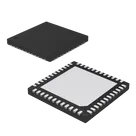
Pin Configuration Overview
Thought for 1 min 44 sec
Using the datasheet as the source of truth is the right way to build a part pin table, especially for exact pin numbers and shared configuration pins . For IC-style parts like this FPGA, pin types are typically classified as Power In, Ground, Input, Output, Bi-Directional, or Unspecified based on the datasheet function .
Here is a pin-by-pin table for ICE40UP5K-SG48I:
Pin table
Table
| Pin # | Pin Name | Function | I/O characteristics | Special considerations |
|---|---|---|---|---|
| 1 | IOT_49b | Bank 0 general-purpose I/O | Bi-directional GPIO | Standard user I/O in Bank 0 |
| 2 | IOT_51a | Bank 0 general-purpose I/O | Bi-directional GPIO | Standard user I/O in Bank 0 |
| 3 | IOT_51b | Bank 0 general-purpose I/O | Bi-directional GPIO | Standard user I/O in Bank 0 |
| 4 | RGB0 | RGB LED driver / GPIO | Open-drain output or GPIO | Can be used as open-drain GPIO; when RGB enabled can sink up to 24 mA for LED drive |
| 5 | RGB1 | RGB LED driver / GPIO | Open-drain output or GPIO | Same as RGB0 |
| 6 | RGB2 | RGB LED driver / GPIO | Open-drain output or GPIO | Same as RGB0 |
| 7 | VCCIO_0 | Bank 0 I/O supply | Power In | Sets Bank 0 I/O voltage standard |
| 8 | VCC | Core supply | Power In | Core power rail |
| 9 | IOT_41b | Bank 0 general-purpose I/O | Bi-directional GPIO | Standard user I/O in Bank 0 |
| 10 | IOT_37a | GPIO / global input G1 | Bi-directional GPIO, clock/global-capable input | Suitable for clocks or other high-fanout signals |
| 11 | IOT_37b | Bank 0 general-purpose I/O | Bi-directional GPIO | Standard user I/O in Bank 0 |
| 12 | IOT_36b | Bank 0 general-purpose I/O | Bi-directional GPIO | Standard user I/O in Bank 0 |
| 13 | IOT_36a_WAKEN | GPIO / wake-enable pin | Bi-directional GPIO / control input | Wake-capable pin; reserve if low-power wake is needed |
| 14 | IOT_33a_SPI_SO | Config SPI data out / GPIO | Output during configuration, GPIO after config | Shared with configuration SPI; do not repurpose at power-up |
| 15 | IOT_33b_SPI_SI | Config SPI data in / GPIO | Input during configuration, GPIO after config | Shared with configuration SPI; do not repurpose at power-up |
| 16 | IOT_34a_SPI_SCK | Config SPI clock / GPIO | Input or output during configuration, GPIO after config | Shared with configuration SPI; role depends on master/slave config mode |
| 17 | IOT_39a_SPI_SS_B | Config SPI chip select / GPIO | Input or output during configuration, GPIO after config | Shared with configuration SPI; not free for user logic until configuration completes |
| 18 | IOT_39b_G2 | GPIO / global input G2 | Bi-directional GPIO, clock/global-capable input | Good candidate for clock/high-fanout input |
| 19 | GND_LED | LED-driver ground | Ground | Tie to board ground; return path for RGB drivers |
| 20 | IOT_46b_G0 | GPIO / global input G0 | Bi-directional GPIO, clock/global-capable input | Good clock/global input pin |
| 21 | VPP_2V5 | NVCM programming supply | Power In | Required for NVCM programming/operation; treat as dedicated supply pin |
| 22 | VCCPLL | PLL supply | Power In | Clean supply recommended; decouple carefully |
| 23 | IOT_44b | Bank 0 general-purpose I/O | Bi-directional GPIO | Standard user I/O in Bank 0 |
| 24 | IOT_44a | Bank 0 general-purpose I/O | Bi-directional GPIO | Standard user I/O in Bank 0 |
| 25 | IOB_3b_G6 | Bank 2 GPIO / global input G6 | Bi-directional GPIO, clock/global-capable input | Good candidate for clock/high-fanout signals |
| 26 | IOB_2a_G7 | Bank 2 GPIO / global input G7 | Bi-directional GPIO, clock/global-capable input | Good candidate for clock/high-fanout signals |
| 27 | IOB_8a | Bank 2 general-purpose I/O | Bi-directional GPIO | Standard user I/O in Bank 2 |
| 28 | IOB_9b | Bank 2 general-purpose I/O | Bi-directional GPIO | Standard user I/O in Bank 2 |
| 29 | VCCIO_2 | Bank 2 I/O supply | Power In | Sets Bank 2 I/O voltage standard |
| 30 | VCC | Core supply | Power In | Core power rail |
| 31 | IOB_16a | Bank 1 general-purpose I/O | Bi-directional GPIO | Standard user I/O in Bank 1 |
| 32 | IOB_16b | Bank 1 general-purpose I/O | Bi-directional GPIO | Standard user I/O in Bank 1 |
| 33 | SPI_VCCIO1 | Bank 1 / config I/O supply | Power In | Supplies Bank 1 and configuration SPI I/O levels |
| 34 | IOB_18a | Bank 1 general-purpose I/O | Bi-directional GPIO | Standard user I/O in Bank 1 |
| 35 | IOB_18b_G3 | Bank 1 GPIO / global input G3 | Bi-directional GPIO, clock/global-capable input | Good candidate for clock/high-fanout signals |
| 36 | IOB_20a | Bank 1 general-purpose I/O | Bi-directional GPIO | Standard user I/O in Bank 1 |
| 37 | IOB_20b_G4 | GPIO / G4 / CDONE shared pin | Bi-directional GPIO, config status shared pin | Has weak pull-up to SPI_VCCIO1; used for configuration-done indication before becoming GPIO |
| 38 | IOB_24a | Bank 1 general-purpose I/O | Bi-directional GPIO | Standard user I/O in Bank 1 |
| 39 | IOB_25b | Bank 1 general-purpose I/O | Bi-directional GPIO | Standard user I/O in Bank 1 |
| 40 | IOB_29a | Bank 1 general-purpose I/O | Bi-directional GPIO | Standard user I/O in Bank 1 |
| 41 | IOB_29b | Bank 1 general-purpose I/O | Bi-directional GPIO | Standard user I/O in Bank 1 |
| 42 | IOB_31a | Bank 1 general-purpose I/O | Bi-directional GPIO | Standard user I/O in Bank 1 |
| 43 | IOB_31b | Bank 1 general-purpose I/O | Bi-directional GPIO | Standard user I/O in Bank 1 |
| 44 | IOB_35a_G5 | Bank 1 GPIO / global input G5 | Bi-directional GPIO, clock/global-capable input | Good candidate for clock/high-fanout signals |
| 45 | IOB_35b | GPIO / CRESET_B shared pin | Input during configuration, GPIO after config | Active-low configuration reset; no internal pull-up, so use external 10 kΩ pull-up to SPI_VCCIO1 if not actively driven |
| 46 | IOB_23b | Bank 1 general-purpose I/O | Bi-directional GPIO | Standard user I/O in Bank 1 |
| 47 | IOB_6a | Bank 2 general-purpose I/O | Bi-directional GPIO | Standard user I/O in Bank 2 |
| 48 | IOB_4a | Bank 2 general-purpose I/O | Bi-directional GPIO | Standard user I/O in Bank 2 |
Table
| Topic | Notes |
|---|---|
| User I/O count | SG48 package provides 39 user I/Os total |
| Bank supplies | Bank 0 uses VCCIO_0, Bank 1 uses SPI_VCCIO1, Bank 2 uses VCCIO_2 |
| Configuration pins | SPI configuration pins and shared status/reset pins are not freely reusable at power-up; they only become normal GPIO after configuration completes |
| Default I/O state | Before configuration, I/Os are tri-stated with a weak pull-up to VCCIO |
| CDONE | Shared on pin 37; includes a weak pull-up to SPI_VCCIO1 |
| CRESET_B | Shared on pin 45; active low, no internal pull-up |
| RGB pins | Pins 4-6 are special open-drain LED-capable outputs, not plain push-pull LED pins |
| PLL supply | VCCPLL should be kept clean and well-decoupled |
| LED ground | GND_LED should tie to board ground |
| Exposed pad | The SG48 exposed paddle must be connected to GND |
| Differential use | General sysIO supports single-ended standards and comparator-style differential usage; no dedicated true-LVDS pin class was identified in the extracted datasheet text |
If you want, I can next turn this into:
- a CSV-style pin list
- a Flux terminal property table with recommended pin types/sections/groups
- or a part-project patch plan to fix the current pin definitions in this project.
Fix pin definitions
Create terminal table
Make CSV pin list
Add usage grouping