Project Overview and Design Analysis
1:14
Project
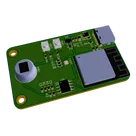
The “Motion Detector Module” is designed for IoT and edge‑computing applications where a compact, low‑power sensor can detect motion and communicate the event wirelessly. Here’s a breakdown of its design and functionality:
-
Purpose and Overall Functionality
- Motion Sensing: At its core, a PIR sensor (IRA‑S230ST01) detects infrared changes when motion occurs.
- Processing and Connectivity: An ESP32‑S3‑MINI module (ESP32‑S3‑MINI‑1‑N8) acts as the central processor, enabling both WiFi and Bluetooth/BLE communications for transmitting motion events or receiving remote commands.
- User Interaction: The module includes tactile switches (such as PTS815) for manual input and an RGB LED (LTST‑C19HE1WT) for visual status—indicating whether motion is detected or transmitting error/status signals.
- USB-C Connectivity: A USB‑C connector (TYPE‑C‑31‑M‑12) provides an interface for programming, power, or even data exchange.
-
Core Components and Their Interactions
- The PIR sensor sends a signal upon detecting motion to one of the ESP32’s input pins.
- The ESP32 microcontroller processes the sensor data and may (for example) update the RGB LED status or send notifications over WiFi/Bluetooth.
- The voltage regulator (AP2112K‑3.3TRG1) provides a stable 3.3 V supply that powers the ESP32, sensor, and other peripheral circuits.
- Passive components (resistors and capacitors) are distributed around power pins and signal lines to ensure proper decoupling, reduce noise, and maintain circuit stability.
- Net portals and ground components are used extensively to ensure that signal, power, and ground paths are clearly defined and interconnected throughout the schematic.
-
Design, Implementation, and Functionality Step by Step
- Sensor Integration: The PIR sensor is connected to the microcontroller’s input, allowing it to monitor ambient infrared levels.
- Microcontroller Setup: The ESP32‑S3 is chosen for its integrated WiFi and Bluetooth capability, supporting remote communication and over‑the‑air updates.
- Power Management: With a supply rail set at 3.3 V, the design uses an efficient LDO (AP2112K‑3.3TRG1) combined with proper decoupling capacitors on both the input and output to ensure stable operation.
- User Interface: Tactile switches are front‑faced for manual intervention (for example, to reset or change operating modes), and the RGB LED offers immediate visual feedback based on system status.
- Connectivity: The USB‑C port simplifies programming and debugging while also offering potential power delivery and data exchange, adding flexibility to the module.
-
Key Technologies, Trade‑offs, and Design Choices
- ESP32‑S3: Chosen for its rich set of features and low‑power operation. Trade‑offs include managing higher integration compared to simpler MCUs.
- PIR Sensor: A mature technology for motion detection; its placement and tuning can affect sensitivity and false triggering.
- Voltage Regulation: A regulator-based design (rather than a switching converter) was likely selected for its simplicity and low noise characteristics despite a potential trade‑off in efficiency.
- Component Selection: Use of surface‑mount parts (0603 and 0805 packages) supports a compact design ideal for integration into consumer or industrial IoT devices.
-
Potential Challenges and Performance Considerations
- Noise and Decoupling: Ensuring adequate filtering around the microcontroller and sensor is critical, as digital switching can cause interference in sensitive analog sensor readings.
- Thermal and Power Considerations: Operating from a 3.3 V rail at low power is ideal for battery‑powered or always‑on IoT devices, but it requires tight control over power supply noise and voltage stability.
- Sensor Calibration: Adjusting the PIR sensor’s sensitivity and field‑of‑view may require fine‑tuning based on the target environment.
-
Real‑world Applications and Future Enhancements
- Applications: The module can be used in security systems, smart lighting, or as part of a home automation network where motion detection triggers actions (like turning on lights or sending notifications).
- Improvements and Scalability: Future enhancements might include incorporating sensor fusion techniques, adaptive power management, or integration with cloud platforms for real‑time monitoring. There may also be opportunities to refine component layout for better thermal performance and reduced electromagnetic interference.
Overall, the design balances functionality with a compact footprint and efficient connectivity. Each choice—from the microcontroller to the passive elements—reflects an optimization for low‑power IoT sensing with robust communication capabilities.
338 days
Ready.
PIR
C5
Capacitance
47n F
C3
Capacitance
22u F
R1
Resistance
47K Ω
C4
Capacitance
3.3n F
R3
Resistance
680K Ω
3V3
R2
Resistance
47K Ω
Reviews

- Wirelessly connects nets on schematic. Used to organize schematics and separate functional blocks. To wirelessly connect net portals, give them same designator. #portaljharwinbarrozo43.0M
- Wirelessly connects power nets on schematic. Identical to the net portal, but with a power symbol. Used to organize schematics and separate functional blocks. To wirelessly connect power net portals, give them the same designator. #portal #powerjharwinbarrozo11.4M
- A generic fixed resistor for rapid developing circuit topology. Save precious design time by seamlessly add more information to this part (value, footprint, etc.) as it becomes available. Standard resistor values: 1.0Ω 10Ω 100Ω 1.0kΩ 10kΩ 100kΩ 1.0MΩ 1.1Ω 11Ω 110Ω 1.1kΩ 11kΩ 110kΩ 1.1MΩ 1.2Ω 12Ω 120Ω 1.2kΩ 12kΩ 120kΩ 1.2MΩ 1.3Ω 13Ω 130Ω 1.3kΩ 13kΩ 130kΩ 1.3MΩ 1.5Ω 15Ω 150Ω 1.5kΩ 15kΩ 150kΩ 1.5MΩ 1.6Ω 16Ω 160Ω 1.6kΩ 16kΩ 160kΩ 1.6MΩ 1.8Ω 18Ω 180Ω 1.8KΩ 18kΩ 180kΩ 1.8MΩ 2.0Ω 20Ω 200Ω 2.0kΩ 20kΩ 200kΩ 2.0MΩ 2.2Ω 22Ω 220Ω 2.2kΩ 22kΩ 220kΩ 2.2MΩ 2.4Ω 24Ω 240Ω 2.4kΩ 24kΩ 240kΩ 2.4MΩ 2.7Ω 27Ω 270Ω 2.7kΩ 27kΩ 270kΩ 2.7MΩ 3.0Ω 30Ω 300Ω 3.0KΩ 30KΩ 300KΩ 3.0MΩ 3.3Ω 33Ω 330Ω 3.3kΩ 33kΩ 330kΩ 3.3MΩ 3.6Ω 36Ω 360Ω 3.6kΩ 36kΩ 360kΩ 3.6MΩ 3.9Ω 39Ω 390Ω 3.9kΩ 39kΩ 390kΩ 3.9MΩ 4.3Ω 43Ω 430Ω 4.3kΩ 43KΩ 430KΩ 4.3MΩ 4.7Ω 47Ω 470Ω 4.7kΩ 47kΩ 470kΩ 4.7MΩ 5.1Ω 51Ω 510Ω 5.1kΩ 51kΩ 510kΩ 5.1MΩ 5.6Ω 56Ω 560Ω 5.6kΩ 56kΩ 560kΩ 5.6MΩ 6.2Ω 62Ω 620Ω 6.2kΩ 62KΩ 620KΩ 6.2MΩ 6.8Ω 68Ω 680Ω 6.8kΩ 68kΩ 680kΩ 6.8MΩ 7.5Ω 75Ω 750Ω 7.5kΩ 75kΩ 750kΩ 7.5MΩ 8.2Ω 82Ω 820Ω 8.2kΩ 82kΩ 820kΩ 8.2MΩ 9.1Ω 91Ω 910Ω 9.1kΩ 91kΩ 910kΩ 9.1MΩ #generics #CommonPartsLibraryjharwinbarrozo1.5M
- A generic fixed capacitor ideal for rapid circuit topology development. You can choose between polarized and non-polarized types, its symbol and the footprint will automatically adapt based on your selection. Supported options include standard SMD sizes for ceramic capacitors (e.g., 0402, 0603, 0805), SMD sizes for aluminum electrolytic capacitors, and through-hole footprints for polarized capacitors. Save precious design time by seamlessly add more information to this part (value, footprint, etc.) as it becomes available. Standard capacitor values: 1.0pF 10pF 100pF 1000pF 0.01uF 0.1uF 1.0uF 10uF 100uF 1000uF 10,000uF 1.1pF 11pF 110pF 1100pF 1.2pF 12pF 120pF 1200pF 1.3pF 13pF 130pF 1300pF 1.5pF 15pF 150pF 1500pF 0.015uF 0.15uF 1.5uF 15uF 150uF 1500uF 1.6pF 16pF 160pF 1600pF 1.8pF 18pF 180pF 1800pF 2.0pF 20pF 200pF 2000pF 2.2pF 22pF 20pF 2200pF 0.022uF 0.22uF 2.2uF 22uF 220uF 2200uF 2.4pF 24pF 240pF 2400pF 2.7pF 27pF 270pF 2700pF 3.0pF 30pF 300pF 3000pF 3.3pF 33pF 330pF 3300pF 0.033uF 0.33uF 3.3uF 33uF 330uF 3300uF 3.6pF 36pF 360pF 3600pF 3.9pF 39pF 390pF 3900pF 4.3pF 43pF 430pF 4300pF 4.7pF 47pF 470pF 4700pF 0.047uF 0.47uF 4.7uF 47uF 470uF 4700uF 5.1pF 51pF 510pF 5100pF 5.6pF 56pF 560pF 5600pF 6.2pF 62pF 620pF 6200pF 6.8pF 68pF 680pF 6800pF 0.068uF 0.68uF 6.8uF 68uF 680uF 6800uF 7.5pF 75pF 750pF 7500pF 8.2pF 82pF 820pF 8200pF 9.1pF 91pF 910pF 9100pF #generics #CommonPartsLibraryjharwinbarrozo1.5M
- A generic fixed inductor for rapid developing circuit topology. *You can now change the footprint and 3D model at the top level anytime you want. This is the power of #genericsjharwinbarrozo15.4k
- An electrical connector acting as reusable interface to a conductor and creating a point where external circuits can be connected.Terminal
- 47 kOhms ±5% 0.125W, 1/8W Chip Resistor 0805 (2012 Metric) Automotive AEC-Q200 Thick Film #forLedBlinkjharwinbarrozo1.2M
- 10uF Capacitor Aluminum Polymer 20% 16V SMD 5x5.3mm #forLedBlink #commonpartslibrary #capacitor #aluminumpolymer #radialcanjharwinbarrozo1.2M
- Yellow 595nm LED Indication - Discrete 1.7V 1206 (3216 Metric) #forLedBlinkjharwinbarrozo1.1M


Inspect
Motion Detector Module
Controls
Properties
Designator Prefix
M
Availability & Pricing
| Distributor | Qty 1 | |
|---|---|---|
| Digi-Key | $3.75–$5.06 | |
| LCSC | $8.18 | |
| Mouser | $7.98 | |
Assets
- Motion Detector Module.png
id=Motion Detector Module
Thumbnail

Welcome 👋
Flux accelerates your PCB design with AI.
Create your account to start using this component and bring your ideas to life.