LoRa Temperature Sensor Project Details
0:25
General (prev)
Project
Evaluating design and trade-offs.
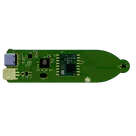
This project is a reference design for a LoRa temperature sensor that gathers environmental data and sends it wirelessly over long distances. It combines low-power sensing with wireless communication and is intended for IoT applications like remote monitoring.
Key elements include:
- The main processor, U2, which handles sensor readings, signal processing, and communication tasks.
- The temperature sensor, U1, which provides accurate temperature (and likely humidity) measurements.
- The LoRa communication module, U3, which enables low-power, long-range wireless data transmission.
- A regulated power supply provided by U4, ensuring stable operation of all circuitry.
- Connectivity components like the J1 port for power and programming, alongside various passives (resistors, capacitors) that support decoupling, signal conditioning, and biasing.
The design is broken down into these steps:
-
Sensing & Processing
-
Wireless Communication
- The U3 is used to broadcast sensor data over a LoRa network. Critical design choices include ensuring low power consumption and proper RF layout to minimize interference.
-
Power Management & Connectivity
Trade-offs and design choices include using the RP2040 for its balance of performance and cost, and selecting LoRa communication to achieve extended range while maintaining low power consumption. The design also emphasizes robust grounding and decoupling strategies by including multiple ground nets and capacitor placements.
Potential challenges involve RF interference, power stability under variable conditions, and ensuring precise sensor calibration. Scaling further might involve multi-sensor arrays, enhanced power management with energy harvesting, and firmware enhancements for network robustness.
Overall, this design is well-suited for remote and distributed sensing applications in smart environments, where low power and long-range communication are critical.
19 days
Ready.
C5
Capacitance
0.1u F
R2
Resistance
80k Ω
3V3
R6
Resistance
27 Ω
I2C_SCL
C9
Capacitance
0.1u F
USB_D-
R3
Resistance
1k Ω
SPI_SCK
C12
Capacitance
0.1u F
VIN
SPI_CS0
LoRa_RESET
VBAT
FAULT
SPI_CS0
LoRa_DIO0
SPI_MOSI
STATUS
LoRa_DIO0
R4
Resistance
1k Ω
3V3
R7
Resistance
5.1K Ω
VIN
FAULT
3V3
I2C_SCL
+1V1
I2C_SDA
3V3
XOUT
3V3
VBAT
USB_D+
3V3
C6
Capacitance
0.1u F
3V3
R5
Resistance
27 Ω
I2C_SDA
STATUS
R1
Resistance
28k Ω
XIN
VIN
SPI_SCK
SPI_MISO
SPI_MISO
USB_D+
XOUT
C11
Capacitance
0.1u F
XIN
SPI_MOSI
+1V1
LoRa_RESET
3V3
+1V1
VBAT
VBAT
VIN
USB_D-
C10
Capacitance
0.1u F
C3
Capacitance
15n F
X1
Frequency
12M Hz
J3
J2
U4
C2
Capacitance
10u F
C4
Capacitance
1u F
U1
C8
Capacitance
22p F
LED2
C7
Capacitance
22p F
J1
U2
LED1
U5
End of Life
U3
please explain what U2 does.

@copilot please explain what U2 does.
1y
The component $U2$ in your project is an $RP2040$ microcontroller manufactured by Raspberry Pi. It is a dual-core Arm Cortex-M0+ microcontroller, designed for low-cost and high-performance applications. Here are some key features:
- Dual-Core Processor: It has two Arm Cortex-M0+ cores running at up to 133MHz.
- Memory: The RP2040 features 264KB of RAM and supports up to 16MB of off-chip flash memory through its QSPI interface.
- GPIO: It provides a rich set of GPIOs with options for PWM, I2C, SPI, UART, and more interfacing capabilities. In your project, several GPIO pins (like GPIO17, GPIO16, etc.) are connected to various peripherals and nets.
- Timers and Analog: Includes programmable PWM, RTC, and three-input ADC channel options (e.g., GPIO26/ADC0, GPIO27/ADC1, etc.).
- USB Support: Includes USB 1.1 Host/Device functionality, crucial for communication tasks.
- Low Power Consumption: Suitable for low-power applications due to its efficient power usage.
- Programmable I/O (PIO): Allows flexible interfacing with digital peripherals, useful for custom protocols.
In your project, $U2$ serves as the control unit managing the overall functionality, interfacing with the LoRa module ($U3$), temperature sensor ($U1$), and handling USB connections, among others. If you have specific functionalities you would like to discuss further, feel free to ask!
1y
Someone is typing...
please explain what J1 does.

1y
The component J1 is a USB Type-C connector. It's typically used for power and data connections in a circuit. Here are some details about its function in your project:
-
Power Supply: The pins labeled VBUS (pins 15 and 16) can be used to supply power to the system. This is common in USB Type-C connectors, allowing devices to be powered from a USB port.
-
Data Transfer: It has differential pairs for USB data lines, DP1 (pin 2), DN1 (pin 3), DP2 (pin 12), and DN2 (pin 13), which can be used for data communication. These pins support USB data signaling.
-
Control and Configuration: It includes CC1 (pin 1) and CC2 (pin 11) pins, which are used for cable orientation detection and role configuration, essential for USB Type-C negotiation.
-
Ground and Shielding: It has multiple pins (7, 8 for GND and 5, 6, 9, 10 for SHIELD) for grounding and EMC shielding, which are important for maintaining signal integrity and reducing electromagnetic interference.
In your LoRa temperature sensor project, J1 would typically be used to connect the circuit to a power source, such as a USB power adapter, and potentially to a computer or other device for data transfer.
1y
Someone is typing...
3
Reviews
Electrical Rule Checks
Missing Footprints
Reports parts that have no footprint.
Design Rule Checks
Overlapping Copper
Reports copper elements that are shorting.
Invalid Layer
Reports nodes that are assigned to a layer that doesn't exist in the layout stackup.
Component Overrides • 17
Deprecated Rules
Reports nodes that are using rules that are not supported anymore.
Layers with Multiple Fills
Reports layers that have multiple copper fills of different nets. Make sure the Connected Layers rule value of nets with fills is valid.
Floating Copper • 1
Name | |
|---|---|
Protected Intrusions
Reports intrusions from objects of other nets into polygons or fills that have the Protected layout rule applied.
Manufacturing
System Checks
Auto-Layout
BetaReports issues with Auto-Layout if Flux cannot route something or must ignore a configuration.
Passive Components
Resistor Power Rating
BetaChecks that the power traveling across a given resistor is under its rating with 50% headroom.
Learn morePull Up/Pull Down Presence
BetaChecks that IC pins that require pull up or pull down resistors have them.
Learn moreCapacitor Voltage Rating
BetaChecks that capacitors have appropriate voltage ratings to prevent overheating and ensure reliable circuit operation.

- Wirelessly connects nets on schematic. Used to organize schematics and separate functional blocks. To wirelessly connect net portals, give them same designator. #portaljharwinbarrozo43.0M
- Wirelessly connects power nets on schematic. Identical to the net portal, but with a power symbol. Used to organize schematics and separate functional blocks. To wirelessly connect power net portals, give them the same designator. #portal #powerjharwinbarrozo11.4M
- A generic fixed resistor for rapid developing circuit topology. Save precious design time by seamlessly add more information to this part (value, footprint, etc.) as it becomes available. Standard resistor values: 1.0Ω 10Ω 100Ω 1.0kΩ 10kΩ 100kΩ 1.0MΩ 1.1Ω 11Ω 110Ω 1.1kΩ 11kΩ 110kΩ 1.1MΩ 1.2Ω 12Ω 120Ω 1.2kΩ 12kΩ 120kΩ 1.2MΩ 1.3Ω 13Ω 130Ω 1.3kΩ 13kΩ 130kΩ 1.3MΩ 1.5Ω 15Ω 150Ω 1.5kΩ 15kΩ 150kΩ 1.5MΩ 1.6Ω 16Ω 160Ω 1.6kΩ 16kΩ 160kΩ 1.6MΩ 1.8Ω 18Ω 180Ω 1.8KΩ 18kΩ 180kΩ 1.8MΩ 2.0Ω 20Ω 200Ω 2.0kΩ 20kΩ 200kΩ 2.0MΩ 2.2Ω 22Ω 220Ω 2.2kΩ 22kΩ 220kΩ 2.2MΩ 2.4Ω 24Ω 240Ω 2.4kΩ 24kΩ 240kΩ 2.4MΩ 2.7Ω 27Ω 270Ω 2.7kΩ 27kΩ 270kΩ 2.7MΩ 3.0Ω 30Ω 300Ω 3.0KΩ 30KΩ 300KΩ 3.0MΩ 3.3Ω 33Ω 330Ω 3.3kΩ 33kΩ 330kΩ 3.3MΩ 3.6Ω 36Ω 360Ω 3.6kΩ 36kΩ 360kΩ 3.6MΩ 3.9Ω 39Ω 390Ω 3.9kΩ 39kΩ 390kΩ 3.9MΩ 4.3Ω 43Ω 430Ω 4.3kΩ 43KΩ 430KΩ 4.3MΩ 4.7Ω 47Ω 470Ω 4.7kΩ 47kΩ 470kΩ 4.7MΩ 5.1Ω 51Ω 510Ω 5.1kΩ 51kΩ 510kΩ 5.1MΩ 5.6Ω 56Ω 560Ω 5.6kΩ 56kΩ 560kΩ 5.6MΩ 6.2Ω 62Ω 620Ω 6.2kΩ 62KΩ 620KΩ 6.2MΩ 6.8Ω 68Ω 680Ω 6.8kΩ 68kΩ 680kΩ 6.8MΩ 7.5Ω 75Ω 750Ω 7.5kΩ 75kΩ 750kΩ 7.5MΩ 8.2Ω 82Ω 820Ω 8.2kΩ 82kΩ 820kΩ 8.2MΩ 9.1Ω 91Ω 910Ω 9.1kΩ 91kΩ 910kΩ 9.1MΩ #generics #CommonPartsLibraryjharwinbarrozo1.5M
- A generic fixed capacitor ideal for rapid circuit topology development. You can choose between polarized and non-polarized types, its symbol and the footprint will automatically adapt based on your selection. Supported options include standard SMD sizes for ceramic capacitors (e.g., 0402, 0603, 0805), SMD sizes for aluminum electrolytic capacitors, and through-hole footprints for polarized capacitors. Save precious design time by seamlessly add more information to this part (value, footprint, etc.) as it becomes available. Standard capacitor values: 1.0pF 10pF 100pF 1000pF 0.01uF 0.1uF 1.0uF 10uF 100uF 1000uF 10,000uF 1.1pF 11pF 110pF 1100pF 1.2pF 12pF 120pF 1200pF 1.3pF 13pF 130pF 1300pF 1.5pF 15pF 150pF 1500pF 0.015uF 0.15uF 1.5uF 15uF 150uF 1500uF 1.6pF 16pF 160pF 1600pF 1.8pF 18pF 180pF 1800pF 2.0pF 20pF 200pF 2000pF 2.2pF 22pF 20pF 2200pF 0.022uF 0.22uF 2.2uF 22uF 220uF 2200uF 2.4pF 24pF 240pF 2400pF 2.7pF 27pF 270pF 2700pF 3.0pF 30pF 300pF 3000pF 3.3pF 33pF 330pF 3300pF 0.033uF 0.33uF 3.3uF 33uF 330uF 3300uF 3.6pF 36pF 360pF 3600pF 3.9pF 39pF 390pF 3900pF 4.3pF 43pF 430pF 4300pF 4.7pF 47pF 470pF 4700pF 0.047uF 0.47uF 4.7uF 47uF 470uF 4700uF 5.1pF 51pF 510pF 5100pF 5.6pF 56pF 560pF 5600pF 6.2pF 62pF 620pF 6200pF 6.8pF 68pF 680pF 6800pF 0.068uF 0.68uF 6.8uF 68uF 680uF 6800uF 7.5pF 75pF 750pF 7500pF 8.2pF 82pF 820pF 8200pF 9.1pF 91pF 910pF 9100pF #generics #CommonPartsLibraryjharwinbarrozo1.5M
- A generic fixed inductor for rapid developing circuit topology. *You can now change the footprint and 3D model at the top level anytime you want. This is the power of #genericsjharwinbarrozo15.1k
- An electrical connector acting as reusable interface to a conductor and creating a point where external circuits can be connected.Terminal
- 47 kOhms ±5% 0.125W, 1/8W Chip Resistor 0805 (2012 Metric) Automotive AEC-Q200 Thick Film #forLedBlinkjharwinbarrozo1.2M
- 10uF Capacitor Aluminum Polymer 20% 16V SMD 5x5.3mm #forLedBlink #commonpartslibrary #capacitor #aluminumpolymer #radialcanjharwinbarrozo1.2M
- Yellow 595nm LED Indication - Discrete 1.7V 1206 (3216 Metric) #forLedBlinkjharwinbarrozo1.1M


Inspect
LoRa temperature sensor Reference Design
Controls
Properties
Availability & Pricing
| Distributor | Qty 1 | |
|---|---|---|
| Digi-Key | $3.42–$7.23 | |
| LCSC | $2.54–$2.66 | |
| Mouser | $26.30 | |
Assets
- LoRa temperature sensor.png
id=LoRa temperature sensor
- LoRa temperature sensor_for Mr Mo.dxf
id=LoRa temperature sensor_for Mr Mo
Thumbnail

Welcome 👋
Flux helps you build PCBs faster with an AI teammate!
Create your account to collaborate, stay updated, fork your own version, and get instant answers from our AI agent.
johannes404
copilot