ESP32 Power Supply Schematic
Updated properties for 2 objects
0:04
Set C1's Capacitance to "100nF"
Set C1's Voltage Rating to "25"
Set C2's Capacitance to "100nF"
Set C2's Voltage Rating to "25"
132 days
Position C1 and C2 by VDD pins...
0:09
Started: Move C1 and C2 near the ESP32 VDD pins
132 days
0:00
Work completed
- C1: set 100 nF, 25 V, 1206 footprint
- C2: set 100 nF, 25 V, 1206 footprint
- C3: set 10 µF, 16 V, 1206 footprint
- R1: set 10 kΩ, 1206 footprint
Remaining tasks
- Place C1 and C2 adjacent to the ESP32 VDD pins
- Place C3 next to the main VDD power input
- Place R1 near the ESP32 EN pin
- Verify all passives are using 1206 footprints and correctly aligned to their nets
Success criteria review
- ✅ All generic components were added with clear designators and correct values
- ❌ Footprint assignment and strategic placement have not yet been verified on the schematic
Recommended next step
Proceed to the Connectivity phase: move the passives to their target locations, connect them to the corresponding ESP32 nets, and then verify the 1206 footprints and placement before moving on to footprint review.
132 days
Ready.
create a detailed step by step plan table for this project to verify its functio...

1y
Certainly! Here’s a detailed step-by-step plan table to verify the functionality of your project:
Table
| Step | Action | Description | Required Tools/Components | Expected Outcome |
|---|---|---|---|---|
| 1 | Review Project Requirements | Verify the project requirements and initial setup. | Project documentation | Clear understanding of project goals. |
| 2 | Identify Connections | List the essential connections needed for the project. | Project schematic | Clear mapping of necessary connections and interfaces. |
| 3 | Connect Power Supply | Connect VDD and GND pins to the power source. | Power supply unit, Multimeter | Stable power supply to the module. |
| 4 | Configure GPIO pins | Configure GPIO pins (IO0 to IO35) based on the project requirements. | ESP32 Datasheet, Flux schematic | Effective GPIO configuration. |
| 5 | Connect Peripheral Devices | Connect required sensors, switches, or other peripherals to GPIO pins. | Various sensors, wire connections | Peripheral devices interfaced correctly. |
| 6 | Program Microcontroller | Write and upload code to the microcontroller to test functionality. | Programming environment, USB cable | Microcontroller programmed with initial test code. |
| 7 | Verify Serial Communication | Test basic communication with the microcontroller (e.g., using UART). | PC, Serial monitor | Successful communication with microcontroller. |
| 8 | Implement Wi-Fi/Bluetooth Features | Connect and program Wi-Fi/Bluetooth functionalities if any. | ESP32, Development environment | Successful wireless communication. |
| 9 | Perform Initial Tests | Run initial tests to ensure all interfaces work (e.g., LED blink, sensor readouts). | Scope/probe, Multimeter, Test environment | Initial test success. |
| 10 | Debugging | Identify and correct any issues identified during testing. | Debugger, Multimeter, Flux schematic | Effective troubleshooting. |
| 11 | Optimize Code | Optimize code for performance and reliability. | Development environment | Optimized microcontroller code. |
| 12 | Final Integration | Integrate all components and test as a complete system. | Project components, test environment | Entire project integrates and functions as expected. |
| 13 | Final Documentation | Document the testing process, results, and any changes made. | Text editor, Documentation tools | Well-documented verification process. |
| 14 | Final Verification | Conduct comprehensive final testing to ensure full functionality. | Complete project setup | Project functionality verified and validated. |
This step-by-step plan should guide you to confidently verify and ensure the functionality of your project. Let me know if there are any specific details you'd like to add or modify.
1y
Someone is typing...
6
import and connect ds18b20 to esp32

@copilot import and connect ds18b20 to esp32
2y
To interface a DS18B20 temperature sensor with an ESP32-WROOM-32E, we'll assume a few things, such as the type of interface (in this case, the One-Wire interface), and typical operation voltages. Correct these assumptions if they're not valid for your setup.
Firstly, let's import the DS18B20 part into your Flux project. You need to follow these steps:
- Open the Add Component menu in your Flux workspace.
- Use the component search bar and type "DS18B20".
- From the search results, select DS18B20 and add it to your workspace.
Now, with respect to connection:
- DS18B20 symbol and ESP32 can be represented as follows:
DS18B20: VDD, GND, DQ

ESP32: IO32, GND, VDD
The connections will be as per below:
- Connect
VDDof DS18B20 toVDDof ESP32. - Connect
GNDof DS18B20 toGNDof ESP32. - Connect
DQof DS18B20 toIO32of ESP32.
You will also need to connect a resistor (4.7k – 10k Ohm is a typical value in many applications) between
VDD and DQ - this acts as a pull-up. Go ahead and add this component similarly in the Flux workspace.Note: The
IO32 pin is assumed to be the GPIO you'll be using for data communication with the DS18B20. However, you can use any other available GPIO pin by changing the above instructions accordingly.Don't forget to reflect these connections in your final schematic!
2y
Someone is typing...
3
Hey, can we move the GNDs away from each other in the part symbol? I can't conne...

add a 3.3v power supply
2y

@markwuflux Hey hey, I changed their position. Let me know if anything needs to be fixed. Thank you!
1

Hey, can we move the GNDs away from each other in the part symbol? I can't connect all 4 GNDs because they are stacked
2y
Someone is typing...
1
Reviews

- Wirelessly connects nets on schematic. Used to organize schematics and separate functional blocks. To wirelessly connect net portals, give them same designator. #portaljharwinbarrozo43.0M
- Wirelessly connects power nets on schematic. Identical to the net portal, but with a power symbol. Used to organize schematics and separate functional blocks. To wirelessly connect power net portals, give them the same designator. #portal #powerjharwinbarrozo11.4M
- A generic fixed resistor for rapid developing circuit topology. Save precious design time by seamlessly add more information to this part (value, footprint, etc.) as it becomes available. Standard resistor values: 1.0Ω 10Ω 100Ω 1.0kΩ 10kΩ 100kΩ 1.0MΩ 1.1Ω 11Ω 110Ω 1.1kΩ 11kΩ 110kΩ 1.1MΩ 1.2Ω 12Ω 120Ω 1.2kΩ 12kΩ 120kΩ 1.2MΩ 1.3Ω 13Ω 130Ω 1.3kΩ 13kΩ 130kΩ 1.3MΩ 1.5Ω 15Ω 150Ω 1.5kΩ 15kΩ 150kΩ 1.5MΩ 1.6Ω 16Ω 160Ω 1.6kΩ 16kΩ 160kΩ 1.6MΩ 1.8Ω 18Ω 180Ω 1.8KΩ 18kΩ 180kΩ 1.8MΩ 2.0Ω 20Ω 200Ω 2.0kΩ 20kΩ 200kΩ 2.0MΩ 2.2Ω 22Ω 220Ω 2.2kΩ 22kΩ 220kΩ 2.2MΩ 2.4Ω 24Ω 240Ω 2.4kΩ 24kΩ 240kΩ 2.4MΩ 2.7Ω 27Ω 270Ω 2.7kΩ 27kΩ 270kΩ 2.7MΩ 3.0Ω 30Ω 300Ω 3.0KΩ 30KΩ 300KΩ 3.0MΩ 3.3Ω 33Ω 330Ω 3.3kΩ 33kΩ 330kΩ 3.3MΩ 3.6Ω 36Ω 360Ω 3.6kΩ 36kΩ 360kΩ 3.6MΩ 3.9Ω 39Ω 390Ω 3.9kΩ 39kΩ 390kΩ 3.9MΩ 4.3Ω 43Ω 430Ω 4.3kΩ 43KΩ 430KΩ 4.3MΩ 4.7Ω 47Ω 470Ω 4.7kΩ 47kΩ 470kΩ 4.7MΩ 5.1Ω 51Ω 510Ω 5.1kΩ 51kΩ 510kΩ 5.1MΩ 5.6Ω 56Ω 560Ω 5.6kΩ 56kΩ 560kΩ 5.6MΩ 6.2Ω 62Ω 620Ω 6.2kΩ 62KΩ 620KΩ 6.2MΩ 6.8Ω 68Ω 680Ω 6.8kΩ 68kΩ 680kΩ 6.8MΩ 7.5Ω 75Ω 750Ω 7.5kΩ 75kΩ 750kΩ 7.5MΩ 8.2Ω 82Ω 820Ω 8.2kΩ 82kΩ 820kΩ 8.2MΩ 9.1Ω 91Ω 910Ω 9.1kΩ 91kΩ 910kΩ 9.1MΩ #generics #CommonPartsLibraryjharwinbarrozo1.5M
- A generic fixed capacitor ideal for rapid circuit topology development. You can choose between polarized and non-polarized types, its symbol and the footprint will automatically adapt based on your selection. Supported options include standard SMD sizes for ceramic capacitors (e.g., 0402, 0603, 0805), SMD sizes for aluminum electrolytic capacitors, and through-hole footprints for polarized capacitors. Save precious design time by seamlessly add more information to this part (value, footprint, etc.) as it becomes available. Standard capacitor values: 1.0pF 10pF 100pF 1000pF 0.01uF 0.1uF 1.0uF 10uF 100uF 1000uF 10,000uF 1.1pF 11pF 110pF 1100pF 1.2pF 12pF 120pF 1200pF 1.3pF 13pF 130pF 1300pF 1.5pF 15pF 150pF 1500pF 0.015uF 0.15uF 1.5uF 15uF 150uF 1500uF 1.6pF 16pF 160pF 1600pF 1.8pF 18pF 180pF 1800pF 2.0pF 20pF 200pF 2000pF 2.2pF 22pF 20pF 2200pF 0.022uF 0.22uF 2.2uF 22uF 220uF 2200uF 2.4pF 24pF 240pF 2400pF 2.7pF 27pF 270pF 2700pF 3.0pF 30pF 300pF 3000pF 3.3pF 33pF 330pF 3300pF 0.033uF 0.33uF 3.3uF 33uF 330uF 3300uF 3.6pF 36pF 360pF 3600pF 3.9pF 39pF 390pF 3900pF 4.3pF 43pF 430pF 4300pF 4.7pF 47pF 470pF 4700pF 0.047uF 0.47uF 4.7uF 47uF 470uF 4700uF 5.1pF 51pF 510pF 5100pF 5.6pF 56pF 560pF 5600pF 6.2pF 62pF 620pF 6200pF 6.8pF 68pF 680pF 6800pF 0.068uF 0.68uF 6.8uF 68uF 680uF 6800uF 7.5pF 75pF 750pF 7500pF 8.2pF 82pF 820pF 8200pF 9.1pF 91pF 910pF 9100pF #generics #CommonPartsLibraryjharwinbarrozo1.5M
- A generic fixed inductor for rapid developing circuit topology. *You can now change the footprint and 3D model at the top level anytime you want. This is the power of #genericsjharwinbarrozo15.4k
- An electrical connector acting as reusable interface to a conductor and creating a point where external circuits can be connected.Terminal
- 47 kOhms ±5% 0.125W, 1/8W Chip Resistor 0805 (2012 Metric) Automotive AEC-Q200 Thick Film #forLedBlinkjharwinbarrozo1.2M
- 10uF Capacitor Aluminum Polymer 20% 16V SMD 5x5.3mm #forLedBlink #commonpartslibrary #capacitor #aluminumpolymer #radialcanjharwinbarrozo1.2M
- Yellow 595nm LED Indication - Discrete 1.7V 1206 (3216 Metric) #forLedBlinkjharwinbarrozo1.1M


Inspect
ESP32-WROOM-32E
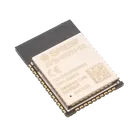
Controls
Properties
Part Type
Integrated Circuit
Manufacturer Name
Manufacturer Part Number
ESP32-WROOM-32
Designator Prefix
U
Resistor
10 kΩ, 1206 package (Chip SMD)
Capacitor 1
100 nF, 25 V, 1206 package x2 (Ceramic)
Capacitor 2
10 µF, 16 V, 1206 package (Ceramic)
Assets
- ESP32-WROOM-32-Footprint_V5.kicad_mod
id=ESP32-WROOM-32-Footprint_V5
 ESP32-WROOM-32
id=default
- MFG_ESP32-WROOM-32E-(4MB-HIGH-TEMP).png
id=MFG_ESP32-WROOM-32E-(4MB-HIGH-TEMP)
- ESP32-WROOM-32-3D.step
id=ESP32-WROOM-32-3D
- ESP32-WROOM-32.kicad_mod
id=NO_ANT
- ESP32-WROOM-32-Footprint_V5-2.kicad_mod
id=ESP32-WROOM-32-Footprint_V5-2
- ESP32-WROOM-32U--3DModel-STEP-56544.STEP
id=ESP32-WROOM-32U--3D
Default
Thumbnail

3d Model
Footprint
Welcome 👋
Flux accelerates your PCB design with AI.
Create your account to start using this component and bring your ideas to life.
bharatn
bharatn
copilot