Power Consumption of U1
0:40
Project
BOM
File
Using BOM Tool.
Looking for "supply current" in 0
Looking for "power consumption current consumption" in 0
Looking for "Electrical characteristics ICC typical" in 0
Looking for "operating modes current Run mode Sleep Stop" in 0
To answer precisely, we use the HC32L110B6YA datasheet specs for supply current and multiply by your VCC. From the datasheet for U1:
At VCC = 3.3 V, typical supply current (all peripherals off) is:
- Run in RAM, RCH clock:
- 4 MHz: IDD typ = 220 µA → P ≈ 0.73 mW
- 8 MHz: 400 µA → 1.32 mW
- 16 MHz: 740 µA → 2.44 mW
- 24 MHz: 1080 µA → 3.56 mW
- 32 MHz: 1400 µA → 4.62 mW
- Sleep mode (all peripherals off), RCH clock:
- 4 MHz: 110 µA → 0.36 mW
- 8 MHz: 190 µA → 0.63 mW
- 16 MHz: 330 µA → 1.09 mW
- 24 MHz: 470 µA → 1.55 mW
- 32 MHz: 580 µA → 1.91 mW
Notes from the datasheet:
- Currents depend on voltage, temperature, clock source/frequency, peripheral usage, I/O loading, code location, etc.
- The above “Run in RAM” figures are at VCC = 3.3 V, VCAP = 1.55 V, RCH clock, peripherals off.
- If running from Flash or enabling peripherals, currents are higher (datasheet provides additional tables).
If you tell me your intended clock frequency, supply voltage, and whether you’ll run from Flash or RAM (and which peripherals are enabled), I can quote the closest datasheet row and compute the corresponding power.
16 MHz Flash run
24 MHz RAM run
8 MHz Sleep mode
32 MHz Flash with ADC/SPI
188 days
Ready.
@docbrown how much power does this component here consume?

@docdrown are you here?
2y

To provide the power consumption information for a component, I need to know the specific component in question. Please provide the designator or part name from the list of components you provided earlier, and I'll provide the information you're looking for.
2y
@natarius, I assume you're referring to the HC32L110B6YA microcontroller. Unfortunately, I don't have the exact power consumption numbers for this specific microcontroller, but it belongs to the HC32L110 series, which is known for its low power consumption. To find the exact numbers, consult the datasheet: https://www.hdsc.com.cn/cn/Index/downloadFile/modelid/65/id/8/key/0
Remember that power consumption can vary depending on the microcontroller's operating modes, clock frequency, peripherals used, and specific settings.
2y
Someone is typing...
7
1


10
@docbrown whats this component connected to?
My apologies for the confusion. For capacitor C3 (100nF non-polarized capacitor), the connections are as follows:
- Pin P1 of C3 is connected to SW1 (Net 2)
- Pin P2 of C3 is connected to Ground (Net 0)
In summary, C3 is connected between SW1 and Ground.
2y
Ah, I see you meant C3 now! Capacitor C3 is a 100nF non-polarized capacitor with the following connections:
- Pin P1 of C3 is connected to SW1 (Net 2)
- Pin P2 of C3 is connected to Ground (Net 0)
In summary, C3 is connected between SW1 and Ground.
2y
I meant C3
2y
I'm sorry, but you haven't specified which component you're referring to. Please provide the designator or part name of the component you want information about, and I'll gladly help you understand its connections.
2y
Someone is typing...
8
explain this project.

1y
Certainly! Let's break down the project:
Overview
This project involves creating a breakout board for the HC32L110B6YA-CSP16 microcontroller. A breakout board is a small PCB (Printed Circuit Board) that allows easy access to the pins of the microcontroller, providing a more convenient development and testing platform. Here are the key elements and components included in the project:
Key Components and Features
- Microcontroller:
- HC32L110B6YA: A low-power microcontroller by Huada Semiconductor Co. Ltd.
- Supporting Components:
Nets define the electrical connections between different components. Each net has a unique identifier and member connections:
- Power Nets:
- VCC: Supplies power to the components.
- GND: Ground connection.
- Signal Nets:
- Interconnect various pins of the microcontroller (U1), capacitors, resistors, crystal, connectors, and switches.
-
Power Supply Decoupling:
-
Crystal Oscillator:
-
Microcontroller I/O Pins:
- To facilitate the development and prototyping with the HC32L110B6YA microcontroller.
- Provide easy access to all necessary components for smooth deployment.
- Ensure reliable clock source with the 32MHz crystal oscillator.
- Stabilize power supply with decoupling capacitors.
This high-level explanation should give you a good understanding of the project's scope and components. Feel free to ask more specific questions!
1y
Someone is typing...
12
@docbrown what does this component do?
As an AI, I cannot visualize the physical layout of the project. But based on the given netlist and components' information, the power wiring for VCC and GND is connected to the appropriate pins on components where necessary. However, please verify the connections against the datasheet and the design guidelines for each component to ensure the overall design is correct. If there are specific connections you're unsure about, feel free to mention them, and I'll provide information based on the available data.
1
As an AI, I cannot analyze the physical wiring of a project directly. However, I can help you with understanding the connections and functionality of the components in the schematic based on the provided netlist and the project's context. If you have any specific questions or concerns, I'd be happy to help.
2y
The position of this chat thread in the schematic is (-29.9246010400377, 3.754924757958719).
2y
The position of this chat thread in the schematic is (-29.9246010400377, 3.754924757958719).
2y
The position of this chat thread in the schematic is (-29.9246010400377, 3.754924757958719).
2y
I'm sorry, but you haven't specified which component you're referring to. If you specify a designator or part name, I can help you understand its function.
2y
Someone is typing...
4
@docbrown where is U1?
C1 is to the right of U1. U1 (HC32L110B6YA microcontroller) is positioned at X-coordinate: -22.6 and Y-coordinate: -12.7, while C1 (Cap-0402-Template) is at X-coordinate: 225.6 and Y-coordinate: -135.3.
2y
Great Scott! U1 is the HC32L110B6YA microcontroller in the schematic. You can find it at the following schematic position: X-coordinate: -22.6 and Y-coordinate: -12.7.
2y
Someone is typing...
5
New Comment
Someone is typing...
9
please explain what C6 does.

2y
In the circuit, the capacitor C6 is connected to the 'Vcap' pin of the microcontroller U1, which typically handles voltage stabilization and noise reduction for the internal core voltage of the microcontroller.
The capacitance value is 4.7µF, suggesting that it's likely used for smoothing and filtering power supply fluctuations.
These are important facets of microcontroller operation because clean and stable power is necessary for accurate and stable operation of the microcontroller, especially when it's running at high frequencies.
As a reminder, connections are as follows:
- Connect U1:Vcap to C6:P1
- Connect C6:P2 to GND:P1
Please adjust this if your intent for this capacitor is different.
2y
Someone is typing...
11
@docbrown how should I approach improving this project?
@lwcassid, the current crystal oscillator (X1) specified in the project is the ABM3C-32.000MHz-D4Y-T from Abracon LLC. This component has a frequency of 32MHz, which is a common choice for microcontrollers like the HC32L110B6YA. The datasheet URL for this oscillator is: https://abracon.com/Resonators/ABM3C.pdf
This oscillator seems suitable for the project, but always make sure you verify its compatibility with other components and confirm it meets your performance and accuracy requirements. If this oscillator does not meet your specific needs, consider alternatives with better stability, frequency tolerance, or operating temperature range that align with your application's demands. Don't forget to double-check the footprint and package size to ensure it fits your PCB layout!
2y

Great Scott, @lwcassid! To improve this HC32L110B6YA-CSP16 breakout board project, I suggest the following steps:
-
Double-check component selection: Ensure all chosen components are suitable for the desired functionality of your board, such as capacitors, resistors, and oscillators. Verify component ratings and confirm the availability of the parts.
-
Optimize power supply decoupling: Place the decoupling capacitors (like C1, C2, C3, and C4) close to the MCU's VCC and GND pins. This minimizes high-frequency noise and improves the stability of voltage supply.
-
Review PCB layout: Keep analog and digital routing separate, minimize ground loops, and maintain short trace lengths, especially for high-speed signals. Also, ensure impedance-controlled tracks for critical signals have the correct width.
-
Label the connectors: Assign meaningful labels to the connectors (like J1, J2, and J3) and create a visual representation of the pinout for straightforward usage.
-
Test point placement: Include test points to allow for easy debugging and testing of important signals and power rails during the bring-up phase of the board.
-
Documentation: Create documentation for the project that outlines the functionality, design choices, and any specific details that could be useful for future reference or optimization.
Lastly, seek feedback from experienced peers who can offer valuable insights and improvements to your design. Good luck!
2y
Someone is typing...
3
SW1
Reviews

- Wirelessly connects nets on schematic. Used to organize schematics and separate functional blocks. To wirelessly connect net portals, give them same designator. #portaljharwinbarrozo43.0M
- Wirelessly connects power nets on schematic. Identical to the net portal, but with a power symbol. Used to organize schematics and separate functional blocks. To wirelessly connect power net portals, give them the same designator. #portal #powerjharwinbarrozo11.4M
- A generic fixed resistor for rapid developing circuit topology. Save precious design time by seamlessly add more information to this part (value, footprint, etc.) as it becomes available. Standard resistor values: 1.0Ω 10Ω 100Ω 1.0kΩ 10kΩ 100kΩ 1.0MΩ 1.1Ω 11Ω 110Ω 1.1kΩ 11kΩ 110kΩ 1.1MΩ 1.2Ω 12Ω 120Ω 1.2kΩ 12kΩ 120kΩ 1.2MΩ 1.3Ω 13Ω 130Ω 1.3kΩ 13kΩ 130kΩ 1.3MΩ 1.5Ω 15Ω 150Ω 1.5kΩ 15kΩ 150kΩ 1.5MΩ 1.6Ω 16Ω 160Ω 1.6kΩ 16kΩ 160kΩ 1.6MΩ 1.8Ω 18Ω 180Ω 1.8KΩ 18kΩ 180kΩ 1.8MΩ 2.0Ω 20Ω 200Ω 2.0kΩ 20kΩ 200kΩ 2.0MΩ 2.2Ω 22Ω 220Ω 2.2kΩ 22kΩ 220kΩ 2.2MΩ 2.4Ω 24Ω 240Ω 2.4kΩ 24kΩ 240kΩ 2.4MΩ 2.7Ω 27Ω 270Ω 2.7kΩ 27kΩ 270kΩ 2.7MΩ 3.0Ω 30Ω 300Ω 3.0KΩ 30KΩ 300KΩ 3.0MΩ 3.3Ω 33Ω 330Ω 3.3kΩ 33kΩ 330kΩ 3.3MΩ 3.6Ω 36Ω 360Ω 3.6kΩ 36kΩ 360kΩ 3.6MΩ 3.9Ω 39Ω 390Ω 3.9kΩ 39kΩ 390kΩ 3.9MΩ 4.3Ω 43Ω 430Ω 4.3kΩ 43KΩ 430KΩ 4.3MΩ 4.7Ω 47Ω 470Ω 4.7kΩ 47kΩ 470kΩ 4.7MΩ 5.1Ω 51Ω 510Ω 5.1kΩ 51kΩ 510kΩ 5.1MΩ 5.6Ω 56Ω 560Ω 5.6kΩ 56kΩ 560kΩ 5.6MΩ 6.2Ω 62Ω 620Ω 6.2kΩ 62KΩ 620KΩ 6.2MΩ 6.8Ω 68Ω 680Ω 6.8kΩ 68kΩ 680kΩ 6.8MΩ 7.5Ω 75Ω 750Ω 7.5kΩ 75kΩ 750kΩ 7.5MΩ 8.2Ω 82Ω 820Ω 8.2kΩ 82kΩ 820kΩ 8.2MΩ 9.1Ω 91Ω 910Ω 9.1kΩ 91kΩ 910kΩ 9.1MΩ #generics #CommonPartsLibraryjharwinbarrozo1.5M
- A generic fixed capacitor ideal for rapid circuit topology development. You can choose between polarized and non-polarized types, its symbol and the footprint will automatically adapt based on your selection. Supported options include standard SMD sizes for ceramic capacitors (e.g., 0402, 0603, 0805), SMD sizes for aluminum electrolytic capacitors, and through-hole footprints for polarized capacitors. Save precious design time by seamlessly add more information to this part (value, footprint, etc.) as it becomes available. Standard capacitor values: 1.0pF 10pF 100pF 1000pF 0.01uF 0.1uF 1.0uF 10uF 100uF 1000uF 10,000uF 1.1pF 11pF 110pF 1100pF 1.2pF 12pF 120pF 1200pF 1.3pF 13pF 130pF 1300pF 1.5pF 15pF 150pF 1500pF 0.015uF 0.15uF 1.5uF 15uF 150uF 1500uF 1.6pF 16pF 160pF 1600pF 1.8pF 18pF 180pF 1800pF 2.0pF 20pF 200pF 2000pF 2.2pF 22pF 20pF 2200pF 0.022uF 0.22uF 2.2uF 22uF 220uF 2200uF 2.4pF 24pF 240pF 2400pF 2.7pF 27pF 270pF 2700pF 3.0pF 30pF 300pF 3000pF 3.3pF 33pF 330pF 3300pF 0.033uF 0.33uF 3.3uF 33uF 330uF 3300uF 3.6pF 36pF 360pF 3600pF 3.9pF 39pF 390pF 3900pF 4.3pF 43pF 430pF 4300pF 4.7pF 47pF 470pF 4700pF 0.047uF 0.47uF 4.7uF 47uF 470uF 4700uF 5.1pF 51pF 510pF 5100pF 5.6pF 56pF 560pF 5600pF 6.2pF 62pF 620pF 6200pF 6.8pF 68pF 680pF 6800pF 0.068uF 0.68uF 6.8uF 68uF 680uF 6800uF 7.5pF 75pF 750pF 7500pF 8.2pF 82pF 820pF 8200pF 9.1pF 91pF 910pF 9100pF #generics #CommonPartsLibraryjharwinbarrozo1.5M
- A generic fixed inductor for rapid developing circuit topology. *You can now change the footprint and 3D model at the top level anytime you want. This is the power of #genericsjharwinbarrozo15.4k
- An electrical connector acting as reusable interface to a conductor and creating a point where external circuits can be connected.Terminal
- 47 kOhms ±5% 0.125W, 1/8W Chip Resistor 0805 (2012 Metric) Automotive AEC-Q200 Thick Film #forLedBlinkjharwinbarrozo1.2M
- 10uF Capacitor Aluminum Polymer 20% 16V SMD 5x5.3mm #forLedBlink #commonpartslibrary #capacitor #aluminumpolymer #radialcanjharwinbarrozo1.2M
- Yellow 595nm LED Indication - Discrete 1.7V 1206 (3216 Metric) #forLedBlinkjharwinbarrozo1.1M


Inspect
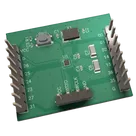
HC32L110B6YA-CSP16 breakout board
Controls
Properties
Product Info Url
Availability & Pricing
| Distributor | Qty 1 | |
|---|---|---|
| Arrow | $0.49 | |
| Digi-Key | $0.58–$1.17 | |
| LCSC | $1.32 | |
| Mouser | $0.61 | |
| Verical | $0.59 | |
Assets
- HC32L110B6YA-CSP16 breakout board image.png
id=HC32L110B6YA-CSP16 breakout board image
- hc32l110b6ya-pcb.png
id=hc32l110b6ya-pcb
Thumbnail


Welcome 👋
Flux helps you build PCBs faster with an AI teammate!
Create your account to collaborate, stay updated, fork your own version, and get instant answers from our AI agent.
docbrown
2
natarius
docbrown
natarius
docbrown
1
natarius