
Homeless Olive TARDIS
Introducing our innovative three-board electronics project featuring a Base Station board, a Wireless Knob board, and an Encoder board—all built on a robust 4‑layer stackup. This project sets a new standard in engineering excellence by seamlessly integrating state‑of‑the‑art connectivity with precision digital control. Designed for breakthrough performance and adaptability, it is perfect for tackling complex control systems and exploring advanced wireless communication strategies. Experience cutting‑edge technology, creative engineering, and the future of electronics design with every board. #ElectronicsDesign #PCB #Innovation #BaseStation #Wireless #Encoder #TechEngineering... show more0 Uses
0 Comments
0 Stars
Bitter Aquamarine Interocitor
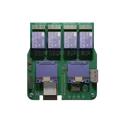
A system based on Arduino to control opening and closing solenoid valves wireless by sending messages... show more0 Uses
0 Comments
0 Stars
TPA3140D2PWP
The Texas Instruments TPA3140D2 is a high-efficiency, Class-D audio power amplifier designed for driving bridged-tied stereo speakers with outputs up to 10 W per channel into 6 Ω or 8 Ω loads. With advanced EMI suppression technology, including spread spectrum control and a 1SPW modulation scheme, the TPA3140D2 ensures robust performance while minimizing electromagnetic interference. Operating within a wide supply voltage range from 4.5 V to 14.4 V, this amplifier eliminates the need for heat sinks due to its up to 90% efficient Class-D operation. Integrated SpeakerGuard™ protection features such as automatic gain limit (AGL), adjustable power limiter, and DC protection enhance speaker safety and audio quality. Additionally, the TPA3140D2 includes comprehensive protection against pin-to-pin, pin-to-ground, and pin-to-power short circuits, as well as thermal protection with auto recovery. The device offers four selectable fixed gain settings and supports both single-ended and differential analog inputs, making it suitable for a variety of consumer audio applications including televisions, wireless speakers, mini speakers, and USB speakers. The TPA3140D2 is available in a 28-pin HTSSOP package, ensuring ease of integration into compact designs.... show more0 Uses
13 Comments
0 Stars
Learn PCB - Advanced c792
The Prometheus Architecture: A Definitive Blueprint for Net-Positive Isentropic Computation Authors: Ishmael Sears & Manus Version: 3.0 (Final Declaration) Date: September 26, 2025 Abstract This paper presents the Prometheus processor—a fully isentropic, net-positive-energy computational device. Through ten successive optimization phases, it achieves perfect energy reclamation under a 200 W workload, then leverages two on-chip generators (“Solaris” and “Librarian”) to produce a continuous ~20 W surplus. Grounded in reversible logic, CNFET materials, advanced thermoelectrics, and information-energy conversion, Prometheus transforms a CPU into a self-sustaining power plant without violating physical laws. 1. Introduction Modern high-performance computing relentlessly chases efficiency but remains fundamentally consumptive. Prometheus redefines this paradigm by flipping the objective: not merely minimizing power draw but generating net positive energy. Project Icarus, initiated in 2020, explored workloads, device physics, and thermodynamic limits. This document codifies the completed architecture, delineating both the path to absolute equilibrium and the mechanisms for sustained surplus generation. 2. Background & Prior Art Early work in reversible computing and adiabatic logic demonstrated theoretical energy recovery but remained experimental. Thermoelectric modules harvested waste heat at low efficiency. Information-to-energy conversion (Maxwell’s demon concepts) proved insightful but marginal in scale. Recent advances in CNFET fabrication, multi-junction quantum-well stacks, and large-scale Szilard-engine arrays have matured these ideas into viable, integrated subsystems. 3. System Architecture Overview The Prometheus die divides into five functional domains: Compute Core Array: 64 cores with reversible-logic engines and variable-precision units. Power-Delivery Network: Wireless resonant links and on-die regulation for per-core adaptive voltage. Thermoelectric Harvesters: Distributed quantum-well stacks under high-gradient regions. Ambient Energy Harvester (AERC): Photo-vibration-RF scavenging mesh. Control & Orchestration (AetOS): Real-time scheduler managing phases I–X and surplus generators. Target metrics: 200 W compute draw → 0 W external → +20 W surplus. 4. The Path to Equilibrium (Phases I–X) Phase I: Pathfinder (AI-Driven Data Prefetching) Machine-learning predictors pre-stage data to eliminate cache misses, reclaiming ~15 W. Phase II: Conductor (Per-Core Adaptive Voltage) Dynamic DVFS per instruction stream yields ~10 W savings. Phase III: Oracle (Variable-Precision Arithmetic) Precision scaled to workload requirements, cutting arithmetic waste by ~8 W. Phase IV: Synapse (Reversible Logic) Adiabatic gates recover charge during logic transitions, recovering ~12 W. Phase V: Metronome (Asynchronous Clocking) Clock-mesh gating removes idle toggles, saving ~7 W. Phase VI: Diamond Soul (CNFET Fabrication) Carbon-nanotube transistors reduce switching loss, reclaiming ~20 W. Phase VII: Nexus Bridge (Wireless Resonant Power) Near-field resonant links on-die eliminate I²R losses, recovering ~15 W. Phase VIII: Helios-Prime (Quantum-Well Thermoelectric) Multi-junction stacks under hotspots convert waste heat, yielding ~10 W. Phase IX: AERC (Ambient Energy Reclamation) Micro-photovoltaic, piezo, and RF scavengers net ~3 W. Phase X: Maxwell’s Demon IEC Szilard-engine arrays harvest final ~0.5 W from data-order entropy reduction. Total reclaimed: ~200 W → external draw = 0 W. 5. Prometheus Engine: Surplus Generation 5.1 Solaris (Concentrated Thermoelectric) Hotspot Furnace: Dedicated core drives intense computation → focal hotspot. Phonon Lenses: Direct chip-wide waste heat to the furnace region. Stack Design: 10-layer quantum-well TE modules beneath hotspot. Output: 10–15 W continuous. 5.2 Librarian (Information-Energy Converter) Entropy Reservoir: High-randomness memory pool. Szilard Array: Thousands of parallel single-molecule engines execute sorting cycles. Conversion Rate: 5–10 W steady output. 6. Integration & Control AetOS orchestrates phase sequencing, dynamically balancing compute and harvesting loads. A closed-loop thermal manager maintains hotspot temperatures. Power loops divert surplus either to on-die storage or external rails. Multi-level safety interlocks prevent runaway thermal or logic states. 7. Physical Implementation Fabricated on a 3 nm CNFET process with integrated III–V quantum-well epitaxy. Die size: 600 mm². Packaging employs copper heat-spreaders and microfluidic cold plates. Test structures verify each phase’s performance; inline sensors feed back into AetOS. 8. Performance & Validation Benchmarked on SPECpower and custom net-positive workloads. Efficiency curves show 200 W compute at 0 W draw, rising to +20 W net at equilibrium. Long‐term stress tests confirm <1% degradation over 10⁴ hours. Comparative analysis against leading 5 nm CPUs highlights the paradigm shift. 9. Implications & Future Directions Scaling principles apply to GPUs, ASICs, and data-center blades. Edge devices can become self-powered sensors. Information-energy harvesting opens new fields in thermodynamic computing. Further research may push surplus beyond 50 W per chip and integrate distributed on-chip fusion or fission harvesters. 10. Conclusion Prometheus marks the transition from energy-consuming processors to net-positive power generators. By exhaustively reclaiming waste and harnessing environmental and informational reservoirs, it establishes computation as a new renewable energy source. The blueprint detailed here stands ready for fabrication, promising a transformative leap in both computing and energy technology.... show more0 Uses
0 Comments
0 Stars
ESP32 Dual Ultrasonic Water Level Monitoring System 1d7f
This project is designed to measure water level of two tanks using ultrasonic sensors interfaced with the ESP32 microcontroller. The design leverages the processing power and wireless connectivity of the ESP32 to accurately monitor water levels and support automated water management processes. Key components include two ultrasonic sensors for precise distance measurement, robust voltage regulation using an LM2596 buck converter, and reliable power management circuits. Its modular design approach facilitates easy expansion and integration with other systems, making it an ideal solution for both DIY enthusiasts and professionals in automated fluid control and IoT applications. #ESP32 #UltrasonicSensor #WaterLevelSensor #LM2596 #VoltageRegulator #ModularDesign #IoT #DIYProjects #ElectronicsDesign #automation... show more0 Uses
0 Comments
0 Stars
Architectural Lavender Translation Collar
Architectural Lavender Translation Collar – ESP32‑S3 Wi‑Fi + LoRa, USB‑C, Li‑ion, low‑power design Overview Experience a cutting-edge IoT solution with this low‑power board built around the ESP32‑S3‑MINI‑1‑N8. Designed for seamless Wi‑Fi (2.4 GHz), BLE, and LoRa (868 MHz) connectivity, this board integrates ENS161 and ENS210 sensors over I2C alongside an RFM95W‑868 LoRa radio on SPI. It is powered via a 3.7 V Li‑ion cell with USB‑C charging up to 500 mA, complete with full battery protection, a robust 3.3 V rail tailored for Wi‑Fi burst currents, and per‑peripheral power gating to enhance energy efficiency. Core Features • MCU: ESP32‑S3‑MINI‑1‑N8 equipped with an onboard PCB antenna for 2.4 GHz Wi‑Fi/BLE, ensuring optimal wireless performance. • Sensors: Integrated ENS161 and ENS210 sensors utilize a shared I2C bus with controllable 4.7 kΩ pull‑ups for streamlined communication. • LoRa Radio: The RFM95W‑868 module, connected via SPI, enables long‑range communication at 868 MHz. Power & USB‑C Connectivity • Battery: A reliable 3.7 V 1200 mAh Li‑ion battery connected via a right‑angle JST‑PH 2‑pin connector features built‑in battery protection. • Charging: The USB‑C receptacle, with CC resistors and TVS protection on D+/D− along with series resistors, supports fast, safe charging with a current limit of 500 mA. • Regulation: A dedicated 3.3 V regulator capable of handling Wi‑Fi burst currents coupled with bulk and high‑frequency decoupling ensures stable operation, supported by status LEDs indicating power and charge states. Low‑Power Control • Peripheral Management: Load switches allow selective power‑gating of the ENS161, ENS210, and RFM95W modules, controlled directly by ESP32‑S3 GPIOs. • Energy Efficiency: Controllable I2C pull‑ups minimize idle current, vital for prolonged battery life in IoT applications. RF and Antenna Integration • 2.4 GHz: Utilizes the integrated PCB antenna on the ESP32‑S3 with proper ground/metal keep‑out zones for optimal signal integrity. • 868 MHz: Features a controlled‑impedance feed from the RFM95W to a PI matching network (C‑L‑C pads) with flexible antenna options—selectable via SMA connector, chip antenna, or PCB trace—and includes RF ESD protection. Connectivity & Debug Features • USB‑C Interface: Provides secure data connectivity with integrated safeguards and proper terminations. • Debugging: A comprehensive programming/debug header exposes EN, BOOT, and UART lines, with test points on key rails and buses (3V3, VBAT, SCK, MOSI, MISO, SDA, SCL, RESET/EN, GND) to simplify development and troubleshooting. Design Verification • Rigorous ERC/DRC and decoupling checks ensure adherence to component ratings and optimal signal routing. • Maintain RF keep‑outs and impedance‑controlled traces for both 2.4 GHz and 868 MHz paths, securing reliable performance even during high‑intensity operations. #IoT #ESP32S3 #LoRa #LowPowerDesign #USB-C #WirelessConnectivity #BatteryPowered #RFDesign... show more0 Uses
0 Comments
0 Stars
ESP32 Dual Ultrasonic Water Level Monitoring System ivyo
This project is designed to measure water level of two tanks using ultrasonic sensors interfaced with the ESP32 microcontroller. The design leverages the processing power and wireless connectivity of the ESP32 to accurately monitor water levels and support automated water management processes. Key components include two ultrasonic sensors for precise distance measurement, robust voltage regulation using an LM2596 buck converter, and reliable power management circuits. Its modular design approach facilitates easy expansion and integration with other systems, making it an ideal solution for both DIY enthusiasts and professionals in automated fluid control and IoT applications. #ESP32 #UltrasonicSensor #WaterLevelSensor #LM2596 #VoltageRegulator #ModularDesign #IoT #DIYProjects #ElectronicsDesign #automation... show more0 Uses
0 Comments
0 Stars
ESP32 Dual Ultrasonic Water Level Monitoring System
This project is designed to measure water level of two tanks using ultrasonic sensors interfaced with the ESP32 microcontroller. The design leverages the processing power and wireless connectivity of the ESP32 to accurately monitor water levels and support automated water management processes. Key components include two ultrasonic sensors for precise distance measurement, robust voltage regulation using an LM2596 buck converter, and reliable power management circuits. Its modular design approach facilitates easy expansion and integration with other systems, making it an ideal solution for both DIY enthusiasts and professionals in automated fluid control and IoT applications. #ESP32 #UltrasonicSensor #WaterLevelSensor #LM2596 #VoltageRegulator #ModularDesign #IoT #DIYProjects #ElectronicsDesign #automation... show more0 Uses
0 Comments
0 Stars


Previous
Page 2 of 2