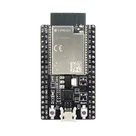
ESP32-DEVKITC-VE Overview
Thought for 3 sec
The part is the ESP32-DEVKITC-VE, an Espressif development board built around the ESP32-WROVER-E wireless module.
Purpose
The ESP32-DEVKITC-VE is a ready-to-use development/evaluation board for building and testing Wi-Fi and Bluetooth/BLE embedded applications. It breaks out the ESP32 module’s GPIOs to header pins and includes the support circuitry needed to power, program, and reset the module easily.
It is commonly used for:
- IoT prototypes
- Wi-Fi sensors and controllers
- BLE devices
- Smart home devices
- Wireless data logging
- Robotics and motor control experiments
- Educational embedded systems projects
- Gateway or bridge devices using UART, SPI, I2C, or other interfaces
The board provides:
- ESP32 dual-core processor
- Xtensa LX6 dual-core 32-bit MCU
- Up to 240 MHz
- Wi-Fi
- 2.4 GHz 802.11 b/g/n
- Bluetooth
- Bluetooth Classic
- Bluetooth Low Energy / BLE
- Memory
- 8 MB external Flash
- 8 MB PSRAM on the WROVER-E module
- GPIO breakout
- Digital I/O
- ADC inputs
- DAC outputs
- PWM
- Capacitive touch inputs
- Common embedded interfaces
- UART
- SPI
- I2C
- I2S
- SDIO / SD card support
- TWAI/CAN-compatible controller
- USB programming/debug convenience
- USB-to-UART bridge on the dev board
- Auto-reset / auto-boot circuitry for flashing firmware
In a circuit, the ESP32-DEVKITC-VE acts as the main controller and wireless communication module.
A typical system looks like this:
Text
USB or 5V input ↓ On-board regulator ↓ 3.3V rail ↓ ESP32-WROVER-E module ↓ GPIO / UART / SPI / I2C / ADC / PWM ↓ Sensors, displays, motors, relays, radios, or other peripherals
The board is usually powered from USB or an external supply. The onboard regulator generates the required 3.3 V rail for the ESP32 module. The ESP32 then runs user firmware and communicates with external devices through its GPIO pins.
For example:
- An I2C temperature sensor connects to ESP32 I2C pins.
- A display may connect over SPI.
- A motor driver can be controlled using PWM outputs.
- A cloud-connected sensor node can read analog/digital signals and transmit data over Wi-Fi.
- A phone app can communicate with it over BLE.
Important characteristics include:
- Integrated Wi-Fi and Bluetooth
- High processing capability for a microcontroller
- Large external PSRAM, useful for memory-heavy applications
- Many peripheral interfaces
- Good prototyping convenience
- RF-certified module-based design
- Breadboard/dev-board friendly headers
- Not just a bare chip — it includes the ESP32 module plus power/programming support circuitry
The 8 MB PSRAM is especially notable. It makes this board more suitable than smaller ESP32 boards for applications involving buffers, graphics, audio, networking stacks, web servers, cameras, or larger data structures.
Family / series
This board belongs to Espressif’s ESP32-DevKitC family of development boards.
The specific module used here is from the ESP32-WROVER-E series, which is part of the broader classic ESP32 family.
ESP32 family overview
The original ESP32 family includes modules such as:
Table
| Module / board type | Main difference | Typical use case |
|---|---|---|
| ESP32-WROOM | Standard ESP32 module, usually no PSRAM | General IoT, sensors, simple Wi-Fi/BLE devices |
| ESP32-WROVER | ESP32 module with external PSRAM | Camera, audio, graphics, larger buffers |
| ESP32-WROVER-E | Updated WROVER module with improved RF/performance characteristics | More robust ESP32 designs needing PSRAM |
| ESP32-DevKitC | Development board using ESP32 module | Prototyping, evaluation, education |
| ESP32-DevKitC-VE | DevKitC variant using ESP32-WROVER-E with larger memory | Prototyping memory-heavy Wi-Fi/BLE applications |
The main differences between ESP32-DevKitC variants are usually:
- Which ESP32 module is installed
- Flash size
- PSRAM availability
- Antenna type
- Pinout/header population
- USB-to-UART bridge variant
- Mechanical layout revisions
Compared to a basic ESP32-DevKitC with an ESP32-WROOM module, the ESP32-DEVKITC-VE is better when the application needs more RAM.
Examples where the WROVER-E version is preferred:
- Image buffering
- Camera-related projects
- Audio streaming
- Web server with larger pages/assets
- BLE + Wi-Fi running together with larger buffers
- Data logging with larger temporary storage
- Edge processing or more complex firmware
A WROOM-based board is often enough for simpler tasks like:
- Reading sensors
- Driving relays
- Sending MQTT data
- Basic BLE beacons
- Simple Wi-Fi control interfaces
The ESP32-DEVKITC-VE is a powerful ESP32 development board designed for prototyping wireless embedded systems. Its key advantage over simpler ESP32 boards is the use of the ESP32-WROVER-E module, which includes extra PSRAM and is better suited for applications that need more memory while still providing Wi-Fi, Bluetooth, many GPIOs, and common embedded interfaces.
Review pins and BOM
Explain pinout usage
Run design review
Check BOM details
Create usage guide