Chat
Welcome to Flux
Treat Flux like your intern. Tell it what you'd like to build and it'll get to work. You can also ask it questions, brainstorm ideas, and teach it your preferences. Learn More
Explain project
Write a project description
Find schematic issues
Create a test plan
Simulate a circuit
Prepare for Manufacturing
Component Selection Workflow
New Subsystem Wizard
Ready.
what do D1 and D2 accomplish for the guitar signal in this circuit? Can you expl...

@copilot what do D1 and D2 accomplish for the guitar signal in this circuit? Can you explain like I'm 5?
2y
D1 and D2 are diodes in the circuit. They act like one-way streets for the guitar signal, allowing it to flow in only one direction. This helps shape the sound of the guitar by clipping or cutting off the peaks of the signal, creating a distorted or crunchy sound that is often used in rock and metal music.
2y
what does the capacitor after the diodes do?
2y
The capacitor after the diodes (C3) serves as a coupling capacitor. It blocks any DC component of the signal and allows only the AC component to pass through. This helps to maintain the correct DC biasing of the following stages in the circuit and prevents any unwanted DC voltage shifts.
2y
8
I know that this potentiometer circuit is for adjusting the distortion, but how ...
@copilot I know that this potentiometer circuit is for adjusting the distortion, but how does it do that?
2y
In a distortion guitar pedal, the potentiometer is typically used to adjust the gain of the input signal. By varying the resistance of the potentiometer, the amount of signal that is allowed to pass through the circuit changes. This, in turn, affects the level of distortion applied to the signal. When the resistance is low, more signal passes through, resulting in higher gain and more distortion. Conversely, when the resistance is high, less signal passes through, resulting in lower gain and less distortion.
2y
6
what is the output of the voltage divider formed by R6 and R7 if there's 9V acro...
@copilot what is the output of the voltage divider formed by R6 and R7 if there's 9V across them? Also what does C7 do?
2y
The output of the voltage divider formed by R6 and R7 with 9V across them is 4.5V. As for C7, it's a capacitor that is typically used for filtering or coupling purposes in the circuit.
2y
what does filtering and coupling mean?
2y
Filtering in a circuit typically refers to the process of removing unwanted frequencies or noise from a signal. Coupling, on the other hand, is the process of transferring a signal from one part of a circuit to another while isolating the two parts electrically. Capacitors are often used for both filtering and coupling purposes in electronic circuits.
2y
11
what does this project actually do?
@copilot what does this project actually do?
2y
This project is for designing an analog guitar pedal. Guitar pedals, also known as effects pedals, are used to modify the sound of the guitar in various ways.
Key components of the project include:
-
Operational Amplifier (U1 - RC4558D): This is the main active component in the circuit, used to amplify the guitar signal.
-
Transistor (Q1 - 2SC1815 PBFREE): This is likely being used for signal amplification as well.
-
Resistors (R1 - R15): These are used in the circuit to control the current and voltage levels.
-
Capacitors (C1 - C13): These are used for various purposes such as signal filtering and power supply bypassing.
-
Connectors (J1 - J8): These are used for connecting the guitar and amplifier to the pedal, and maybe for power supply and other auxiliary connections.
-
Diodes (D1, D2 - MA150): Most probably these are used for signal clipping, which is a common technique in distortion and overdrive pedals.
Please note that without a detailed circuit description or schematic, it is difficult to provide a more specific explanation of how the circuit works.
2y
13
what does a clipped sine wave look like?
@copilot what does a clipped sine wave look like?
2y
A clipped sine wave is a sine wave that has been manipulated so it does not reach its maximum high or low values. This creates a square wave output without sacrificing any of the desired phase noise performance. In a clipped sine wave, the sinusoidal wave is shown in red and the clipped sine wave is shown in yellow. source
2y
10
what does this half of the circuit do in my project
@copilot what does this half of the circuit do in my project
2y
Based on the schematic position -32, 295, it appears we are looking at the general vicinity of the operational amplifier (U1) and the surrounding components.
This part of the Analog Guitar Pedal circuit mainly forms an active filter stage utilizing the operational amplifier (U1) along with resistors and capacitors around it. The purpose of this stage is to shape the frequency response of the guitar signal. It can be used to emphasize or attenuate certain frequency bands, providing tone control or other desired effects for the sound output. Component values and configuration determine the type and characteristics of the active filter (e.g., low-pass, high-pass, band-pass, or band-stop).
Without a more specific area or components mentioned, it is difficult to provide a detailed explanation of the exact portion of the circuit. If there is a particular component or connection you would like more information about, please provide the designator or part name for clarification.
2y
4
what is the point of a capacitor to ground on the non-inverting op amp feedback ...
@copilot what is the point of a capacitor to ground on the non-inverting op amp feedback path?
2y
12
why is this capacitor here on the input signal?
@copilot why is this capacitor here on the input signal?
2y
The capacitor (C1) at the input signal is likely used for filtering or coupling purposes. It can help remove any DC offset from the input signal and allow only the AC component (guitar signal) to pass through. This is a common technique in audio circuits to ensure proper signal processing and prevent unwanted DC voltage from affecting the circuit.
2y
5
R3
Resistance
10kΩ
R2
Resistance
22kΩ
C2
Capacitance
100nF
Reviews

- Wirelessly connects nets on schematic. Used to organize schematics and separate functional blocks. To wirelessly connect net portals, give them same designator. #portaljharwinbarrozo43.0M
- Wirelessly connects power nets on schematic. Identical to the net portal, but with a power symbol. Used to organize schematics and separate functional blocks. To wirelessly connect power net portals, give them the same designator. #portal #powerjharwinbarrozo11.4M
- A generic fixed resistor ideal for rapid circuit topology development. Its footprint automatically adapts based on the selected package case code—supporting 0402, 0603, 0805, 1203, and many other standard SMD packages, as well as axial horizontal and vertical configurations. Save precious design time by seamlessly add more information to this part (value, footprint, etc.) as it becomes available. Standard resistor values: 1.0 ohm, 10 ohm, 100 ohm, 1.0k ohm, 10k ohm, 100k ohm, 1.0M ohm 1.1 ohm, 11 ohm, 110 ohm, 1.1k ohm, 11k ohm, 110k ohm, 1.1M ohm 1.2 ohm, 12 ohm, 120 ohm, 1.2k ohm, 12k ohm, 120k ohm, 1.2M ohm 1.3 ohm, 13 ohm, 130 ohm, 1.3k ohm, 13k ohm, 130k ohm, 1.3M ohm 1.5 ohm, 15 ohm, 150 ohm, 1.5k ohm, 15k ohm, 150k ohm, 1.5M ohm 1.6 ohm, 16 ohm, 160 ohm, 1.6k ohm, 16k ohm, 160k ohm, 1.6M ohm 1.8 ohm, 18 ohm, 180 ohm, 1.8K ohm, 18k ohm, 180k ohm, 1.8M ohm 2.0 ohm, 20 ohm, 200 ohm, 2.0k ohm, 20k ohm, 200k ohm, 2.0M ohm 2.2 ohm, 22 ohm, 220 ohm, 2.2k ohm, 22k ohm, 220k ohm, 2.2M ohm 2.4 ohm, 24 ohm, 240 ohm, 2.4k ohm, 24k ohm, 240k ohm, 2.4M ohm 2.7 ohm, 27 ohm, 270 ohm, 2.7k ohm, 27k ohm, 270k ohm, 2.7M ohm 3.0 ohm, 30 ohm, 300 ohm, 3.0K ohm, 30K ohm, 300K ohm, 3.0M ohm 3.3 ohm, 33 ohm, 330 ohm, 3.3k ohm, 33k ohm, 330k ohm, 3.3M ohm 3.6 ohm, 36 ohm, 360 ohm, 3.6k ohm, 36k ohm, 360k ohm, 3.6M ohm 3.9 ohm, 39 ohm, 390 ohm, 3.9k ohm, 39k ohm, 390k ohm, 3.9M ohm 4.3 ohm, 43 ohm, 430 ohm, 4.3k ohm, 43K ohm, 430K ohm, 4.3M ohm 4.7 ohm, 47 ohm, 470 ohm, 4.7k ohm, 47k ohm, 470k ohm, 4.7M ohm 5.1 ohm, 51 ohm, 510 ohm, 5.1k ohm, 51k ohm, 510k ohm, 5.1M ohm 5.6 ohm, 56 ohm, 560 ohm, 5.6k ohm, 56k ohm, 560k ohm, 5.6M ohm 6.2 ohm, 62 ohm, 620 ohm, 6.2k ohm, 62K ohm, 620K ohm, 6.2M ohm 6.8 ohm, 68 ohm, 680 ohm, 6.8k ohm, 68k ohm, 680k ohm, 6.8M ohm 7.5 ohm, 75 ohm, 750 ohm, 7.5k ohm, 75k ohm, 750k ohm, 7.5M ohm 8.2 ohm, 82 ohm, 820 ohm, 8.2k ohm, 82k ohm, 820k ohm, 8.2M ohm 9.1 ohm, 91 ohm, 910 ohm, 9.1k ohm, 91k ohm, 910k ohm, 9.1M ohm #generics #CommonPartsLibraryjharwinbarrozo1.5M
- A generic fixed capacitor ideal for rapid circuit topology development. You can choose between polarized and non-polarized types, its symbol and the footprint will automatically adapt based on your selection. Supported options include standard SMD sizes for ceramic capacitors (e.g., 0402, 0603, 0805), SMD sizes for aluminum electrolytic capacitors, and through-hole footprints for polarized capacitors. Save precious design time by seamlessly add more information to this part (value, footprint, etc.) as it becomes available. Standard capacitor values: 1.0pF, 10pF, 100pF, 1000pF, 0.01uF, 0.1uF, 1.0uF, 10uF, 100uF, 1000uF, 10000uF 1.1pF, 11pF, 110pF, 1100pF 1.2pF, 12pF, 120pF, 1200pF 1.3pF, 13pF, 130pF, 1300pF 1.5pF, 15pF, 150pF, 1500pF, 0.015uF, 0.15uF, 1.5uF, 15uF, 150uF, 1500uF 1.6pF, 16pF, 160pF, 1600pF 1.8pF, 18pF, 180pF, 1800pF 2.0pF, 20pF, 200pF, 2000pF 2.2pF, 22pF, 220pF, 2200pF, 0.022uF, 0.22uF, 2.2uF, 22uF, 220uF, 2200uF 2.4pF, 24pF, 240pF, 2400pF 2.7pF, 27pF, 270pF, 2700pF 3.0pF, 30pF, 300pF, 3000pF 3.3pF, 33pF, 330pF, 3300pF, 0.033uF, 0.33uF, 3.3uF, 33uF, 330uF, 3300uF 3.6pF, 36pF, 360pF, 3600pF 3.9pF, 39pF, 390pF, 3900pF 4.3pF, 43pF, 430pF, 4300pF 4.7pF, 47pF, 470pF, 4700pF, 0.047uF, 0.47uF, 4.7uF, 47uF, 470uF, 4700uF 5.1pF, 51pF, 510pF, 5100pF 5.6pF, 56pF, 560pF, 5600pF 6.2pF, 62pF, 620pF, 6200pF 6.8pF, 68pF, 680pF, 6800pF, 0.068uF, 0.68uF, 6.8uF, 68uF, 680uF, 6800uF 7.5pF, 75pF, 750pF, 7500pF 8.2pF, 82pF, 820pF, 8200pF 9.1pF, 91pF, 910pF, 9100pF #generics #CommonPartsLibraryjharwinbarrozo1.5M
- A generic fixed inductor suitable for rapid circuit topology development. The footprint automatically adapts based on the selected package, supporting standard SMD sizes (e.g., 0402, 0603, 0805) as well as well-known inductor packages such as SDR1806, PA4320, SRN6028, and SRR1260. Standard inductor values: 1.0 nH, 10 nH, 100 nH, 1.0 µH, 10 µH, 100 µH, 1.0 mH 1.2 nH, 12 nH, 120 nH, 1.2 µH, 12 µH, 120 µH, 1.2 mH 1.5 nH, 15 nH, 150 nH, 1.5 µH, 15 µH, 150 µH, 1.5 mH 1.8 nH, 18 nH, 180 nH, 1.8 µH, 18 µH, 180 µH, 1.8 mH 2.2 nH, 22 nH, 220 nH, 2.2 µH, 22 µH, 220 µH, 2.2 mH 2.7 nH, 27 nH, 270 nH, 2.7 µH, 27 µH, 270 µH, 2.7 mH 3.3 nH, 33 nH, 330 nH, 3.3 µH, 33 µH, 330 µH, 3.3 mH 3.9 nH, 39 nH, 390 nH, 3.9 µH, 39 µH, 390 µH, 3.9 mH 4.7 nH, 47 nH, 470 nH, 4.7 µH, 47 µH, 470 µH, 4.7 mH 5.6 nH, 56 nH, 560 nH, 5.6 µH, 56 µH, 560 µH, 5.6 mH 6.8 nH, 68 nH, 680 nH, 6.8 µH, 68 µH, 680 µH, 6.8 mH 8.2 nH, 82 nH, 820 nH, 8.2 µH, 82 µH, 820 µH, 8.2 mH #generics #CommonPartsLibraryjharwinbarrozo15.7k
- An electrical connector acting as reusable interface to a conductor and creating a point where external circuits can be connected.Terminal
- 47 kOhms ±5% 0.125W, 1/8W Chip Resistor 0805 (2012 Metric) Automotive AEC-Q200 Thick Film #forLedBlinkjharwinbarrozo1.2M
- 10uF Capacitor Aluminum Polymer 20% 16V SMD 5x5.3mm #forLedBlink #commonpartslibrary #capacitor #aluminumpolymer #radialcanjharwinbarrozo1.2M
- Yellow 595nm LED Indication - Discrete 1.7V 1206 (3216 Metric) #forLedBlinkjharwinbarrozo1.1M


Analog Guitar Pedal V0
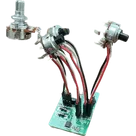
Schematic by Carson
Cal Poly Senior Project
This Flux Project only attempts to export a PCB. An external BoM can be found on Mouser with this access ID: 2b6f7daaed
Properties
Pricing & Availability
Distributor | Qty 1 |
|---|---|
Digi-Key | $1.30–$1.82 |
LCSC | $2.28 |
Mouser | $1.91 |
Controls
Welcome 👋
Flux helps you build PCBs faster with an AI teammate!
Create your account to collaborate, stay updated, fork your own version, and get instant answers from our AI agent.
markwuflux
copilot