Transistor Circuit for Soil Moisture Control
1:26
Chat History
Project
Clarifying tool usage rules.
Focusing on the plan tool.
Defining project context.
Responding with the plan tool.
Maintaining clarity in the plan.
I’ve prepared a plan to build your analog dry-soil pump switch. It will add probe sensing, a comparator with hysteresis, and an N‑MOSFET + flyback diode driver.
Summary of steps:
- Add connectors and decoupling: Terminal, Capacitor.
- Probe sensing and filtering: Resistor, Capacitor, optional ESD Diode.
- Comparator + hysteresis: Comparator with adjustable threshold.
- Pump driver + protection: N-MOSFET low-side switch, Flyback Diode, bulk input cap.
Click Start on the plan bar to execute the plan, and I’ll implement it in your project.
43 days

0:35
Chat History
Project
Linking components in Spanish.
Resumen rápido:
- Objetivo: encender una bomba de 5 V cuando las sondas de acero inoxidable dejen de conducir (suelo seco), con circuito 100% analógico.
- Arquitectura acordada:
- Sondas resistivas externas con polarización de baja corriente y filtro RC usando Resistor y Capacitor; opcional protección con ESD Diode.
- Detección con Comparator e histéresis (umbral ajustable).
- Conector para 5 V, bomba y sondas: Terminal.
- Driver de la bomba con N-MOSFET en lado bajo y Flyback Diode; más desacoplos.
- Datos recibidos: sondas externas por cable; bomba “de baja potencia”; control analógico.
¿Quieres que proceda a implementar este esquema ahora?
Pedirle el esquema actual
Elegir comparador y MOSFET
Definir umbral e histéresis
Revisar protección de sondas
22 days
Ready to start.
Show Plan
led rojo

Poner una fuente de tension
2y

@copilot led rojo
2y
Entiendo que quieres agregar un LED rojo a tu proyecto. Los LEDs son componentes muy útiles y se usan en una gran variedad de aplicaciones para indicar estados, iluminar áreas y más.
Primero, necesitarás seleccionar un LED rojo adecuado para tu diseño. Los LEDs vienen en varias formas y tamaños, y los dos factores clave a considerar son la tensión y la corriente. Usualmente, un LED rojo opera alrededor de 2V y 20mA.
Aquí hay una descripción general de cómo puedes agregarlo a tu diseño en Flux:
-
Añade el LED a tu proyecto: Busca un "LED rojo" en la biblioteca de componentes de Flux y arrástralo a tu diseño.
-
Añade una resistencia: Los LEDs necesitan una resistencia en serie para limitar la corriente a través de ellos. Suponiendo que estás alimentando tu diseño con una fuente de 5V, necesitarás una resistencia de aproximadamente 150 ohmios. Localiza un "Resistor" en la biblioteca de componentes de Flux, y selecciona o escribe 150 en la caja de parámetros.
-
Conecta la resistencia y el LED: Conecta la resistencia en serie con el LED rojo. En la práctica, el terminal positivo del LED (ánodo) se conecta al lado de la resistencia que está conectado a la fuente de alimentación (5V). El terminal negativo del LED (cátodo) se conecta al lado de la resistencia que está conectado a tierra.
-
Conecta el LED y la resistencia al interruptor: El lado de la resistencia que está conectada al LED debe estar conectada al terminal del interruptor (por ejemplo, P1.1)
Este es un resumen de cómo puedes agregar un LED rojo a tu diseño en Flux. Espero que esto te sea útil! Recuerda que estos son solamente consejos generales y la implementación exacta dependerá de las necesidades y especificaciones exactas de tu proyecto.
2y
Someone is typing...
5
3 D Cell Batteries / Vertical Position.

como relizar una placa para un semsfor con 555
2y
Para realizar un circuito de semáforo utilizando el temporizador 555 necesitaremos los siguientes componentes:
- IC 555 Timer
- Resistor (R1, R2, R3)
- Capacitores (C1)
- LEDs (D1, D2, D3) que representan las luces de semáforo verde, amarillo y rojo respectivamente
- Transistores (Q1, Q2, Q3) para controlar los LEDs
Aquí te dejo un esquema básico para conectar estos componentes:
-
Primero, configura el 555 en un circuito astable. Para hacer esto:
- Conectar
555:Pin 4(Reset) y555: Pin 8(VCC) a la fuente de alimentación. - Conectar
555:Pin 1(Ground) al suelo (0V). - Conectar
C1:Pin 1a555:Pin 2(Trigger) y555:Pin 6(Threshold) - Conectar
R1:Pin 1a555:Pin 7(Discharge) yR2:Pin 1. - Conectar
R1:Pin 2y555:Pin 8(VCC) - Conectar
R2:Pin 2y555:Pin 6(Threshold).
- Conectar
-
Conecta los emisores de los transistores al suelo.
- Conectar
Q1:E,Q2:E, yQ3:Eal suelo.
- Conectar
-
Conecta las bases de los transistores a las salidas de los divisores de voltaje asociados.
- Conectar
R3:Pin 1aQ1:B,R4:Pin 1aQ2:B, yR5:Pin 1aQ3:B.
- Conectar
-
Conectar los LEDs a los colectores de los transistores.
- Conectar
D1:Pin 1aQ1:C,D2:Pin 1aQ2:C, yD3:Pin 1aQ3:C.
- Conectar
-
Conectar el otro pin de cada LED a la fuente de alimentación.
Este es solo un ejemplo básico. Las resistencias y los capacitores se deben seleccionar para obtener la temporización deseada. También es posible agregar una etapa de flip-flop para controlar cual LED está encendido en un momento dado.
Por favor, nota que los puntos de conexión exactos citados pueden variar en función de la IC 555 u otros componentes específicos que estés utilizando. Sería útil tener las hojas de datos de los componentes a mano para verificar. También es importante recordar que este circuito podría no ser el ajuste correcto si estás buscando un comportamiento de semáforo más complejo.
Por último, una vez que tengas el circuito en una placa de prototipos (breadboard) y funcione como deseas, puedes usar Flux para diseñar el esquema real y la la placa de PCB.
Recuerda que siempre es necesario revisar y testear tu circuito. Si tienes algún problema, estaré encantado de ayudarte.
2y

3 D Cell Batteries / Vertical Position.
2y
Someone is typing...
3
Check that none of the unconnected pins require pull-up or pull-down resistors t...

ola
2y
2y
Absolutely, we need more information about the components connected to the pins P1 and P2 in order to provide an accurate answer. However, generally speaking:
-
If the pins are GPIO (General Purpose Input/Output) pins of a microcontroller, pull-up or pull-down resistors may be required to ensure that they're not floating when not connected. The exact need would depend on the microcontroller specifications and the rest of your circuit.
-
If the pins are part of an OMRON push button, these components typically don't need pull-up or pull-down resistors.
Without specific details on the microcontroller or other components connected to these pins, my assumptions could be inaccurate. Please let me know if you can provide more details about your components, so I can give a more accurate answer.
2y
Someone is typing...
4
list all P2 pins in a table format. For each pin provide its pin number, pin nam...

1y
Based on the information provided, here are the details for the pin of the connector $P2$:
Table
| Pin Number | Pin Name | Function |
|---|---|---|
| 3 | Unspecified | Unspecified |
If this information is not detailed enough or if you can provide more specifics about your requirement, I can help you further refine or identify the pin functions.
1y
Someone is typing...
11
puedes hacer un circuito de compuerta not conectado a un foco led con entrada de...

2y
Claro, puedo ayudarte a diseñar un circuito simple con una compuerta NOT (inversora) que controle un LED utilizando una alimentación de 9V. Para este diseño, vamos a suponer que usaremos:
- Una compuerta NOT estándar, como la que se encuentra en la familia de circuitos integrados 74LS04.
- Un LED estándar con un voltaje directo típico de 2V y una corriente de funcionamiento de 20mA.
- Una resistencia para limitar la corriente a través del LED.
- Un voltaje de alimentación de 9V.
Para calcular la resistencia necesaria para limitar la corriente a través del LED a 20mA dado un voltaje de alimentación de 9V, usaremos la ley de Ohm. Suponiendo que el voltaje de salida de la compuerta NOT es lo suficientemente cercano a 9V cuando está en estado alto, tenemos:
Vfuente=9V
VLED=2V
ILED=20mA=0.02A
La caída de voltaje a través de la resistencia será la diferencia entre el voltaje de la fuente y el voltaje del LED:
VR=Vfuente−VLED=9V−2V=7V
Utilizando la ley de Ohm para calcular el valor de la resistencia:
R=ILEDVR=0.02A7V=350Ω
Un valor estándar cercano sería $ 360\Omega $.
Esquemático sugerido
-
Componentes:
- CI1: 74LS04 (Compuerta NOT)
- R1: $ 360\Omega $ (resistencia para limitar la corriente a través del LED)
- LED1: LED estándar
- Fuente de alimentación: 9V
-
Conexiones:
- Conecte el pin 14 (Vcc) del 74LS04 al polo positivo de la fuente de alimentación (9V).
- Conecte el pin 7 (GND) del 74LS04 al polo negativo de la fuente de alimentación.
- Conecte una entrada de la compuerta NOT (por ejemplo, pin 1) al polo positivo de la fuente de alimentación para que la salida (pin 2) esté normalmente en estado bajo, y sea alta sólo cuando la entrada esté baja.
- Para el LED:
- Conecte el ánodo del LED1 a través de R1 (360Ω) al pin 2 de CI1 (salida de la compuerta NOT).
- Conecte el cátodo de LED1 al polo negativo de la fuente de alimentación.
Este es un esquema básico para controlar un LED con una compuerta NOT y una fuente de alimentación de 9V. Recuerde que es importante verificar las hojas de datos de los componentes específicos que está utilizando para adaptar correctamente los valores de los componentes, especialmente la resistencia, según las necesidades de su LED y la lógica de salida de la compuerta NOT.
2y
Someone is typing...
7
how do I use Flux?

@copilot how do I use Flux?
2y
Flux.ai is an online electronics CAD program where you can design electrical schematics and lay out PCBs. The tool is browser-based and does not require any installation. Here are some basic steps to use Flux:
-
Create an account: To start using Flux, you need to create an account on the Flux website.
-
Create or import a project: After logging in, you can create a new project or import an existing one. Flux supports different design file formats for import/export including Gerber, KiCAD, etc.
-
Design a schematic: Flux's schematic editor allows you to add and connect electronic components to form a circuit schematic. Browse or search through the extensive component library to add components to your project.
-
Layout PCB: Once the schematic is complete, switch to PCB layout mode to design the physical layout of your circuit. Arrange components on your board and route connections between them based on your schematic.
-
Verify and export: When your design is finished, you can use Flux's design rule check (DRC) and electrical rule check (ERC) features to validate your design, and then export your PCB layout in the file format suitable for your PCB manufacturer.
Remember that when I suggest specific connections on your schematic, you can have me do those connections for you by clicking on the "Take Action" button[1].
If you are new to Flux, I suggest going through the tutorials and help documents available on the Flux website. This will give you an in-depth understanding of how to use the tool. You can also explore the library of video tutorials, crash courses, and recorded events on YouTube[2], [3].
If you run into any issues or have questions, you can connect with the Flux community on Slack for support[4].
And remember, Flux is built for collaboration, so it can support workflows found in larger engineering organizations as well[5]. Enjoy designing with Flux.ai!
2y
Someone is typing...
6
create a high level mermaid block diagram of this project. Include key component...

1y
Sure, I will create a high-level Mermaid diagram for your project including the key components and their manufacturer part numbers. Here it is:
Diagram
In this diagram:
- SW refers to the push button switch with the manufacturer name OMRON.
- P2 and P1 refer to pin headers with unspecified pin types.
If you have specific manufacturer part numbers, we can include those as well. For now, I've assumed the manufacturer name as OMRON based on your provided details. Let me know if you need any changes or additional details!
1y
Someone is typing...
9
P2
P1
Reviews

- Wirelessly connects nets on schematic. Used to organize schematics and separate functional blocks. To wirelessly connect net portals, give them same designator. #portaljharwinbarrozo43.0M
- Wirelessly connects power nets on schematic. Identical to the net portal, but with a power symbol. Used to organize schematics and separate functional blocks. To wirelessly connect power net portals, give them the same designator. #portal #powerjharwinbarrozo11.4M
- A generic fixed resistor for rapid developing circuit topology. Save precious design time by seamlessly add more information to this part (value, footprint, etc.) as it becomes available. Standard resistor values: 1.0Ω 10Ω 100Ω 1.0kΩ 10kΩ 100kΩ 1.0MΩ 1.1Ω 11Ω 110Ω 1.1kΩ 11kΩ 110kΩ 1.1MΩ 1.2Ω 12Ω 120Ω 1.2kΩ 12kΩ 120kΩ 1.2MΩ 1.3Ω 13Ω 130Ω 1.3kΩ 13kΩ 130kΩ 1.3MΩ 1.5Ω 15Ω 150Ω 1.5kΩ 15kΩ 150kΩ 1.5MΩ 1.6Ω 16Ω 160Ω 1.6kΩ 16kΩ 160kΩ 1.6MΩ 1.8Ω 18Ω 180Ω 1.8KΩ 18kΩ 180kΩ 1.8MΩ 2.0Ω 20Ω 200Ω 2.0kΩ 20kΩ 200kΩ 2.0MΩ 2.2Ω 22Ω 220Ω 2.2kΩ 22kΩ 220kΩ 2.2MΩ 2.4Ω 24Ω 240Ω 2.4kΩ 24kΩ 240kΩ 2.4MΩ 2.7Ω 27Ω 270Ω 2.7kΩ 27kΩ 270kΩ 2.7MΩ 3.0Ω 30Ω 300Ω 3.0KΩ 30KΩ 300KΩ 3.0MΩ 3.3Ω 33Ω 330Ω 3.3kΩ 33kΩ 330kΩ 3.3MΩ 3.6Ω 36Ω 360Ω 3.6kΩ 36kΩ 360kΩ 3.6MΩ 3.9Ω 39Ω 390Ω 3.9kΩ 39kΩ 390kΩ 3.9MΩ 4.3Ω 43Ω 430Ω 4.3kΩ 43KΩ 430KΩ 4.3MΩ 4.7Ω 47Ω 470Ω 4.7kΩ 47kΩ 470kΩ 4.7MΩ 5.1Ω 51Ω 510Ω 5.1kΩ 51kΩ 510kΩ 5.1MΩ 5.6Ω 56Ω 560Ω 5.6kΩ 56kΩ 560kΩ 5.6MΩ 6.2Ω 62Ω 620Ω 6.2kΩ 62KΩ 620KΩ 6.2MΩ 6.8Ω 68Ω 680Ω 6.8kΩ 68kΩ 680kΩ 6.8MΩ 7.5Ω 75Ω 750Ω 7.5kΩ 75kΩ 750kΩ 7.5MΩ 8.2Ω 82Ω 820Ω 8.2kΩ 82kΩ 820kΩ 8.2MΩ 9.1Ω 91Ω 910Ω 9.1kΩ 91kΩ 910kΩ 9.1MΩ #generics #CommonPartsLibraryjharwinbarrozo1.5M
- A generic fixed capacitor ideal for rapid circuit topology development. You can choose between polarized and non-polarized types, its symbol and the footprint will automatically adapt based on your selection. Supported options include standard SMD sizes for ceramic capacitors (e.g., 0402, 0603, 0805), SMD sizes for aluminum electrolytic capacitors, and through-hole footprints for polarized capacitors. Save precious design time by seamlessly add more information to this part (value, footprint, etc.) as it becomes available. Standard capacitor values: 1.0pF 10pF 100pF 1000pF 0.01uF 0.1uF 1.0uF 10uF 100uF 1000uF 10,000uF 1.1pF 11pF 110pF 1100pF 1.2pF 12pF 120pF 1200pF 1.3pF 13pF 130pF 1300pF 1.5pF 15pF 150pF 1500pF 0.015uF 0.15uF 1.5uF 15uF 150uF 1500uF 1.6pF 16pF 160pF 1600pF 1.8pF 18pF 180pF 1800pF 2.0pF 20pF 200pF 2000pF 2.2pF 22pF 20pF 2200pF 0.022uF 0.22uF 2.2uF 22uF 220uF 2200uF 2.4pF 24pF 240pF 2400pF 2.7pF 27pF 270pF 2700pF 3.0pF 30pF 300pF 3000pF 3.3pF 33pF 330pF 3300pF 0.033uF 0.33uF 3.3uF 33uF 330uF 3300uF 3.6pF 36pF 360pF 3600pF 3.9pF 39pF 390pF 3900pF 4.3pF 43pF 430pF 4300pF 4.7pF 47pF 470pF 4700pF 0.047uF 0.47uF 4.7uF 47uF 470uF 4700uF 5.1pF 51pF 510pF 5100pF 5.6pF 56pF 560pF 5600pF 6.2pF 62pF 620pF 6200pF 6.8pF 68pF 680pF 6800pF 0.068uF 0.68uF 6.8uF 68uF 680uF 6800uF 7.5pF 75pF 750pF 7500pF 8.2pF 82pF 820pF 8200pF 9.1pF 91pF 910pF 9100pF #generics #CommonPartsLibraryjharwinbarrozo1.5M
- A generic fixed inductor for rapid developing circuit topology. *You can now change the footprint and 3D model at the top level anytime you want. This is the power of #genericsjharwinbarrozo15.4k
- An electrical connector acting as reusable interface to a conductor and creating a point where external circuits can be connected.Terminal
- 47 kOhms ±5% 0.125W, 1/8W Chip Resistor 0805 (2012 Metric) Automotive AEC-Q200 Thick Film #forLedBlinkjharwinbarrozo1.2M
- 10uF Capacitor Aluminum Polymer 20% 16V SMD 5x5.3mm #forLedBlink #commonpartslibrary #capacitor #aluminumpolymer #radialcanjharwinbarrozo1.2M
- Yellow 595nm LED Indication - Discrete 1.7V 1206 (3216 Metric) #forLedBlinkjharwinbarrozo1.1M


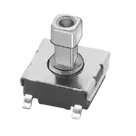
A momentary or non-latching switch which causes a temporary change in the state of an electrical circuit only while the switch is physically actuated. SWITCH TACTILE SPST-NO 0.05A 24V
Pricing & Availability
Distributor | Qty 1 |
|---|
Assets
SW_SPST_Omron_B3FS-105xP.step
3D_SW_SPST_Omron_B3FS-105xP
push-button-closed
push-button-closed
B3FS-1050P-thumb.png
B3FS-1050P-thumbThumbnail
push-button-open
push-button-openDefaultkicad_mod
SW_SPST_Omron_B3FS-105xP.kicad_mod
SW_SPST_Omron_B3FS-105xPFootprintControls
Welcome 👋
Flux accelerates your PCB design with AI.
Create your account to start using this component and bring your ideas to life.
alrivera
copilot
- Incomplete Circuit: The project only has two pins (P1 and P2) with unspecified functions. There are no connections or components other than the push button.
- Designator Prefix Misused: The designator prefix is usually used to standardize component labels (e.g., SW1, SW2 for switches). You might want to correct the designator prefix for better clarity.
- Manufacturer Information: You mentioned the manufacturer "OMRON" with the value
Recommendations:1, but there's no further context or component selection from OMRON.- Define Component Functions: Clearly define what P1 and P2 represent. Typically, a push button would have more precise pin definitions and connections (e.g., connect to a microcontroller input, a resistor, and ground).
- Basic Schematic: Create a basic circuit using the push button. For example, connect it to a microcontroller or another part of your schematic:
- Connect P1 to one terminal of the switch.
- Connect P2 to the other terminal of the switch.
- Optionally, add pull-up or pull-down resistors to ensure there is a defined logic level when the button is not pressed.
Example Schematic:-
Push Button (Assume P1 and P2 are linked to the switch terminals):
- Connect P1 to a resistor R1:1.
- Connect R1:2 to the ground.
- Connect P2 to an input pin of a microcontroller MCU:PIN.
-
Components to consider:
- Resistor R1: A typical pull-down resistor value might be 10kΩ.
- Microcontroller MCU: For illustration, let's assume a pin (e.g., PIN) on a microcontroller.
Updated Connections: