PCB Manufacturing Quote Inquiry
Worked for 2 mins 55 sec
I generated a bare-PCB fabrication quote for 5 boards, using the detected board specs: 100 × 90 mm, 4-layer FR4, 1.6 mm, green solder mask, HASL, no assembly.
Table
| Manufacturer | PCB Price | Cheapest Shipping | Est. Total | Lead Time |
|---|---|---|---|---|
| JLCPCB | $2.00 | $8.63–$9.03 | ~$10.63–$11.03 | PCB: 2–4 days; shipping: 8–13 days |
| Aisler | $79.75 | $5.50 | ~$85.25 | PCB: 10–15 days; shipping: 3–7 days |
| OSH Park | $279.00 | Free | $279.00 | PCB: 9–14 days; shipping: 2–5 days |
| PCBWay | $298.20 | $5.00 | $303.20 | PCB: 8–9 days; shipping: 15–25 days |
Best value: JLCPCB is the clear cheapest option for this board.
Open item: this quote is for bare PCBs only; assembly was not included. If you want, I can also quote assembled boards using the BOM and pick-and-place data.
Open item: this quote is for bare PCBs only; assembly was not included. If you want, I can also quote assembled boards using the BOM and pick-and-place data.
Quote assembly and exports
Quote assembled boards
Export Gerbers
Run final DRC
Check assembly risks
Refine this doc
Ask about this doc
README
High-Fidelity Class-D Audio Amplifier
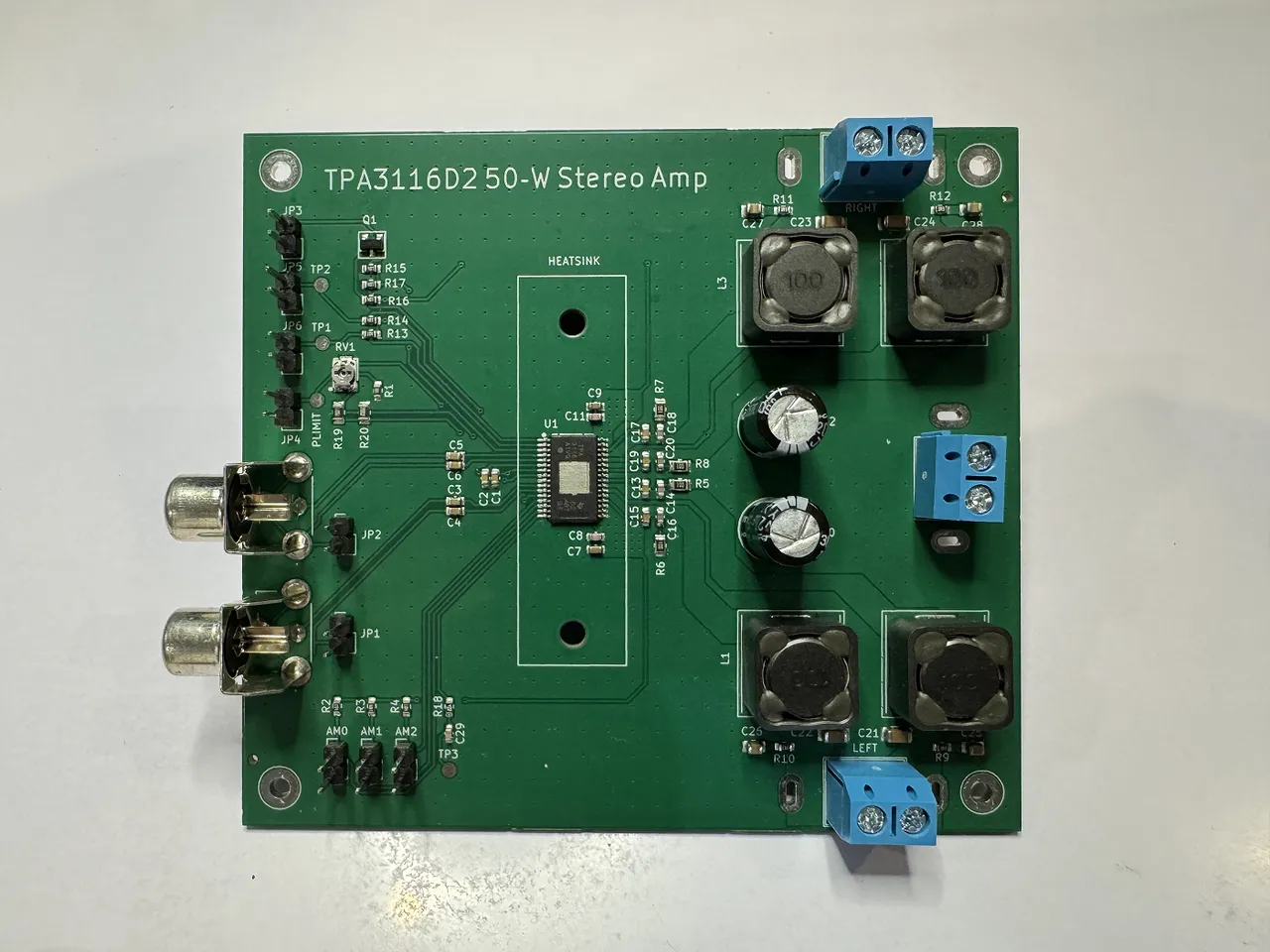
A compact 50 W stereo / 100 W mono Class-D amplifier board built around the TI TPA3116D2DAD, equipped with SpeakerGuard™
Image
Table
| 3D printed | Top lid cover | Body |
|---|---|---|
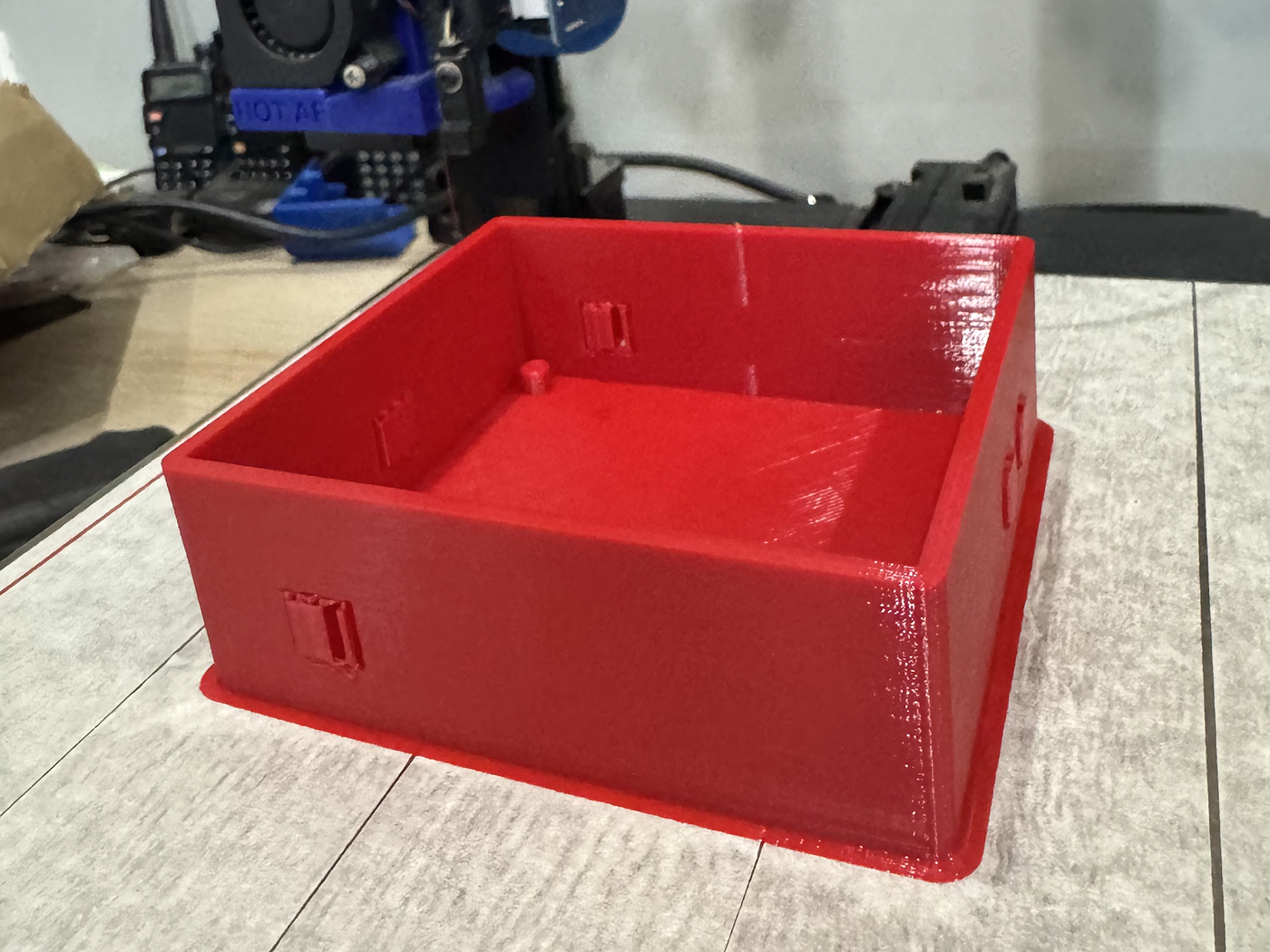 Image | 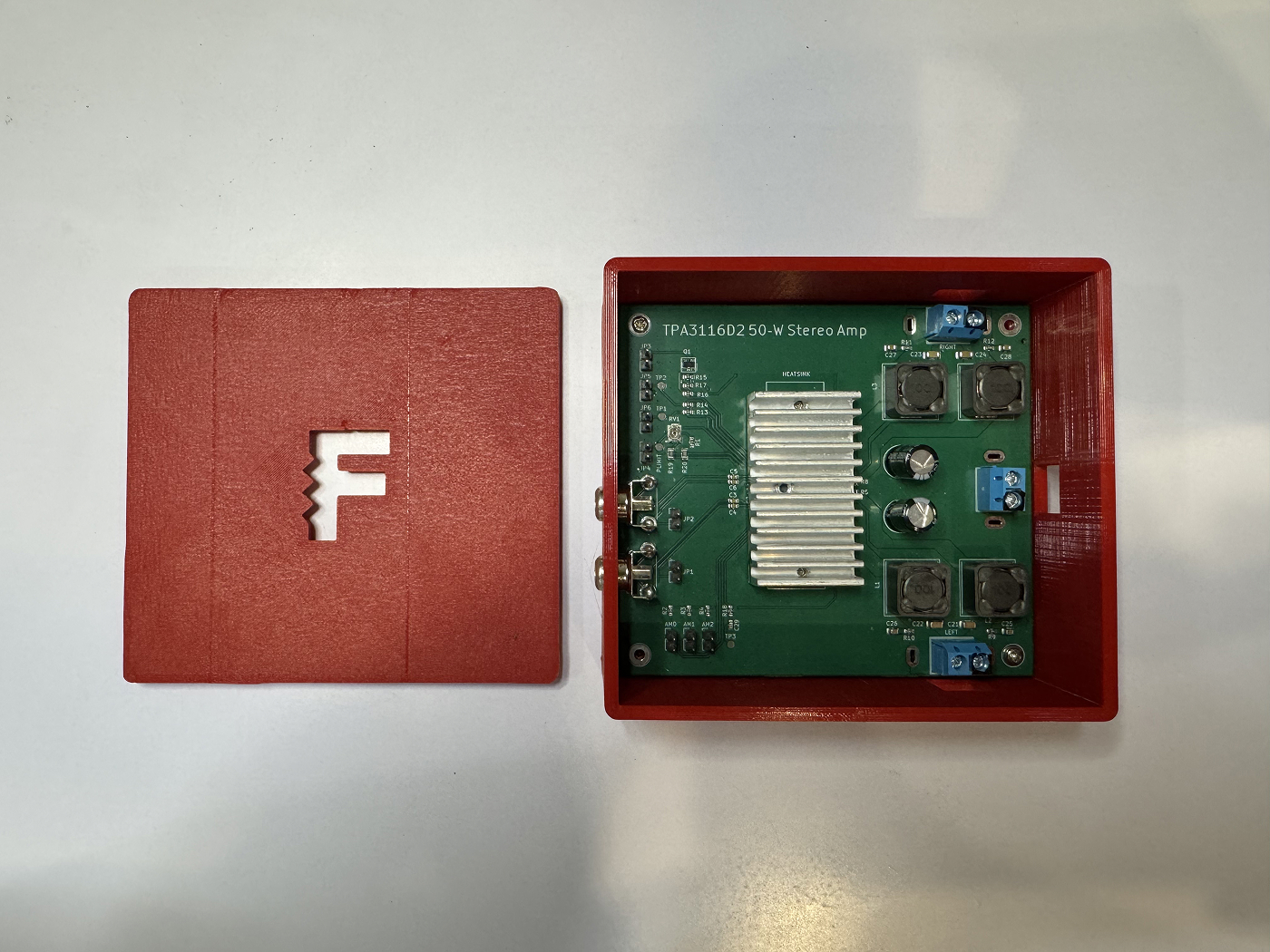 Image | 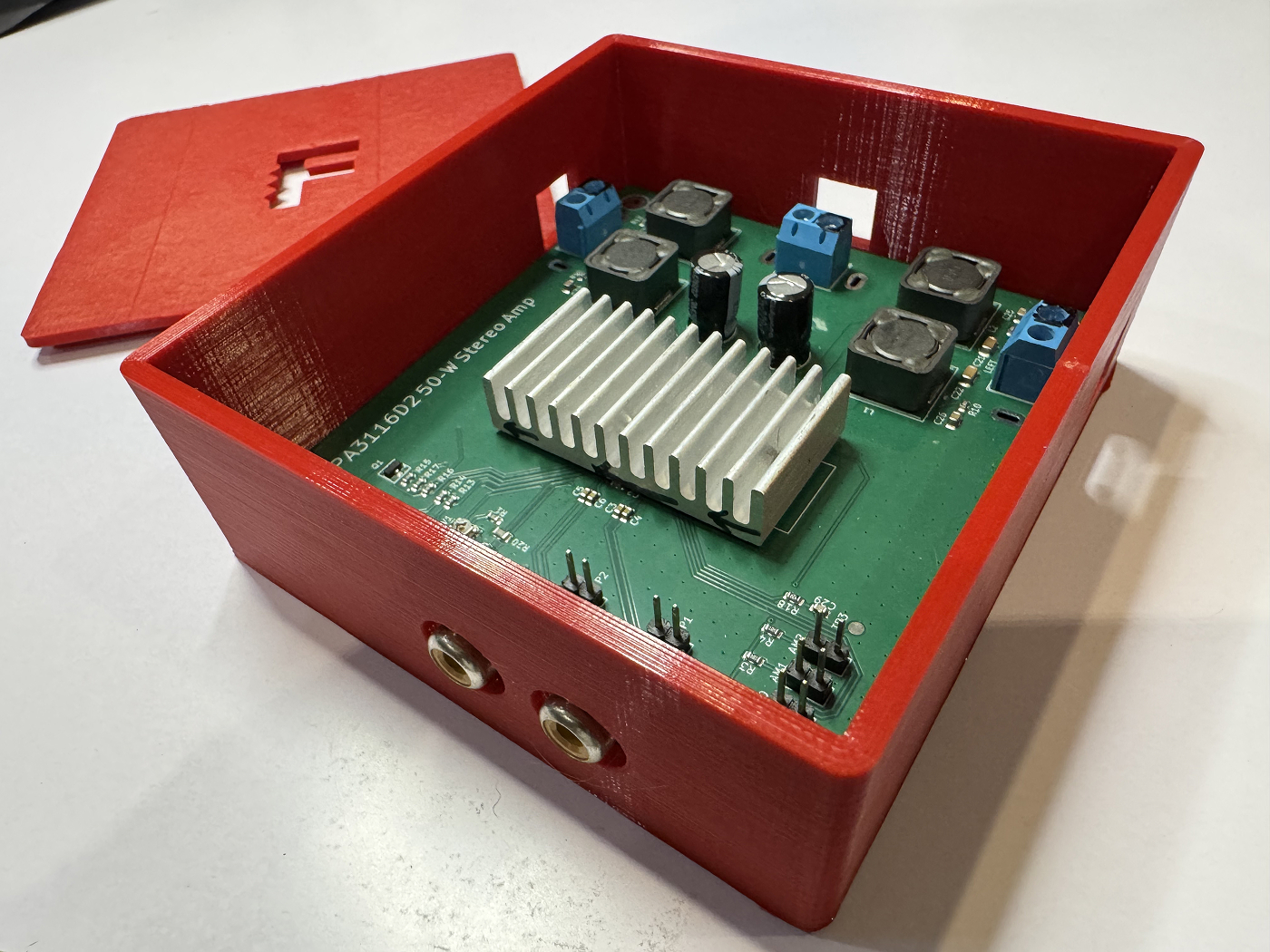 Image |
What it is?
This is a PCB-level Class-D audio amplifier design with:
- Analog stereo RCA inputs for left and right audio
- Bridge-tied speaker outputs through screw terminal blocks
- External PVCC power input through a terminal block
- LC output filtering on all four half-bridge outputs
- Snubber networks to tame switching-edge ringing
- SpeakerGuard™ DC protection — the TPA3116D2DAD monitors the output for DC faults and shuts down automatically before a DC condition can damage the connected speaker — no external relay or protection circuit needed
- Bulk and local supply capacitance around the amplifier power rail
- Bootstrap capacitors for the Class-D high-side switching stages
- Mode/configuration jumpers for gain, modulation, mute/shutdown, and mono/stereo-related behavior
- Fault / control signals broken out in the schematic for experimentation and debugging
- Mounting holes and enclosure-minded geometry so it can become a finished object, not just a bare board
At the center stage is U1: TPA3116D2DAD, a TI stereo Class-D amplifier IC. Around it are the parts that make a Class-D amp behave like an audio product instead of a noisy power switch: input coupling, output inductors, output capacitors, bootstrap caps, decoupling, snubbers, and configuration resistors/jumpers. Why TPA3116DAD? →
Why I built this?
Most audio amplifier modules you find online are black boxes. They work, but you have no idea why, and there's nowhere to go when you want to change something. I wanted the opposite of that.
This is a practical, high-power, analog-input Class-D amplifier, small enough for a desktop enclosure, capable enough to drive real passive speakers from a phone, DAC, computer, mixer, or preamp. Default configuration is 50W stereo. Push it into mono/PBTL mode and you have a single high-headroom channel when you need the extra muscle.
The design is intentionally open. Tweak the gain, rework the input network, rethink the speaker terminals, design your own thermal strategy, build your own front panel. Push it further by integrating a Bluetooth module and you have a wireless speaker. Add a microphone array with a wake-word processor and you're in Amazon Echo Dot territory — a proper voice-controlled room speaker you built yourself.
The TPA3116D2DAD is well-documented, widely available, and cheap enough. That makes it a good foundation for something you'll actually finish.
For the hardcore EE audio folks: yes, there's a block diagram. I know you physically cannot evaluate a design until you've seen at least three boxes and some arrows. 😂
Want to remix this?
The board works. Here's where I'd take it further.
- Bluetooth version — integrate a Bluetooth audio module directly on the board. No dongle, no adapter, just pair and play.
- Voice assistant version — add a microphone array and wake-word processor. A self-contained Echo Dot alternative you built and actually understand.
- Balanced input version — replace the RCA input with differential input conditioning for cleaner signal handling in noisier environments like a desk with a PC or a studio rack.
- Compact embedded version — shrink the board, edge-align the connectors, and optimize for dropping directly into a powered speaker cabinet.
Take a big leap from what's already here. That's the point.
Fork it and make it yours → Break it and learn something.
Who this is for?
This project is for people who like audio hardware enough to want to touch the circuit: builders, students, hackers, speaker tinkerers, enclosure designers, and anyone who has looked at a cheap Class-D module and thought, “I want to understand and modify that.”
It is not meant to be the final word in audiophile amplifier design. It is meant to be a strong starting point: readable, forkable, and opinionated enough to invite changes.
If you remix it, I would love to see versions with cleaner enclosure integration, different input options, more formal measurement data, better thermal characterization, or a production-friendly BOM. The fun part of this project is that the core amplifier is already capable — the remix space is everything around it.
📈 Simulation and validation
Why the TPA3116D2DAD
The TPA3116D2DAD was selected as the best overall amplifier IC choice from the evaluated candidates because it provides the most complete set of built-in device and speaker protection features among the parts compared, while also being available at low cost through JLCPCB/LCSC and mainstream distributors.
Input, Output, and Jumpers
Safety and power handling notes
How can I manufacturer this?
Work-in-progress
Project status

This is a working hardware design direction centered on Class-D amplifier topology. The schematic includes the main amplifier, analog inputs, output filtering, snubbers, configuration jumpers, power input, and speaker outputs. The next best community contribution would be clearer configuration documentation, validated mono-mode instructions, test data, and a polished enclosure build.
Fork it, label it, measure it, break it carefully, and make it louder.
High-Fidelity Class-D Audio Amplifier
What it is?
Why I built this?
Want to remix this?
Who this is for?
📈 Simulation and validation
Why the TPA3116D2DAD
Input, Output, and Jumpers
Safety and power handling notes
How can I manufacturer this?
Project status