Chat
Welcome to Flux
Treat Flux like your intern. Tell it what you'd like to build and it'll get to work. You can also ask it questions, brainstorm ideas, and teach it your preferences. Learn More
Explain project
Write a project description
Find schematic issues
Create a test plan
Simulate a circuit
Prepare for Manufacturing
Component Selection Workflow
New Subsystem Wizard
Write I2C initialization code
Generate firmware skeleton
please explain what U3 does.

1y
The component with the designator U3 is a PIR203A-D0, a passive infrared (PIR) sensor. Here’s how it functions within your project:
- Purpose: The PIR sensor detects motion by measuring changes in infrared radiation, which are emitted by objects in its field of view.
- Operation: When a moving object, particularly a warm body like a human, enters its sensing area, the infrared radiation level changes. The PIR sensor outputs a digital signal indicating motion detection.
- Pins:
- D (Pin 1): This is the digital output pin where the sensor sends a voltage signal high when motion is detected.
- S (Pin 2): Typically connected to the power source (VCC) for the sensor.
- G (Pin 3): Ground connection for the sensor.
In summary, U3 is essential for detecting motion and triggering the camera module in your project. If you have more questions or need further assistance, feel free to ask!
1y
4
please explain what U2 does.
1y
In your project, the component with the designator U2 is an HC-SR501, which is a Passive Infrared (PIR) sensor module. Here's what it does:
-
Motion Detection: The HC-SR501 detects movement based on changes in infrared radiation. When a living being, such as a person or an animal, moves within its field of view, the sensor detects this change and outputs a signal.
-
Signal Output: The sensor has a "Data" pin that outputs a high signal when motion is detected. This can be used to trigger other components in the circuit, such as turning on a camera or lighting up an LED.
-
Power Supply: U2 requires a power supply, typically around 5V, connected to its "VCC" pin, and a ground connection to its "GND" pin.
In this specific project, the HC-SR501 likely serves to activate the camera module when it detects motion, making it a central component for motion-triggered recording or monitoring. Would you like more detailed information on how to integrate this with the rest of your circuit?
1y
1
please explain what U2 does.
1y
The component U2 is an HC-SR501 Passive Infrared (PIR) sensor module. Its primary function is to detect motion based on changes in infrared radiation. Here's a brief explanation of how it works:
-
PIR Sensor Functionality: The HC-SR501 detects motion by measuring variations in the infrared (IR) light radiating from objects in its field of view. When there is a sudden change, such as a warm body moving in front of it, the sensor triggers an output signal.
-
Output Signal: Upon detecting motion, the sensor typically provides a digital high signal on its output pin, which can be connected to other devices to trigger actions (e.g., turning on a light or activating a camera as in your project).
-
Power and Ground Connections: It usually requires a DC voltage to operate, around 5V to 20V, which in this case is connected through
VCC, and has aGNDpin for ground connection. -
Applications: It is commonly used in security systems, automatic lighting, and other motion detection applications.
In your project, the PIR sensor's data output would be connected to trigger the ESP32−CAM1 module to activate the camera when motion is detected. Would you like to know how to connect it to the rest of your circuit?
1y
1
No files yet
Reviews
Documents
Documents are markdown text files which describe project goals, capture details, or even simulation outputs.
Assets

WiFi Camera with Motion Detection-removebg-preview.png
WiFi Camera with Motion Detection-removebg-previewThumbnailWiFi Camera with Motion Detection Reference Design
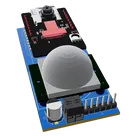
This project is a WiFi Camera with Motion Detection, utilizing ESP32-CAM module and HC-SR501 PIR sensor. The camera is activated by the sensor's output. The system also includes power regulation and communication headers for setup and control.
#WiFi #MCU #PIR #ReferenceDesign #project #ESP32 #camera #referenceDesign #edgeComputing #espressif #template #reference-design
Properties
Pricing & Availability
Distributor | Qty 1 |
|---|---|
LCSC | $8.23 |
Controls
Welcome 👋
Flux helps you build PCBs faster with an AI teammate!
Create your account to collaborate, stay updated, fork your own version, and get instant answers from our AI agent.
alanaja
copilot