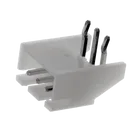
JST XH Connector Design Overview

3:18

Clarifying component design.

Understanding component linking.

Navigating linking rules.

Considering linking options.

Structuring project components and linking.

Accessing knowledge base.

Analyzing the schematic.

Reviewing the bill of materials.

Looking for "series pitch" in eXH.pdf

Looking for "rated current" in eXH.pdf

Looking for "rated voltage" in eXH.pdf

Looking for "operating temperature range" in eXH.pdf

Looking for "applicable wire" in eXH.pdf

Looking for "mating housing 3 circuits" in eXH.pdf

Looking for "S3B-XH-A footprint recommended pc board hole" in eXH.pdf

Looking for "right-angle header board edge" in eXH.pdf

Looking for "pin 1 mark" in eXH.pdf

Exploring alternative suggestions.

Project overview This project is a reusable Flux part for the JST XH family 3-circuit, right-angle, through-hole board connector S3B-XH-A(LF)(SN). It provides a schematic symbol exposing three passive pins and a PCB footprint for 2.5 mm pitch, side-entry (right-angle) board-to-wire connectivity.
Core components and how they interact
  • Symbol pins: The schematic contains three passive terminals representing connector circuits:
    • 1 (Pin 1)
    • 2 (Pin 2)
    • 3 (Pin 3)
  • Interaction: As a connector library part, it has no nets inside this project. In a host design, these pins are wired to the target signals or rails. The PCB footprint provides plated through-holes (and boss hole if applicable) to mechanically and electrically anchor the connector.
Key specifications from the datasheet The following values are taken verbatim from the official JST XH series datasheet PDF.
Key specs

Table


ParameterValue
Series pitch2.5 ±0.05 mm (series-defined; PCB layout shows 2.5 mm spacing)
Current rating3 A AC/DC (AWG #22)
Voltage rating250 V AC/DC
Operating temperature-25 C to +85 C (including temperature rise under load)
Applicable wireAWG #30 to AWG #22; insulation O.D. 0.9 mm to 1.9 mm
Mating housing (3 circuits)XHP-3
PCB hole sizes (reference)Pins: φ0.9 +0.1/0 mm; Boss: φ1.7 +0.1/0 mm
PCB hole pitch tolerance±0.05 mm; shall not accumulate (per note)
Design and implementation
  • Schematic symbol: Three passive terminals (1, 2, 3) expose the connector circuits. Pin numbering follows the datasheet convention (datasheet references “No. 1 circuit”).
  • Footprint intent: Through-hole pads at 2.5 mm pitch sized per datasheet, plus a boss hole when required by the specific header variant. The right-angle, side-entry form factor implies a board-edge setback (“dimension C” in the datasheet) to ensure the shroud clears the PCB edge.
  • Mechanical alignment: The boss hole and keepouts provide anti-rotation and insertion guidance; pad sizes and tolerances follow JST’s notes (e.g., hole pitch tolerance ±0.05 mm and non-accumulating).
Design choices, trade-offs, and optimizations
  • Right-angle THT vs vertical or SMT:
    • Pros: Excellent mechanical robustness, convenient side-entry cable, suited for hand or wave soldering.
    • Cons: Larger board-edge footprint, assembly height over board edge, not ideal for tight enclosures.
  • 2.5 mm pitch vs denser families: Good balance for up to 3 A per datasheet with AWG #22; larger than 2.0 mm families (e.g., PH) but easier to hand-assemble and more forgiving mechanically.
  • Hole sizing and tolerances: Using datasheet drill sizes and tolerance guidance improves fit across board vendors and drilling methods; consider slightly larger pin holes on hard FR-4 as JST advises.
Potential challenges and performance considerations
  • Board-edge clearance: Observe JST’s “dimension C” for side-entry headers to avoid mechanical clash with the shroud and latch features.
  • Soldering process: Through-hole parts favor wave or selective solder; ensure thermal reliefs and solder-side clearances. Avoid copper pours too close to holes to prevent wicking.
  • Current and temperature: Respect the 3 A rating (AWG #22). In high-ambient or limited airflow, derate current to maintain temperature rise within the -25 C to +85 C operating range.
  • Tolerance stack-up: Hole pitch tolerance is ±0.05 mm and must not accumulate; keep global datum references consistent to prevent fit issues.
  • Strain relief: Cables can exert side loads on right-angle headers; consider housing latch orientation and enclosure features to mitigate stress.
Real-world applications
  • Low-voltage power input (5–24 V) and distribution up to 3 A per circuit.
  • Simple sensor or peripheral harnesses where keyed, shrouded connections are preferred.
  • Field-serviceable modules that benefit from robust, widely available crimp housings like XHP-3.
Areas for improvement and future enhancements
  • Symbol and footprint clarity:
    • Add an explicit Pin 1 marker on silkscreen and assembly layers aligned with the datasheet “No. 1 circuit”.
    • Include a clear courtyard per IPC guidance to aid DFM checks.
  • Mechanical fidelity:
    • Ensure the boss hole is present and correctly located for the specific S3B-XH-A variant; add keepout behind the connector to reflect housing overhang.
    • Document and implement the board edge setback (“dimension C”) per the datasheet’s side-entry guidance.
  • Metadata and usability:
    • Add distributor links and full MPN metadata to streamline sourcing.
    • Provide a 3D model and correct height to improve enclosure checks.
  • Variants and scalability:
    • Offer alternate footprints for top-entry or SMT headers as separate parts to cover more mechanical scenarios and assembly flows.
    • Provide housing and crimp contact references in documentation so users can choose complete mating sets based on wire gauge and insulation O.D.
Notes specific to this Flux part
  • The schematic’s pin objects (1, 2, 3) are passive and un-netted here by design; connectivity is defined in the end design where the connector is used.
  • The project properties indicate “Max Current: 3A”; this matches the datasheet’s “Current rating: 3 A AC/DC (AWG #22)”. Always confirm against cable gauge and thermal environment.
If you want, I can review the footprint against the datasheet dimensions (pad drills, boss hole, and edge setback) and add silkscreen/courtyard refinements.
Review footprint dimensions
Pick mating parts
Edge clearance guidance
Silkscreen pin-1 marking
Current/temperature derating
79 days

Ready.


1
2
3


  • Ground
    A common return path for electric current. Commonly known as ground.
  • Net Portal
    Wirelessly connects nets on schematic. Used to organize schematics and separate functional blocks. To wirelessly connect net portals, give them same designator. #portal
  • Power Net Portal
    Wirelessly connects power nets on schematic. Identical to the net portal, but with a power symbol. Used to organize schematics and separate functional blocks. To wirelessly connect power net portals, give them the same designator. #portal #power
  • Generic Resistor
    A generic fixed resistor ideal for rapid circuit topology development. Its footprint automatically adapts based on the selected package case code—supporting 0402, 0603, 0805, 1203, and many other standard SMD packages, as well as axial horizontal and vertical configurations. Save precious design time by seamlessly add more information to this part (value, footprint, etc.) as it becomes available. Standard resistor values: 1.0 ohm, 10 ohm, 100 ohm, 1.0k ohm, 10k ohm, 100k ohm, 1.0M ohm 1.1 ohm, 11 ohm, 110 ohm, 1.1k ohm, 11k ohm, 110k ohm, 1.1M ohm 1.2 ohm, 12 ohm, 120 ohm, 1.2k ohm, 12k ohm, 120k ohm, 1.2M ohm 1.3 ohm, 13 ohm, 130 ohm, 1.3k ohm, 13k ohm, 130k ohm, 1.3M ohm 1.5 ohm, 15 ohm, 150 ohm, 1.5k ohm, 15k ohm, 150k ohm, 1.5M ohm 1.6 ohm, 16 ohm, 160 ohm, 1.6k ohm, 16k ohm, 160k ohm, 1.6M ohm 1.8 ohm, 18 ohm, 180 ohm, 1.8K ohm, 18k ohm, 180k ohm, 1.8M ohm 2.0 ohm, 20 ohm, 200 ohm, 2.0k ohm, 20k ohm, 200k ohm, 2.0M ohm 2.2 ohm, 22 ohm, 220 ohm, 2.2k ohm, 22k ohm, 220k ohm, 2.2M ohm 2.4 ohm, 24 ohm, 240 ohm, 2.4k ohm, 24k ohm, 240k ohm, 2.4M ohm 2.7 ohm, 27 ohm, 270 ohm, 2.7k ohm, 27k ohm, 270k ohm, 2.7M ohm 3.0 ohm, 30 ohm, 300 ohm, 3.0K ohm, 30K ohm, 300K ohm, 3.0M ohm 3.3 ohm, 33 ohm, 330 ohm, 3.3k ohm, 33k ohm, 330k ohm, 3.3M ohm 3.6 ohm, 36 ohm, 360 ohm, 3.6k ohm, 36k ohm, 360k ohm, 3.6M ohm 3.9 ohm, 39 ohm, 390 ohm, 3.9k ohm, 39k ohm, 390k ohm, 3.9M ohm 4.3 ohm, 43 ohm, 430 ohm, 4.3k ohm, 43K ohm, 430K ohm, 4.3M ohm 4.7 ohm, 47 ohm, 470 ohm, 4.7k ohm, 47k ohm, 470k ohm, 4.7M ohm 5.1 ohm, 51 ohm, 510 ohm, 5.1k ohm, 51k ohm, 510k ohm, 5.1M ohm 5.6 ohm, 56 ohm, 560 ohm, 5.6k ohm, 56k ohm, 560k ohm, 5.6M ohm 6.2 ohm, 62 ohm, 620 ohm, 6.2k ohm, 62K ohm, 620K ohm, 6.2M ohm 6.8 ohm, 68 ohm, 680 ohm, 6.8k ohm, 68k ohm, 680k ohm, 6.8M ohm 7.5 ohm, 75 ohm, 750 ohm, 7.5k ohm, 75k ohm, 750k ohm, 7.5M ohm 8.2 ohm, 82 ohm, 820 ohm, 8.2k ohm, 82k ohm, 820k ohm, 8.2M ohm 9.1 ohm, 91 ohm, 910 ohm, 9.1k ohm, 91k ohm, 910k ohm, 9.1M ohm #generics #CommonPartsLibrary
  • Generic Capacitor
    A generic fixed capacitor ideal for rapid circuit topology development. You can choose between polarized and non-polarized types, its symbol and the footprint will automatically adapt based on your selection. Supported options include standard SMD sizes for ceramic capacitors (e.g., 0402, 0603, 0805), SMD sizes for aluminum electrolytic capacitors, and through-hole footprints for polarized capacitors. Save precious design time by seamlessly add more information to this part (value, footprint, etc.) as it becomes available. Standard capacitor values: 1.0pF, 10pF, 100pF, 1000pF, 0.01uF, 0.1uF, 1.0uF, 10uF, 100uF, 1000uF, 10000uF 1.1pF, 11pF, 110pF, 1100pF 1.2pF, 12pF, 120pF, 1200pF 1.3pF, 13pF, 130pF, 1300pF 1.5pF, 15pF, 150pF, 1500pF, 0.015uF, 0.15uF, 1.5uF, 15uF, 150uF, 1500uF 1.6pF, 16pF, 160pF, 1600pF 1.8pF, 18pF, 180pF, 1800pF 2.0pF, 20pF, 200pF, 2000pF 2.2pF, 22pF, 220pF, 2200pF, 0.022uF, 0.22uF, 2.2uF, 22uF, 220uF, 2200uF 2.4pF, 24pF, 240pF, 2400pF 2.7pF, 27pF, 270pF, 2700pF 3.0pF, 30pF, 300pF, 3000pF 3.3pF, 33pF, 330pF, 3300pF, 0.033uF, 0.33uF, 3.3uF, 33uF, 330uF, 3300uF 3.6pF, 36pF, 360pF, 3600pF 3.9pF, 39pF, 390pF, 3900pF 4.3pF, 43pF, 430pF, 4300pF 4.7pF, 47pF, 470pF, 4700pF, 0.047uF, 0.47uF, 4.7uF, 47uF, 470uF, 4700uF 5.1pF, 51pF, 510pF, 5100pF 5.6pF, 56pF, 560pF, 5600pF 6.2pF, 62pF, 620pF, 6200pF 6.8pF, 68pF, 680pF, 6800pF, 0.068uF, 0.68uF, 6.8uF, 68uF, 680uF, 6800uF 7.5pF, 75pF, 750pF, 7500pF 8.2pF, 82pF, 820pF, 8200pF 9.1pF, 91pF, 910pF, 9100pF #generics #CommonPartsLibrary
  • Generic Inductor
    A generic fixed inductor suitable for rapid circuit topology development. The footprint automatically adapts based on the selected package, supporting standard SMD sizes (e.g., 0402, 0603, 0805) as well as well-known inductor packages such as SDR1806, PA4320, SRN6028, and SRR1260. Standard inductor values: 1.0 nH, 10 nH, 100 nH, 1.0 µH, 10 µH, 100 µH, 1.0 mH 1.2 nH, 12 nH, 120 nH, 1.2 µH, 12 µH, 120 µH, 1.2 mH 1.5 nH, 15 nH, 150 nH, 1.5 µH, 15 µH, 150 µH, 1.5 mH 1.8 nH, 18 nH, 180 nH, 1.8 µH, 18 µH, 180 µH, 1.8 mH 2.2 nH, 22 nH, 220 nH, 2.2 µH, 22 µH, 220 µH, 2.2 mH 2.7 nH, 27 nH, 270 nH, 2.7 µH, 27 µH, 270 µH, 2.7 mH 3.3 nH, 33 nH, 330 nH, 3.3 µH, 33 µH, 330 µH, 3.3 mH 3.9 nH, 39 nH, 390 nH, 3.9 µH, 39 µH, 390 µH, 3.9 mH 4.7 nH, 47 nH, 470 nH, 4.7 µH, 47 µH, 470 µH, 4.7 mH 5.6 nH, 56 nH, 560 nH, 5.6 µH, 56 µH, 560 µH, 5.6 mH 6.8 nH, 68 nH, 680 nH, 6.8 µH, 68 µH, 680 µH, 6.8 mH 8.2 nH, 82 nH, 820 nH, 8.2 µH, 82 µH, 820 µH, 8.2 mH #generics #CommonPartsLibrary
  • Terminal
    Terminal
    An electrical connector acting as reusable interface to a conductor and creating a point where external circuits can be connected.
  • RMCF0805JT47K0
    47 kOhms ±5% 0.125W, 1/8W Chip Resistor 0805 (2012 Metric) Automotive AEC-Q200 Thick Film #forLedBlink
  • 875105359001
    10uF Capacitor Aluminum Polymer 20% 16V SMD 5x5.3mm #forLedBlink #commonpartslibrary #capacitor #aluminumpolymer #radialcan
  • CTL1206FYW1T
    Yellow 595nm LED Indication - Discrete 1.7V 1206 (3216 Metric) #forLedBlink

S3B-XH-A(LF)(SN)

S3B-XH-A(LF)(SN) thumbnail
Connector Header Through Hole, Right Angle 3 position 0.098" (2.50mm) #commonpartslibrary #connector #tht

Properties

Connector

JST Sales America Inc.

S3B-XH-A(LF)(SN)

P

Pricing & Availability

Distributor

Qty 1

Controls