ESP32-S3 Pin Function Overview
2:51
Clarifying tool usage.
Assessing I2C requirements.
Gathering I2C pin information.
Formulating queries for I2C information.
Looking for "I2C pins supported, which GPIO can be used for I2C, IO matrix mapping, any restrictions" in esp32_s3_wroom_1_wroom_1u_datasheet_en-2930317.pdf
Looking for "Pin definitions table mentioning functions like I2C_SCL, I2C_SDA, or general statement about mapping I2C to GPIO" in esp32_s3_wroom_1_wroom_1u_datasheet_en-2930317.pdf
Looking for "Strapping pins and notes that affect I2C pin choice" in esp32_s3_wroom_1_wroom_1u_datasheet_en-2930317.pdf
Looking for "Electrical characteristics or pad capabilities related to input/output for GPIOs used with I2C" in esp32_s3_wroom_1_wroom_1u_datasheet_en-2930317.pdf
Looking for "Number of I2C controllers (I2C0/I2C1) and signal matrix routing description" in esp32_s3_wroom_1_wroom_1u_datasheet_en-2930317.pdf
Looking for "Default UART0 pins and other fixed-function pins that may conflict (e.g., USB, JTAG)" in esp32_s3_wroom_1_wroom_1u_datasheet_en-2930317.pdf
Preparing minimal response.
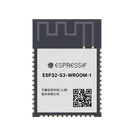
- Device: ESP32-S3-WROOM-1-N16R8
- I2C controllers: The ESP32‑S3 has two I2C bus interfaces (I2C0 and I2C1).
- Pin assignment: “For I2C, the pins used can be chosen from any GPIOs via the GPIO Matrix.”
- I2C speed: “Up to 800 kbit/s (constrained by SCL and SDA pull-up strength).”
- Strapping pins (affect boot): GPIO0 (weak pull-up), GPIO3 (floating), GPIO45 (weak pull-down), GPIO46 (weak pull-down). They can be used as normal GPIOs after reset, but avoid external circuits that fight their required levels at boot.
- Variant caveats:
- On modules with Octal SPI PSRAM, IO35/IO36/IO37 are not available for other uses.
- On some 1.8 V VDD_SPI variants, GPIO47/48 operate at 1.8 V.
- Any available GPIO on the module can be assigned as SDA or SCL via the GPIO Matrix, with the practical cautions below.
- Avoid choosing pins that conflict with other active functions in your design:
- USB Serial/JTAG or USB OTG uses GPIO19/GPIO20 when the internal PHY is enabled.
- JTAG defaults are on GPIO39–GPIO42.
- UART0 defaults to GPIO43/GPIO44 (TXD0/RXD0).
- The four strapping pins (GPIO0, GPIO3, GPIO45, GPIO46) must not be forced to the wrong level during boot.
- SDA = GPIO8
- SCL = GPIO18 These are fully supported for I2C via the GPIO Matrix and are good choices given your other peripherals.
- I2C requires external pull-up resistors on both SDA and SCL to 3.3 V. Using 4.7 kΩ is a solid starting value at 3.3 V for standard/fast mode. Example part: 4.7k Resistor.
- Place the pull-ups close to the touch controller and keep SDA/SCL short and away from the 80 MHz SPI.
- Do not load or strap GPIO3/0/45/46 in ways that alter boot.
- If you enable on-chip USB, avoid using GPIO19/20 for I2C.
- If your module variant uses Octal PSRAM, do not plan on IO35–IO37 for I2C.
Ready.
Reviews

- Wirelessly connects nets on schematic. Used to organize schematics and separate functional blocks. To wirelessly connect net portals, give them same designator. #portaljharwinbarrozo43.0M
- Wirelessly connects power nets on schematic. Identical to the net portal, but with a power symbol. Used to organize schematics and separate functional blocks. To wirelessly connect power net portals, give them the same designator. #portal #powerjharwinbarrozo11.4M
- A generic fixed resistor for rapid developing circuit topology. Save precious design time by seamlessly add more information to this part (value, footprint, etc.) as it becomes available. Standard resistor values: 1.0Ω 10Ω 100Ω 1.0kΩ 10kΩ 100kΩ 1.0MΩ 1.1Ω 11Ω 110Ω 1.1kΩ 11kΩ 110kΩ 1.1MΩ 1.2Ω 12Ω 120Ω 1.2kΩ 12kΩ 120kΩ 1.2MΩ 1.3Ω 13Ω 130Ω 1.3kΩ 13kΩ 130kΩ 1.3MΩ 1.5Ω 15Ω 150Ω 1.5kΩ 15kΩ 150kΩ 1.5MΩ 1.6Ω 16Ω 160Ω 1.6kΩ 16kΩ 160kΩ 1.6MΩ 1.8Ω 18Ω 180Ω 1.8KΩ 18kΩ 180kΩ 1.8MΩ 2.0Ω 20Ω 200Ω 2.0kΩ 20kΩ 200kΩ 2.0MΩ 2.2Ω 22Ω 220Ω 2.2kΩ 22kΩ 220kΩ 2.2MΩ 2.4Ω 24Ω 240Ω 2.4kΩ 24kΩ 240kΩ 2.4MΩ 2.7Ω 27Ω 270Ω 2.7kΩ 27kΩ 270kΩ 2.7MΩ 3.0Ω 30Ω 300Ω 3.0KΩ 30KΩ 300KΩ 3.0MΩ 3.3Ω 33Ω 330Ω 3.3kΩ 33kΩ 330kΩ 3.3MΩ 3.6Ω 36Ω 360Ω 3.6kΩ 36kΩ 360kΩ 3.6MΩ 3.9Ω 39Ω 390Ω 3.9kΩ 39kΩ 390kΩ 3.9MΩ 4.3Ω 43Ω 430Ω 4.3kΩ 43KΩ 430KΩ 4.3MΩ 4.7Ω 47Ω 470Ω 4.7kΩ 47kΩ 470kΩ 4.7MΩ 5.1Ω 51Ω 510Ω 5.1kΩ 51kΩ 510kΩ 5.1MΩ 5.6Ω 56Ω 560Ω 5.6kΩ 56kΩ 560kΩ 5.6MΩ 6.2Ω 62Ω 620Ω 6.2kΩ 62KΩ 620KΩ 6.2MΩ 6.8Ω 68Ω 680Ω 6.8kΩ 68kΩ 680kΩ 6.8MΩ 7.5Ω 75Ω 750Ω 7.5kΩ 75kΩ 750kΩ 7.5MΩ 8.2Ω 82Ω 820Ω 8.2kΩ 82kΩ 820kΩ 8.2MΩ 9.1Ω 91Ω 910Ω 9.1kΩ 91kΩ 910kΩ 9.1MΩ #generics #CommonPartsLibraryjharwinbarrozo1.5M
- A generic fixed capacitor ideal for rapid circuit topology development. You can choose between polarized and non-polarized types, its symbol and the footprint will automatically adapt based on your selection. Supported options include standard SMD sizes for ceramic capacitors (e.g., 0402, 0603, 0805), SMD sizes for aluminum electrolytic capacitors, and through-hole footprints for polarized capacitors. Save precious design time by seamlessly add more information to this part (value, footprint, etc.) as it becomes available. Standard capacitor values: 1.0pF 10pF 100pF 1000pF 0.01uF 0.1uF 1.0uF 10uF 100uF 1000uF 10,000uF 1.1pF 11pF 110pF 1100pF 1.2pF 12pF 120pF 1200pF 1.3pF 13pF 130pF 1300pF 1.5pF 15pF 150pF 1500pF 0.015uF 0.15uF 1.5uF 15uF 150uF 1500uF 1.6pF 16pF 160pF 1600pF 1.8pF 18pF 180pF 1800pF 2.0pF 20pF 200pF 2000pF 2.2pF 22pF 20pF 2200pF 0.022uF 0.22uF 2.2uF 22uF 220uF 2200uF 2.4pF 24pF 240pF 2400pF 2.7pF 27pF 270pF 2700pF 3.0pF 30pF 300pF 3000pF 3.3pF 33pF 330pF 3300pF 0.033uF 0.33uF 3.3uF 33uF 330uF 3300uF 3.6pF 36pF 360pF 3600pF 3.9pF 39pF 390pF 3900pF 4.3pF 43pF 430pF 4300pF 4.7pF 47pF 470pF 4700pF 0.047uF 0.47uF 4.7uF 47uF 470uF 4700uF 5.1pF 51pF 510pF 5100pF 5.6pF 56pF 560pF 5600pF 6.2pF 62pF 620pF 6200pF 6.8pF 68pF 680pF 6800pF 0.068uF 0.68uF 6.8uF 68uF 680uF 6800uF 7.5pF 75pF 750pF 7500pF 8.2pF 82pF 820pF 8200pF 9.1pF 91pF 910pF 9100pF #generics #CommonPartsLibraryjharwinbarrozo1.5M
- A generic fixed inductor for rapid developing circuit topology. *You can now change the footprint and 3D model at the top level anytime you want. This is the power of #genericsjharwinbarrozo15.5k
- An electrical connector acting as reusable interface to a conductor and creating a point where external circuits can be connected.Terminal
- 47 kOhms ±5% 0.125W, 1/8W Chip Resistor 0805 (2012 Metric) Automotive AEC-Q200 Thick Film #forLedBlinkjharwinbarrozo1.2M
- 10uF Capacitor Aluminum Polymer 20% 16V SMD 5x5.3mm #forLedBlink #commonpartslibrary #capacitor #aluminumpolymer #radialcanjharwinbarrozo1.2M
- Yellow 595nm LED Indication - Discrete 1.7V 1206 (3216 Metric) #forLedBlinkjharwinbarrozo1.1M


Pricing & Availability
Distributor | Qty 1 |
|---|
Assets
ESP32-S3-WROOM-1-N16R8.stp
3D_ESP32-S3-WROOM-1-N16R83D Model
ESP32-S3-WROOM-1-N16R8
ESP32-S3-WROOM-1-N16R8 Symbol.svgDefault
ESP32-S3-WROOM-1-N16R8-thumb.png
ESP32-S3-WROOM-1-N16R8-thumbThumbnailESP32S3WROOM1N16R8.kicad_mod
FP_ESP32S3WROOM1N16R8FootprintControls
Welcome 👋
Flux accelerates your PCB design with AI.
Create your account to start using this component and bring your ideas to life.