LoRa Temperature Sensor Project Details
0:25
Evaluating design and trade-offs.
This project is a reference design for a LoRa temperature sensor that gathers environmental data and sends it wirelessly over long distances. It combines low-power sensing with wireless communication and is intended for IoT applications like remote monitoring.
Key elements include:
- The main processor, U2, which handles sensor readings, signal processing, and communication tasks.
- The temperature sensor, U1, which provides accurate temperature (and likely humidity) measurements.
- The LoRa communication module, U3, which enables low-power, long-range wireless data transmission.
- A regulated power supply provided by U4, ensuring stable operation of all circuitry.
- Connectivity components like the J1 port for power and programming, alongside various passives (resistors, capacitors) that support decoupling, signal conditioning, and biasing.
The design is broken down into these steps:
-
Sensing & Processing
-
Wireless Communication
- The U3 is used to broadcast sensor data over a LoRa network. Critical design choices include ensuring low power consumption and proper RF layout to minimize interference.
-
Power Management & Connectivity
Trade-offs and design choices include using the RP2040 for its balance of performance and cost, and selecting LoRa communication to achieve extended range while maintaining low power consumption. The design also emphasizes robust grounding and decoupling strategies by including multiple ground nets and capacitor placements.
Potential challenges involve RF interference, power stability under variable conditions, and ensuring precise sensor calibration. Scaling further might involve multi-sensor arrays, enhanced power management with energy harvesting, and firmware enhancements for network robustness.
Overall, this design is well-suited for remote and distributed sensing applications in smart environments, where low power and long-range communication are critical.
Ask for schematic help
Power integrity review
RF layout considerations
Low-power optimization
Scalability and expansion
102 days
Ready.
To get started, talk to Flux or create a New Document.
Reviews
Documents
Documents are markdown text files which describe project goals, capture details, or even simulation outputs.
Assets

LoRa temperature sensor.png
LoRa temperature sensorThumbnaildxf
LoRa temperature sensor_for Mr Mo.dxf
LoRa temperature sensor_for Mr MoLoRa temperature sensor Reference Design
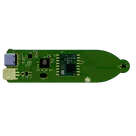
This project is a LoRa temperature sensor. It uses the RP2040 microcontroller and a SHT31 temperature sensor and also RFM95 for LoRa communication
#LoRa #referenceDesign #simple-embedded #raspberrypi #template #reference-design
Properties
Pricing & Availability
Distributor | Qty 1 |
|---|---|
Digi-Key | $3.42–$7.23 |
LCSC | $2.54–$2.66 |
Mouser | $26.30 |
Controls
Welcome 👋
Flux helps you build PCBs faster with an AI teammate!
Create your account to collaborate, stay updated, fork your own version, and get instant answers from our AI agent.