Generates both a regulated positive rail (OUT⁺) and negative rail (OUT⁻) from a single input (VIN).
Ideal when you need small bipolar supplies (e.g. ±2.5 V, ±5 V) but don’t want an inductor-based solution.
2. Key Features
Dual charge-pump architecture with internal 2 MHz oscillator and MOSFET switch array.
Adjustable outputs via external resistor dividers on FB⁺ and FB⁻ pins.
Built-in LDO regulators for low-noise, tightly regulated rails.
Power-Good (PGOOD) flag (open-drain) to indicate when both outputs are in regulation.
Shutdown pins (EN⁺, EN⁻) enable individual disabling of each pump, reducing quiescent current.
Capable of up to 250 mA per output.
3. How It Operates in the Circuit
Oscillator & Pumping Stage
A 2 MHz clock drives internal switches that shuttle charge into flying capacitors (C1+, C1–).
Switch-to-Output Stage
Pumped voltage is steered through an internal LDO stage to produce regulated OUT⁺ and OUT⁻.
Feedback & Regulation
External resistor dividers on FB⁺/FB⁻ set the exact output voltages.
The chip adjusts switch duty-cycle and LDO gate drive to maintain regulation.
Monitoring & Control
PGOOD asserts low when both rails are within regulation bands.
EN pins allow power-down or sequencing.
4. Common Applications
Hi-Fi audio headphone amplifiers (bias rails)
Op-amp power biasing in precision analog circuits
Powering data converters (ADC/DAC supply rails)
Interface supplies for mixed-signal or wireless modules
Hand-held instrumentation where ± rails are needed without large inductors
5. Notable Characteristics
High switching frequency (2 MHz) allows use of small SMD capacitors (0603/0805).
Low-ESR pump caps yield better efficiency and lower output impedance.
Exposed pad WSON package for superior thermal performance.
Wide temperature range (–40 °C to +85 °C).
6. Series & Family Context
The LM27762 belongs to TI’s family of high-frequency, dual-output charge-pump regulators.
Fixed-output variants (e.g. LM27762-5.0) provide factory-set ±5 V with no external divider.
Adjustable versions (LM27762DSSR) let you pick any ± output within the device’s range (typically ±1.5 V to ±6 V).
Key differences across the family:
Output voltage options (fixed vs. adjustable)
Maximum output current (200–300 mA)
Package styles (WSON vs. QFN)
Use-case trade-offs:
Choose fixed versions for simpler BOM when only one bipolar voltage is needed.
Choose the adjustable LM27762DSSR for flexibility in mixed-supply or multi-rail systems.
By using U5, your signal generator gains compact, inductor-less ± rails that are essential for driving the op-amps (e.g., U1–U3) and delivering clean, stable waveforms.
The feedback on the Operational Amplifier (Op-Amp) U1 is implemented through a resistor R1 and a resistor R3.
In this case, U1 is configured in a non-inverting amplifier configuration. The input signal is applied to the non-inverting input (U1:+), while the output (U1:OUTPUT) is fed back to the inverting input (U1:-) via resistors R1 and R3, forming a voltage divider.
The feedback helps to stabilize the amplifier’s gain and improve its performance. It works as follows:
The Op-Amp produces an output signal in response to the difference between its input signals.
A portion of the output signal is fed back to the inverting input via resistors R3 and R1 that act as voltage dividers, hence the name 'feedback'.
Since the feedback signal is in phase with the input, it counteracts any increase or decrease in the input signal to maintain a stable output.
This feedback configuration gives us a voltage gain of:
Gain=1+R1R3
The exact values of the resistors (R3 and R1) in the divider help define the amplifier's closed-loop gain. Thus, by adjusting R1 or R3, you can control the gain of the op-amp circuit.
Also, in this case, R1 is connected to the ground, forming negative feedback, which is essential for amplifier stability, accuracy, and predictability. Negative feedback tends to decrease the output (due to the inverse phase) and is used in most amplifiers to improve bandwidth and distortion while stabilizing the gain.
The capacitor C2, according to the netlist, is directly connected between the output (OUTPUT pin) and the inverting input (- pin) of the operational amplifier U2. This setup constitutes a feedback loop.
C2 effectively operates as an integral component of a high-pass filter which is part of the configuration of the op-amp U2. In the feedback loop of an amplifier, having a capacitor allows the circuit to preferentially amplify higher frequencies more than lower frequencies, creating a 'high-pass' effect.
The exact cut-off frequency of the high-pass filter is determined by the values of the capacitor C2 and the resistor R5, in line with the formula:
fc=2πR5C21
Where:
$f_{c} $ is the cut-off frequency,
$R5$ is the resistance connected to the capacitor in feedback loop, and
$C2$ is the capacitance value of the capacitor in the feedback loop.
In the Fourier domain, the phase of the output signal is shifted by 90 degrees by the capacitor which can be useful for specific applications where a phase shift or waveform shaping is required. However, more information about the whole circuit and its intended application is needed to say more about the exact influence and role of C2 in this circuit.
Wirelessly connects nets on schematic. Used to organize schematics and separate functional blocks. To wirelessly connect net portals, give them same designator. #portal
Wirelessly connects power nets on schematic. Identical to the net portal, but with a power symbol. Used to organize schematics and separate functional blocks. To wirelessly connect power net portals, give them the same designator. #portal #power
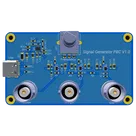
This project is a Signal Generator, designed to output waveforms such as sine, square and triangular waves. It leverages the capabilities of operational amplifiers (op-amps) like the LMV321 in combination with resistors and capacitors to shape the output signals. The design benefits from the op-amps' negative feedback to stabilize and regulate the signal output. #project#LMV321
nico
copilot