Chat
Welcome to Flux
Treat Flux like your intern. Tell it what you'd like to build and it'll get to work. You can also ask it questions, brainstorm ideas, and teach it your preferences. Learn More
Explain project
Write a project description
Find schematic issues
Create a test plan
Simulate a circuit
Prepare for Manufacturing
Component Selection Workflow
New Subsystem Wizard
recommend a replacement for Q1.

2y
For a replacement of Q1, which is designated as SIR680ADP-T1-RE3 (a Vishay model), you'll want a MOSFET that matches or exceeds the original device's specifications for your PWM controller application. The SIR680ADP-T1-RE3 is a 60V, 80A, N-Channel Power MOSFET. When looking for a replacement, consider the following specifications:
- Drain-to-Source Voltage (VDS): Equal or higher than 60V.
- Continuous Drain Current (ID): Equal or higher than 80A.
- Gate Threshold Voltage (VGS(th)): Similar to ensure compatibility with drive voltage.
- R_DS(on): As low as possible to minimize on-state losses.
- Package: Make sure the replacement fits your PCB layout, SIR680ADP-T1-RE3 is in a PowerPAK SO-8 package.
One possible replacement, considering the requirements, is the IRLB8743PbF from Infineon Technologies. Its key features include:
- Drain-to-Source Voltage (VDS): 30V (Lower than SIR680ADP but might be sufficient depending on your application's voltage requirements. If your application requires close to 60V, consider an alternative recommendation.)
- Continuous Drain Current (ID): 160A (providing ample capability for high current applications).
- R_DS(on): 4.5 mΩ (max at 10V V_GS), providing low conduction losses.
- Package: TO-220, which is different from the PowerPAK SO-8 of SIR680ADP-T1-RE3, so check if the package difference is acceptable for your layout.
If the 30V VDS of the IRLB8743PbF is not suitable due to higher voltage requirements in your project, another alternative is the IRFZ44N:
- Drain-to-Source Voltage (VDS): 55V (Closer to the original spec).
- Continuous Drain Current (ID): 49A.
- R_DS(on): 17.5 mΩ (max at 10V V_GS).
- Package: TO-220.
Each replacement option has its own advantages and trade-offs, so the final decision should be based on the specific requirements of your project, such as the maximum operating voltage and the physical layout constraints. Always cross-check the datasheet of the potential replacement to ensure it meets your circuit's requirements.
2y
Someone is typing...
5
crea un circuito de una señal pwm

1y
Para crear un circuito de señal PWM (Pulse Width Modulation), normalmente utilizamos un temporizador 555 en configuración astable. En este circuito, el ciclo de trabajo se puede ajustar utilizando un potenciómetro. Aquí tienes una descripción general para crear un circuito PWM básico:
Componentes Necesarios:
- LM555 Timer IC
- Resistor (e.g. $R_1$ = 1kΩ, $R_2$ = 10kΩ)
- Capacitor (e.g. $C_1$ = 10nF, $C_2$ = 47nF)
- Potenciómetro (e.g. $RV_1$ = 100kΩ)
- Diodos (e.g. $D_1$, $D_2$, $D_3$ = 1N4007W)
-
Conecta $IC_1$ (555 Timer) conforme a lo siguiente:
- Pin 1 (GND) a GND
- Pin 2 (TRIG) a Pin 6 (THR)
- Pin 3 (OUT) a $PWM_OUT$:P1
- Pin 4 (RESET) a VCC
- Pin 5 (CTRL) mediante un capacitor $C_1$:P2 a GND
- Pin 6 (THR) mediante $D_2$:K al potenciómetro $RV_1$ terminal medio
- Pin 7 (DISCH) al nodo entre $R_1$ y $R_2$
- Pin 8 (VCC) a VCC
-
Conecta el potenciómetro $RV_1$:
- Un terminal lateral a VCC
- Terminal opuesto a GND
-
Conecta los resistores:
- $R_1$:P1 a VCC
- $R_1$:P2 al terminal medio del potenciómetro
- $R_2$:P1 al terminal medio del potenciómetro y $D_3$:A
- $R_2$:P2 al pin 7 del 555
-
Un capacitor de desacoplo $C_2$ entre VCC y GND para suavizar posibles fluctuaciones de voltaje.
Este circuito genera una señal PWM cuya frecuencia se determina por la combinación de los valores de resistores y el condensador, mientras que se puede ajustar el ciclo de trabajo usando el potenciómetro.
Por favor, indica si deseas algún ajuste específico en el diseño o si hay alguna otra consulta que pueda ayudarte.
1y
Someone is typing...
8
https://cdn2.flux.ai/flux-comment-files/files/commentFileId-1690907a8019ec0aa743...

@copilot  https://cdn2.flux.ai/flux-comment-files/files/commentFileId-1690907a8019ec0aa7439829b3d53611fe95293cde173504fdbc6ecd1b4782aa.jpeg?GoogleAccessId=graviton-mvp%40appspot.gserviceaccount.com&Expires=4877702512&Signature=tSwMumVnRnjSDXe8Z3jddEMk2GIomL61XfmQrAqd3y%2B83j4pb%2BEotNRQUR3%2FkwR1gOMfDBQuLQQuOhmqRhjYiWxbeMTBloCocG4Ey5LWbL5UPMu5UWD0kjR7YudRauS6MRH1RKXA2pwW41iiDFrdAoLbVDZJ4g8w%2FYNCaahzGk0BlTR9A83u8bQyOnNyYaoheEsmogDGTTjjUUGDLwjm9%2B7%2F9HlzDmb79AaclpRq4oUodzAyvLXLzOQ%2B5Kdj4XmsiqclKQZrVor%2FJWsitM0HpjvWQTJtxJQwmD2iYSOmFZCrSMygioDyBhNA%2BDSZcWvvVc9V0EGl9u5Vty%2BzJCxdwQ%3D%3D
Image
1y
It seems like you've uploaded an image, but there was no accompanying question or context. How can I assist you with your Pulse Width Modulation (PWM) Controller project? Are you looking for help with a specific component, connection, or troubleshooting within Flux?
1y
Someone is typing...
7
explain this project.

@copilot why there are two diodes connected to the potentiometer with different polarization
2y
The two diodes connected to the potentiometer (RV1) with differing polarization serve a specific function in the Pulse Width Modulation (PWM) Controller circuit, mainly related to shaping and controlling the charge and discharge paths within the circuit. Let's break down their role:
- D2 (1N4007W) connected with its cathode (K) to RV1, and D3 (1N4007W) connected with its anode (A) to RV1 create alternate paths for current flow during different phases of the operation of the LM555 timer IC in the circuit.
-
Charge Phase: During the charge phase, the output of the LM555 timer (IC1:Q) is high, allowing current to flow through the charge path. D3 (1N4007W) is polarized such that its anode (A) is connected to the discharge (DIS) pin of the LM555 (IC1:DIS) via the potentiometer RV1. This allows D3 to conduct during the charge phase, providing a path for the charge current to reach the timing capacitor (C2) via the potentiometer RV1. This configuration allows the charging time (and thus, the pulse width) to be adjustable via RV1.
-
Discharge Phase: Conversely, when IC1's output (Q) goes low, it initiates the discharge phase. The discharge pin (IC1:DIS) directly connects to the timing capacitor (C2). In this phase, D2 (with its cathode to RV1) becomes forward-biased, allowing the capacitor C2 to discharge through it and the potentiometer RV1. D3 is reverse-biased in this phase and does not conduct.
-
PWM Control via Potentiometer: The use of two diodes in this manner, with one facing each direction, effectively allows the potentiometer to adjust the charge and discharge times of the timing capacitor differently. This is useful for adjusting the duty cycle of the PWM signal.
-
Protection and Directionality: Besides adjustment, these diodes also ensure current flows in the correct direction during each phase, protecting other components and preventing undesired feedback.
-
Impedance Matching: It also plays a role in matching the impedance during the charge and discharge cycles, ensuring stable operation of the timer.
By having the diodes in reverse orientations relative to each other, the circuit can utilize the varying resistance of the potentiometer to effectively manipulate both the charge and discharge times, thereby adjusting the duty cycle of the PWM output. This is critical for applications requiring precise control over the PWM signal characteristics.
2y

2y
This project is a Pulse Width Modulation (PWM) Controller, which uses an LM555 timer IC as its main component. The design is constructed to control a load, such as a motor or LED, using a MOSFET (SIR680ADP-T1-RE3). The duty cycle of the PWM signal can be adjusted using a potentiometer (P0915N-FC15BR100K).
Here are the main parts of the controller:
-
LM555 timer (IC1): It is configured in the astable mode, which allows it to produce a PWM signal. The key pins are Ground (GND), Trigger (TR), Output (Q), Reset (R), Control Voltage (CV), Threshold (THR), Discharge (DIS), and Supply voltage (VCC).
-
MOSFET (Q1): This component allows the PWM signal from the LM555 to control a larger load.
-
Potentiometer (RV1): This adjustable resistor is used to modify the duty cycle of the PWM signal, thus changing the amount of time a signal is on versus off.
-
Resistors (R1, R2, R3, R4): These are used for various functions within the circuit such as current limiting and setting the oscillation frequency of the PWM signal.
-
Capacitors (C1, C2, C3): They have various functions such as smoothing out power supply noise, and, paired with resistors, setting the frequency and duty cycle of the PWM signal.
-
Diodes (D1, D2, D3): These direct current in only one direction, and prevent it from flowing in the opposite direction.
Without knowing the exact connections of individual pins, that is a general overview of how the PWM Controller should work.
2y
Someone is typing...
2
explain this project.

@copilot explain this project.
2y
This project describes the design and components of a Pulse Width Modulation (PWM) Controller using an LM555 timer IC. Pulse Width Modulation is a technique used to encode the amplitude of a signal into the width of a series of signal pulses, effectively controlling power delivery to various types of loads. This kind of controller can be used for various applications including motor control, dimming LED lights, or controlling the heat output of heating elements.
Key Components:
-
IC1 (LM555CM): Central to the project, the LM555 timer IC is used in a configuration that generates PWM signals. It has various pins for different functions like threshold (THR), trigger (TR), discharge (DIS), control voltage (CV), reset (R), output (Q), and power supply (VCC/GND).
-
Q1 (SIR680ADP-T1-RE3): A MOSFET used to drive the load with the PWM signal generated by IC1. It acts as a switch that controls the power supplied to the load.
-
RV1 (P0915N-FC15BR100K): A potentiometer used to adjust the PWM signal's duty cycle by altering the resistance in the circuit, thus controlling the effective power delivered to the load.
-
Capacitors (C1, C2, C3): Used for various purposes including filtering and timing. C1 and C2 are smaller (10nF and 47nF respectively), likely used for timing and noise reduction, while C3 is a larger capacitor (100uF) possibly for power supply smoothing.
-
Resistors (R1, R2, R3, R4): Used to set biasing currents, timing characteristics for the PWM, and possibly for pull-up/down configurations. R1 and R2 are 1kΩ, and R3 and R4 are 10kΩ.
-
LED1: Used as an indicator, likely showing the PWM controller's operational status or PWM signal presence.
-
Diodes (D1, D2, D3): Likely used for protecting the circuit from voltage spikes, directing current flow, or as part of a freewheeling diode arrangement. All three diodes are 1N4007W types, which are general-purpose, high-voltage rectifier diodes.
-
Multiple nets define how components are interconnected, ensuring the proper flow of electrical signals and power through the circuit. Notable nets include connections for the IC1's various pins (GND, TR, Q, R, CV, THR, DIS, VCC), which are crucial for its configuration and operation as a PWM generator.
-
The project involves various nets for interconnecting components like the potentiometer (RV1) for adjusting the PWM signal, the capacitor (C1, C2, C3) and resistor networks (R1, R2, R3, R4) for timing and signal shaping, the MOSFET (Q1) for driving the load, and diodes (D1, D2, D3) for protection.
-
The project uses various designators such as PWM_OUT, VIN, LOAD+, and LOAD- for easy identification of major connection points like the PWM signal output, power input, and load connections.
-
The use of the license (Creative Commons Attribution 4.0 International License) suggests that the design is open for modification and redistribution, encouraging community sharing and iteration on this basic PWM controller design.
Overall, this project represents a fundamental but versatile PWM Controller circuit, demonstrating the essential components and configurations used in PWM signal generation and application.
2y
Someone is typing...
4
please explain what IC1 does.

Someone is typing...
6
9
https://cdn2.flux.ai/flux-comment-files/files/commentFileId-6bb69a7e732fb40a316f...
@copilot  https://cdn2.flux.ai/flux-comment-files/files/commentFileId-6bb69a7e732fb40a316fd4ace7ec8132cf727430a687e1980e10697b920dff85.jpeg?GoogleAccessId=graviton-mvp%40appspot.gserviceaccount.com&Expires=4882170783&Signature=Xnw7PKuDqXjZoVCdhuSpjefIEp1ObWlV2MgdJHSGBHscbCbx1%2FpneE7u%2BhUU8sn8P6lbtNaK9biU5hVQTeRpeWRDJxfYo7I8oxCj4aO%2FH1bBsKTgkiE4JrmKp9GeD8%2FdpNh0SQ1EA%2FX58qKFD7ek5iK37nWL308EnreXoIMb%2F1eBVVgAJlIMeDUII%2F8eTHCnuTfjY%2BKy7bwcV89ordSHXAT0CVzpZJIx%2Bz32pnll2OIsEANHO2TF2c54XfWEt4futCKLzA7fTJOVInxU6NgkWYRdZ%2FT%2BGAhZF5TXKW%2FgNiWENkc1jPP9JOb0WcE564QWu5qs50i0eLHm1i2Y2%2Fq1Tg%3D%3D
Image
1y
It looks like you have an enclosure with some rotary switches, LEDs, and what appears to be a display module and additional components. How can I assist you with your project?
1y
Someone is typing...
-Vin
C2
Not Recommended for New Designs
Capacitance
47nF
VIN
PWM_OUT
C1
Capacitance
10nF
+Vin
VIN
VIN
R3
Resistance
10kΩ
D3
C3
Capacitance
100uF
D2
IC1
Not Recommended for New Designs
Reviews
 A generic fixed inductor suitable for rapid circuit topology development. The footprint automatically adapts based on the selected package, supporting standard SMD sizes (e.g., 0402, 0603, 0805) as well as well-known inductor packages such as SDR1806, PA4320, SRN6028, and SRR1260. Standard inductor values: 1.0 nH, 10 nH, 100 nH, 1.0 µH, 10 µH, 100 µH, 1.0 mH 1.2 nH, 12 nH, 120 nH, 1.2 µH, 12 µH, 120 µH, 1.2 mH 1.5 nH, 15 nH, 150 nH, 1.5 µH, 15 µH, 150 µH, 1.5 mH 1.8 nH, 18 nH, 180 nH, 1.8 µH, 18 µH, 180 µH, 1.8 mH 2.2 nH, 22 nH, 220 nH, 2.2 µH, 22 µH, 220 µH, 2.2 mH 2.7 nH, 27 nH, 270 nH, 2.7 µH, 27 µH, 270 µH, 2.7 mH 3.3 nH, 33 nH, 330 nH, 3.3 µH, 33 µH, 330 µH, 3.3 mH 3.9 nH, 39 nH, 390 nH, 3.9 µH, 39 µH, 390 µH, 3.9 mH 4.7 nH, 47 nH, 470 nH, 4.7 µH, 47 µH, 470 µH, 4.7 mH 5.6 nH, 56 nH, 560 nH, 5.6 µH, 56 µH, 560 µH, 5.6 mH 6.8 nH, 68 nH, 680 nH, 6.8 µH, 68 µH, 680 µH, 6.8 mH 8.2 nH, 82 nH, 820 nH, 8.2 µH, 82 µH, 820 µH, 8.2 mH #generics #CommonPartsLibraryjharwinbarrozo16.5k
- A generic fixed capacitor ideal for rapid circuit topology development. You can choose between polarized and non-polarized types, its symbol and the footprint will automatically adapt based on your selection. Supported options include standard SMD sizes for ceramic capacitors (e.g., 0402, 0603, 0805), SMD sizes for aluminum electrolytic capacitors, and through-hole footprints for polarized capacitors. Save precious design time by seamlessly add more information to this part (value, footprint, etc.) as it becomes available. Standard capacitor values: 1.0pF, 10pF, 100pF, 1000pF, 0.01uF, 0.1uF, 1.0uF, 10uF, 100uF, 1000uF, 10000uF 1.1pF, 11pF, 110pF, 1100pF 1.2pF, 12pF, 120pF, 1200pF 1.3pF, 13pF, 130pF, 1300pF 1.5pF, 15pF, 150pF, 1500pF, 0.015uF, 0.15uF, 1.5uF, 15uF, 150uF, 1500uF 1.6pF, 16pF, 160pF, 1600pF 1.8pF, 18pF, 180pF, 1800pF 2.0pF, 20pF, 200pF, 2000pF 2.2pF, 22pF, 220pF, 2200pF, 0.022uF, 0.22uF, 2.2uF, 22uF, 220uF, 2200uF 2.4pF, 24pF, 240pF, 2400pF 2.7pF, 27pF, 270pF, 2700pF 3.0pF, 30pF, 300pF, 3000pF 3.3pF, 33pF, 330pF, 3300pF, 0.033uF, 0.33uF, 3.3uF, 33uF, 330uF, 3300uF 3.6pF, 36pF, 360pF, 3600pF 3.9pF, 39pF, 390pF, 3900pF 4.3pF, 43pF, 430pF, 4300pF 4.7pF, 47pF, 470pF, 4700pF, 0.047uF, 0.47uF, 4.7uF, 47uF, 470uF, 4700uF 5.1pF, 51pF, 510pF, 5100pF 5.6pF, 56pF, 560pF, 5600pF 6.2pF, 62pF, 620pF, 6200pF 6.8pF, 68pF, 680pF, 6800pF, 0.068uF, 0.68uF, 6.8uF, 68uF, 680uF, 6800uF 7.5pF, 75pF, 750pF, 7500pF 8.2pF, 82pF, 820pF, 8200pF 9.1pF, 91pF, 910pF, 9100pF #generics #CommonPartsLibraryjharwinbarrozo1.5M
- A generic fixed resistor ideal for rapid circuit topology development. Its footprint automatically adapts based on the selected package case code—supporting 0402, 0603, 0805, 1203, and many other standard SMD packages, as well as axial horizontal and vertical configurations. Save precious design time by seamlessly add more information to this part (value, footprint, etc.) as it becomes available. Standard resistor values: 1.0 ohm, 10 ohm, 100 ohm, 1.0k ohm, 10k ohm, 100k ohm, 1.0M ohm 1.1 ohm, 11 ohm, 110 ohm, 1.1k ohm, 11k ohm, 110k ohm, 1.1M ohm 1.2 ohm, 12 ohm, 120 ohm, 1.2k ohm, 12k ohm, 120k ohm, 1.2M ohm 1.3 ohm, 13 ohm, 130 ohm, 1.3k ohm, 13k ohm, 130k ohm, 1.3M ohm 1.5 ohm, 15 ohm, 150 ohm, 1.5k ohm, 15k ohm, 150k ohm, 1.5M ohm 1.6 ohm, 16 ohm, 160 ohm, 1.6k ohm, 16k ohm, 160k ohm, 1.6M ohm 1.8 ohm, 18 ohm, 180 ohm, 1.8K ohm, 18k ohm, 180k ohm, 1.8M ohm 2.0 ohm, 20 ohm, 200 ohm, 2.0k ohm, 20k ohm, 200k ohm, 2.0M ohm 2.2 ohm, 22 ohm, 220 ohm, 2.2k ohm, 22k ohm, 220k ohm, 2.2M ohm 2.4 ohm, 24 ohm, 240 ohm, 2.4k ohm, 24k ohm, 240k ohm, 2.4M ohm 2.7 ohm, 27 ohm, 270 ohm, 2.7k ohm, 27k ohm, 270k ohm, 2.7M ohm 3.0 ohm, 30 ohm, 300 ohm, 3.0K ohm, 30K ohm, 300K ohm, 3.0M ohm 3.3 ohm, 33 ohm, 330 ohm, 3.3k ohm, 33k ohm, 330k ohm, 3.3M ohm 3.6 ohm, 36 ohm, 360 ohm, 3.6k ohm, 36k ohm, 360k ohm, 3.6M ohm 3.9 ohm, 39 ohm, 390 ohm, 3.9k ohm, 39k ohm, 390k ohm, 3.9M ohm 4.3 ohm, 43 ohm, 430 ohm, 4.3k ohm, 43K ohm, 430K ohm, 4.3M ohm 4.7 ohm, 47 ohm, 470 ohm, 4.7k ohm, 47k ohm, 470k ohm, 4.7M ohm 5.1 ohm, 51 ohm, 510 ohm, 5.1k ohm, 51k ohm, 510k ohm, 5.1M ohm 5.6 ohm, 56 ohm, 560 ohm, 5.6k ohm, 56k ohm, 560k ohm, 5.6M ohm 6.2 ohm, 62 ohm, 620 ohm, 6.2k ohm, 62K ohm, 620K ohm, 6.2M ohm 6.8 ohm, 68 ohm, 680 ohm, 6.8k ohm, 68k ohm, 680k ohm, 6.8M ohm 7.5 ohm, 75 ohm, 750 ohm, 7.5k ohm, 75k ohm, 750k ohm, 7.5M ohm 8.2 ohm, 82 ohm, 820 ohm, 8.2k ohm, 82k ohm, 820k ohm, 8.2M ohm 9.1 ohm, 91 ohm, 910 ohm, 9.1k ohm, 91k ohm, 910k ohm, 9.1M ohm #generics #CommonPartsLibraryjharwinbarrozo1.5M
- An electrical connector acting as reusable interface to a conductor and creating a point where external circuits can be connected.Terminal
- Wirelessly connects nets on schematic. Used to organize schematics and separate functional blocks. To wirelessly connect net portals, give them same designator. #portaljharwinbarrozo43.0M
- General Purpose Thick Film Standard Power and High-Power Chip Resistor 47 kOhms ±5% 0.125W, 1/8W Chip Resistor 0805 (2012 Metric) Automotive AEC-Q200 Thick Film Features: - RMCF – standard power ratings - RMCP – high power ratings - Nickel barrier terminations standard - Power derating from 100% at 70ºC to zero at +155ºC - RoHS compliant, REACH compliant, and halogen free - AEC-Q200 compliantjharwinbarrozo1.2M
- 10 µF 16 V Aluminum - Polymer Capacitors Radial, Can - SMD 30mOhm 2000 Hrs @ 105°C #commonpartslibrary #capacitor #aluminumpolymer #radialcanjharwinbarrozo1.2M
- Battery Holder (Open) Coin, 20.0mm 1 Cell SMD (SMT) Tab bate or batt #forLedBlinkjharwinbarrozo700.5k


Pulse Width Modulation (PWM) Controller
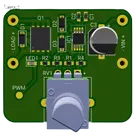
This project is a Pulse Width Modulation (PWM) Controller, built around an LM555 timer IC. It controls a load connected to a MOSFET, with adjustments via a potentiometer, and uses capacitors, resistors and diodes for various functions. #PWM #controller #project #Template #projectTemplate
Properties
Pricing & Availability
Distributor | Qty 1 |
|---|---|
Digi-Key | $3.47–$4.48 |
LCSC | $2.43–$2.80 |
Mouser | $6.00 |
Controls
Welcome 👋
Flux helps you build PCBs faster with an AI teammate!
Create your account to collaborate, stay updated, fork your own version, and get instant answers from our AI agent.
valikxd
copilot