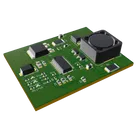
L1 Inductor Overview and Applications

1:03

General (prev)
Chat History
Project
Knowledge Base

Gathering project details.

Using Knowledge Base Tool.

Searching for datasheet details.

Based on the LTC4007 Module schematic and the Flux knowledge base guidance, here’s an overview:
1. How it Works
  • Core IC: LTC4007EGN#TRPBF controls an external n-channel MOSFET charger stage.
  • Power Path: VIN → external MOSFETs (Q2, Q3) → inductor (L1) → battery (VBAT).
  • Regulation: The PROG pin resistor sets charge current; the RT pin resistor sets switching frequency; the ITH pin network provides loop compensation.
2. Key Features
  • Input Range: Up to 36 V DC.
  • Charge Current: Programmable (typically 50 mA to several amperes) via R_PROG.
  • Multi-Cell Support: Configurable for 1 to 4 Li-ion cells in series.
  • Protections (knowledge base recommends adding these):
    • Polarity and reverse‐current blocking (internal MOSFET control + external Schottky diodes D1/D2).
    • Overvoltage, undervoltage, overcurrent, and thermal‐limit shutdown.
    • Status LEDs (LED1–LED3) indicate CHRG, FAULT, LOBAT.
3. Limitations
  • Efficiency: As a switching charger controller with external MOSFETs and inductor, overall efficiency typically 85–93%.
  • Thermal: Knowledge base notes that for high‐ambient operation, derate charge current by 20% above 85 °C.
  • Minimum Load: Requires a minimum battery voltage above 2.5 V to regulate properly.
4. Protection Schemes
  • Based on knowledge base guidance for “designing battery charger protection features”:
    • Charge current and voltage clamped by the LTC4007 and external FETs.
    • Automatic current‐limit reduces I_CHG if external MOSFETs overheat or if ambient > 125 °C.
    • Reverse discharge blocked when VIN is removed.
5. High-Temperature Operation
  • LTC4007 Recommended Operating Conditions: –40 °C to +125 °C (@file data).
  • Flux knowledge base recommends a 20% charge-current derating above 85 °C.
  • External MOSFETs (AO3400A/AO3401A) and inductor (SRR1260) maintain performance up to 125 °C.
6. Battery Compatibility
  • Supports Li-ion, LiFePO₄, NiMH, NiCd chemistries (1–4 cells in series).
  • For LiFePO₄, use 3.2 V nominal per cell (knowledge base: “battery chemistry LiFePO4”).
  • Single-cell 18650 (3.7 V nom.) is typical (knowledge base: “designing single-cell li-ion battery charger”).
7. Charge Speed & Duration
  • Charge Current = 50 µA / R_PROG (kΩ). For R_PROG = 40 kΩ, I_CHG ≈ 2 A.
  • Time to charge a 2 200 mAh cell: ∼(C / I) = 2.2 Ah / 2 A ≈ 1.1 h (not accounting for taper).
  • Knowledge base recommends accounting for tapering in final 10% of charge, adding ~20 min.
In summary, this module is a flexible, programmable multi-cell charger with robust protections, suitable for portable and industrial applications from –40 °C up to +125 °C. Its charge current and cell count are easily adjusted, making it broadly compatible with Li-ion, LiFePO₄, NiMH, and NiCd batteries.
127 days

Ready.


Would this work as an ltc3779? I need the output to be 12v

@copilot Would this work as an ltc3779? I need the output to be 12v
1y
The LTC3779 and LTC4007 serve different purposes. The LTC4007 is a lithium-ion battery charger IC, while the LTC3779 is a high-efficiency, 4-switch buck-boost DC/DC controller. It seems that you want to achieve a 12V output, which is more aligned with what the LTC3779 can provide.
If you're looking to redesign this circuit using an LTC3779 to achieve a 12V output, here are some considerations and steps you might take:
  1. Power Path: The connections will differ since the LTC3779 has different pin functionalities. You would need to connect the input voltage to its VIN and VOUT to where you need the 12V.
  2. Buck-Boost Configuration: Ensure that the inductor $L1$ and other passive components are selected to handle the currents and power levels you're targeting. The inductor value may need adjustment from 10µH.
  3. Feedback Network: Design the feedback network to set the desired output voltage. The resistors in your current design might need changing to set the output to 12V accurately.
  4. High-Frequency Operation: Ensure the appropriate compensation network if you plan to run the LTC3779 at high frequency.
  5. Protection Features: The buck-boost converter also requires appropriate layout and component selection for stability and protection, similar to your existing design.
  6. Additional Components: You may need additional MOSFETs or diodes, which are essential for the buck-boost topology in the LTC3779.
Unfortunately, simply replacing the LTC4007 with an LTC3779 wouldn't work without considerable modification since it involves different circuit designs and requirements. If you can provide more details on your input voltage and current requirements, we can explore further how to achieve your goal with the LTC3779.
1y
Someone is typing...
que es este circuito

@copilot que es este circuito
1y
Este proyecto es un circuito cargador de batería de iones de litio basado en el IC LTC4007. Este diseño incorpora MOSFETs de potencia n-channel y características de protección extensivas para condiciones de sobrecorriente, sobre voltaje, bajo voltaje y sobre temperatura. Es ideal para sistemas portátiles alimentados por batería.
Las funcionalidades clave del proyecto incluyen:
  • IC LTC4007: Este es el controlador principal para la carga de la batería, y también maneja la mayoría de las características de protección.
  • MOSFETs de potencia n-channel: Elementos clave para la conmutación de potencia en la arquitectura del cargador.
  • Diversos componentes de respaldo como resistencias y capacitores que fácilmente ajustables para cambiar las características de funcionamiento del circuito según las necesidades específicas.
Por favor, si tienes alguna pregunta específica sobre los componentes individuales o sobre cómo funciona el circuito, no dudes en preguntar!
1y
je veux la traduction française
1y
Ce projet est un circuit de chargeur de batterie lithium-ion basé sur le composant intégré (IC) LTC4007. Cette conception intègre des MOSFETs de puissance à canal N et offre des fonctionnalités étendues de protection contre les surintensités, les surtensions, les sous-tensions et les surchauffes. Elle est idéale pour des systèmes portables alimentés par batterie.
Les caractéristiques clés du projet incluent :
  • IC LTC4007 : C'est le contrôleur principal pour la charge de la batterie, qui gère également la majorité des fonctionnalités de protection.
  • MOSFETs de puissance à canal N : Éléments clés pour la commutation de puissance dans l'architecture du chargeur.
  • Divers composants de support tels que des résistances et des condensateurs, qui peuvent être facilement ajustés pour modifier les caractéristiques de fonctionnement du circuit en fonction des besoins spécifiques.
Si vous avez des questions spécifiques concernant les composants individuels ou le fonctionnement du circuit, n'hésitez pas à demander !
1y
Someone is typing...
3
CHRG
LOBAT
R3
Resistance
10k Ω
CHRG
ACP
LOBAT
FLAG
R7
Resistance
100k Ω
SHDN
FAULT
ACP
ICL
R9
Resistance
32.4k Ω
R16
Resistance
100k Ω
FAULT
FLAG
FAULT
C6
Capacitance
0.47u F
CHRG
ACP
LOBAT
FAULT
ACP


  • Ground
    A common return path for electric current. Commonly known as ground.
  • Net Portal
    Wirelessly connects nets on schematic. Used to organize schematics and separate functional blocks. To wirelessly connect net portals, give them same designator. #portal
  • Power Net Portal
    Wirelessly connects power nets on schematic. Identical to the net portal, but with a power symbol. Used to organize schematics and separate functional blocks. To wirelessly connect power net portals, give them the same designator. #portal #power
  • Generic Resistor
    A generic fixed resistor for rapid developing circuit topology. Save precious design time by seamlessly add more information to this part (value, footprint, etc.) as it becomes available. Standard resistor values: 1.0Ω 10Ω 100Ω 1.0kΩ 10kΩ 100kΩ 1.0MΩ 1.1Ω 11Ω 110Ω 1.1kΩ 11kΩ 110kΩ 1.1MΩ 1.2Ω 12Ω 120Ω 1.2kΩ 12kΩ 120kΩ 1.2MΩ 1.3Ω 13Ω 130Ω 1.3kΩ 13kΩ 130kΩ 1.3MΩ 1.5Ω 15Ω 150Ω 1.5kΩ 15kΩ 150kΩ 1.5MΩ 1.6Ω 16Ω 160Ω 1.6kΩ 16kΩ 160kΩ 1.6MΩ 1.8Ω 18Ω 180Ω 1.8KΩ 18kΩ 180kΩ 1.8MΩ 2.0Ω 20Ω 200Ω 2.0kΩ 20kΩ 200kΩ 2.0MΩ 2.2Ω 22Ω 220Ω 2.2kΩ 22kΩ 220kΩ 2.2MΩ 2.4Ω 24Ω 240Ω 2.4kΩ 24kΩ 240kΩ 2.4MΩ 2.7Ω 27Ω 270Ω 2.7kΩ 27kΩ 270kΩ 2.7MΩ 3.0Ω 30Ω 300Ω 3.0KΩ 30KΩ 300KΩ 3.0MΩ 3.3Ω 33Ω 330Ω 3.3kΩ 33kΩ 330kΩ 3.3MΩ 3.6Ω 36Ω 360Ω 3.6kΩ 36kΩ 360kΩ 3.6MΩ 3.9Ω 39Ω 390Ω 3.9kΩ 39kΩ 390kΩ 3.9MΩ 4.3Ω 43Ω 430Ω 4.3kΩ 43KΩ 430KΩ 4.3MΩ 4.7Ω 47Ω 470Ω 4.7kΩ 47kΩ 470kΩ 4.7MΩ 5.1Ω 51Ω 510Ω 5.1kΩ 51kΩ 510kΩ 5.1MΩ 5.6Ω 56Ω 560Ω 5.6kΩ 56kΩ 560kΩ 5.6MΩ 6.2Ω 62Ω 620Ω 6.2kΩ 62KΩ 620KΩ 6.2MΩ 6.8Ω 68Ω 680Ω 6.8kΩ 68kΩ 680kΩ 6.8MΩ 7.5Ω 75Ω 750Ω 7.5kΩ 75kΩ 750kΩ 7.5MΩ 8.2Ω 82Ω 820Ω 8.2kΩ 82kΩ 820kΩ 8.2MΩ 9.1Ω 91Ω 910Ω 9.1kΩ 91kΩ 910kΩ 9.1MΩ #generics #CommonPartsLibrary
  • Generic Capacitor
    A generic fixed capacitor ideal for rapid circuit topology development. You can choose between polarized and non-polarized types, its symbol and the footprint will automatically adapt based on your selection. Supported options include standard SMD sizes for ceramic capacitors (e.g., 0402, 0603, 0805), SMD sizes for aluminum electrolytic capacitors, and through-hole footprints for polarized capacitors. Save precious design time by seamlessly add more information to this part (value, footprint, etc.) as it becomes available. Standard capacitor values: 1.0pF 10pF 100pF 1000pF 0.01uF 0.1uF 1.0uF 10uF 100uF 1000uF 10,000uF 1.1pF 11pF 110pF 1100pF 1.2pF 12pF 120pF 1200pF 1.3pF 13pF 130pF 1300pF 1.5pF 15pF 150pF 1500pF 0.015uF 0.15uF 1.5uF 15uF 150uF 1500uF 1.6pF 16pF 160pF 1600pF 1.8pF 18pF 180pF 1800pF 2.0pF 20pF 200pF 2000pF 2.2pF 22pF 20pF 2200pF 0.022uF 0.22uF 2.2uF 22uF 220uF 2200uF 2.4pF 24pF 240pF 2400pF 2.7pF 27pF 270pF 2700pF 3.0pF 30pF 300pF 3000pF 3.3pF 33pF 330pF 3300pF 0.033uF 0.33uF 3.3uF 33uF 330uF 3300uF 3.6pF 36pF 360pF 3600pF 3.9pF 39pF 390pF 3900pF 4.3pF 43pF 430pF 4300pF 4.7pF 47pF 470pF 4700pF 0.047uF 0.47uF 4.7uF 47uF 470uF 4700uF 5.1pF 51pF 510pF 5100pF 5.6pF 56pF 560pF 5600pF 6.2pF 62pF 620pF 6200pF 6.8pF 68pF 680pF 6800pF 0.068uF 0.68uF 6.8uF 68uF 680uF 6800uF 7.5pF 75pF 750pF 7500pF 8.2pF 82pF 820pF 8200pF 9.1pF 91pF 910pF 9100pF #generics #CommonPartsLibrary
  • Generic Inductor
    A generic fixed inductor for rapid developing circuit topology. *You can now change the footprint and 3D model at the top level anytime you want. This is the power of #generics
  • Terminal
    Terminal
    An electrical connector acting as reusable interface to a conductor and creating a point where external circuits can be connected.
  • RMCF0805JT47K0
    47 kOhms ±5% 0.125W, 1/8W Chip Resistor 0805 (2012 Metric) Automotive AEC-Q200 Thick Film #forLedBlink
  • 875105359001
    10uF Capacitor Aluminum Polymer 20% 16V SMD 5x5.3mm #forLedBlink #commonpartslibrary #capacitor #aluminumpolymer #radialcan
  • CTL1206FYW1T
    Yellow 595nm LED Indication - Discrete 1.7V 1206 (3216 Metric) #forLedBlink

Inspect

LTC4007 Module

LTC4007 Module
Description

Created
Last updated by vasy_skral
1 Contributor(s)
vasy_skral

Controls

Availability & Pricing

DistributorQty 1
Digi-Key$6.79–$14.43
LCSC$20.58–$22.19
Mouser$12.21

Assets