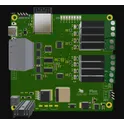
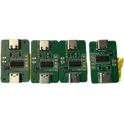
Spot the mistake! Learn how to use AI to conduct a design review on an ESP32-based control board. This project is ideal for autonomous or radio-controller robots featuring inputs for sensors, encoders, and a Flysky RC receiver, plus an I2C display for configuration.
1 Star
Humidity, Pressure, Temperature 0 ~ 100% RH I²C, SPI ±3% 1 s Surface Mount The BME280 integrates three sensors—temperature, relative humidity, and pressure—along with a high-performance digital interface. It communicates via I²C or SPI, making it easy to interface with microcontrollers like Arduino, ESP32, and STM32. It is designed for low power consumption, making it suitable for battery-powered applications such as portable weather stations and smart home devices. Key Features Environmental Sensing Measures: Temperature Relative Humidity Barometric Pressure Enables altitude estimation based on pressure readings High Accuracy Temperature: ±1.0°C (typical) Humidity: ±3% RH (typical) Pressure: ±1 hPa (typical) Low Power Consumption Typical current: ~0.6 µA (sleep mode) ~3.6 µA (measurement mode) Ideal for battery-operated devices Communication Interfaces Supports: I²C (up to 3.4 MHz) SPI (3-wire / 4-wire) Easy integration with most microcontrollers Compact Package Small footprint: 2.5 × 2.5 × 0.93 mm LGA package Suitable for space-constrained designs Built-in Features Factory-calibrated coefficients stored in NVM Configurable oversampling and filtering Integrated ADC for high-resolution measurements #commonpartslibrary #sensor #humidity #pressure
1 Star
High-level recreation of the ThirstIQ Cap wiring diagram using an ESP32-WROOM-32 with AMS1117-3.3 regulated battery input, inline ON/OFF switch, four touch input headers on IO32/IO33/IO25/IO26, shared I2C OLED and RTC on IO21/IO22, UART debug/programming header on TXD0/RXD0, BOOT and RESET pushbuttons on IO0 and EN, buzzer on IO4, common 3V3/GND distribution, and PCB preparation for a 160 mm x 100 mm 4-layer layout. Layout intent includes clean 3.3 V power distribution, local decoupling for regulator and ESP32, accessible external headers/buttons, short clean BOOT/EN traces, shared I2C routing, touch-signal separation from noisy power and buzzer traces, and ESP32 antenna keepout.
1 Star
Spot the mistake! Learn how to use AI to conduct a design review on an ESP32-based control board. This project is ideal for autonomous or radio-controller robots featuring inputs for sensors, encoders, and a Flysky RC receiver, plus an I2C display for configuration.
1 Star
Learn how to use AI Auto Layout on this ESP32 Espresso Smart Scale! In one click you’ll see AI Auto Layout perform magic. Pay close attention to how we recommend creating rulesets, zones, and fanouts. By copying the setup in this example on your own project, you’ll have a fully routed board in no time!
1 Star
This project is a reference design for an ESP32-WROOM-32E based device. It features USB-C for power and data transfer, onboard voltage regulation, and multiple peripheral connections. It also includes a CH340C for USB to serial conversion #referenceDesign #project #ESP32 #ESP32WROOM #RF #WIFI #MCU #simpleEmbedded #espressif #template
1 Star
Bluetooth RC car controller using ESP32-WROOM-32E, TB6612FNG dual H-bridge, XL4015 5V buck module, DC barrel battery input, dual 2-pin motor screw terminals, 1000uF VM bulk capacitor, 100nF decoupling, 10k EN pull-up, 30 mil power traces, 10 mil signal traces, and ESP32 antenna edge keep-out.
1 Star
This project is a reference design for an ESP32-MINI-1 based device. It features USB-C for power and data transfer, onboard voltage regulation, and multiple peripheral connections. It also includes a CH340C for USB to serial conversion #referenceDesign #project #ESP32 #ESP32MINI #RF #WIFI #MCU #referenceDesign #simple-embedded #espressif #template #reference-design #polygon
1 Star
This project is a reference design for an ESP32-WROVER-E based device. It features USB-C for power and data transfer, onboard voltage regulation, and multiple peripheral connections. It also includes a CH340C for USB to serial conversion #referenceDesign #project #ESP32 #ESP32WROVER #RF #WIFI #MCU #referenceDesign #simple-embedded #espressif #template #reference-design #polygon
1 Star
This project is a reference design for an ESP32-S2-MINI-2U based device. It features USB-C for power and data transfer, onboard voltage regulation, and multiple peripheral connections. It also includes a CH340C for USB to serial conversion #referenceDesign #project #ESP32 #ESP32S2 #RF #WIFI #MCU #referenceDesign #simple-embedded #espressif #template #reference-design
1 Star
This project is a reference design for an ESP32-WROOM-32U based device. It features USB-C for power and data transfer, onboard voltage regulation, and multiple peripheral connections. It also includes a CH340C for USB to serial conversion #referenceDesign #project #ESP32 #ESP32WROOM #RF #WIFI #MCU #referenceDesign #simple-embedded #espressif #template #reference-design
1 Star
This project uses an ESP32 microcontroller and OV2640 camera to create a WiFi-enabled digital camera. It uses AMS1117 voltage regulators to provide regulated power, a CH340C for USB communication, and includes capacitors and resistors for circuit balance. Ideal for IoT and edge computing tasks. #referenceDesign #project #ESP32 #ESP32WROVER #RF #WIFI #MCU #referenceDesign #edge-computing #edgeComputing #espressif #template #reference-design
1 Star
This project is a motherboard for the ESP32-CAM module, which enables easy and flexible WiFi camera applications. The motherboard provides power supply, programming interface, and GPIO expansion for the ESP32-CAM. It also supports external sensors for more functionality. #motherboard #WiFi #MCU #ReferenceDesign #project #ESP32 #camera #referenceDesign #edgeComputing #espressif #template #reference-design
1 Star
Compact 2-Layer ESP32-WROOM-32E Ultrasonic Emitter Board with USB-C Auto-Programming, On-Board 12 V→3.3 V Buck (3V3 trunk at 24 mil, capacitors clustered at distribution node, COUT placed adjacent to U3), 3× Low-Side MOSFET Drivers, Optional U.FL Antenna, ESD/TVS Protection, RF/Power Partitioning, and Named Nets (PWR_12V_IN, 3V3, GND, DRV_CH1/2/3, LED_PWR/LED_NET/LED_EMIT) #ultrasonic #ESP32 #RFDesign #PowerDesign #PCBDesign
1 Star
Learn how to use AI Auto Layout on this ESP32 Espresso Smart Scale! In one click you’ll see AI Auto Layout perform magic. Pay close attention to how we recommend creating rulesets, zones, and fanouts. By copying the setup in this example on your own project, you’ll have a fully routed board in no time!
1 Star
Learn how to use AI Auto Layout on this ESP32 Espresso Smart Scale! In one click you’ll see AI Auto Layout perform magic. Pay close attention to how we recommend creating rulesets, zones, and fanouts. By copying the setup in this example on your own project, you’ll have a fully routed board in no time!
1 Star
Spot the mistake! Learn how to use AI to conduct a design review on an ESP32-based control board. This project is ideal for autonomous or radio-controller robots featuring inputs for sensors, encoders, and a Flysky RC receiver, plus an I2C display for configuration.
1 Star
Learn how to use AI Auto Layout on this ESP32 Espresso Smart Scale! In one click you’ll see AI Auto Layout perform magic. Pay close attention to how we recommend creating rulesets, zones, and fanouts. By copying the setup in this example on your own project, you’ll have a fully routed board in no time!
1 Star
This project is a plant care system that uses an ESP32-S3-MINI-1U-N8 microcontroller to automate plant care tasks. This system includes three Songle relays, multiple resistors, capacitors, and transistors, all powered at 3.3V, 5V, or 12V. It also incorporates a USB Type-C connector. #referenceDesign #edge-computing #edgeComputing #espressif #template #iot #ESP32 #relay #reference-design
1 Star
Learn how to use AI Auto Layout on this ESP32 Espresso Smart Scale! In one click you’ll see AI Auto Layout perform magic. Pay close attention to how we recommend creating rulesets, zones, and fanouts. By copying the setup in this example on your own project, you’ll have a fully routed board in no time!
1 Star
This LED driver board is a compact yet powerful solution supporting both 5V and 12V LED strips, including popular addressable RGB LEDs such as NeoPixel WS2812, WS2813, WS2815. Compatible with all XIAO boards, it enables smart control and automation through WLED and Home Assistant when using XIAO ESP32 Series, while offering flexible power options and comprehensive protection for safe, reliable operation in your lighting setup.
1 Star
Proyecto de riego automatico, utilizando un esp32, con conexión wifi, toma de temperatura ambiente y humedad ambiente con un densor modelo DH. Varias tomas (3) de la humedad de la tierra mediante un sensor capacitivo, Salida para activar tres electrovalvulas de 12 voltios. Alimentación o por baterías o por paneles solares
1 Star
Spot the mistake! Learn how to use AI to conduct a design review on an ESP32-based control board. This project is ideal for autonomous or radio-controller robots featuring inputs for sensors, encoders, and a Flysky RC receiver, plus an I2C display for configuration.
1 Star
Learn how to use AI Auto Layout on this ESP32 Espresso Smart Scale! In one click you’ll see AI Auto Layout perform magic. Pay close attention to how we recommend creating rulesets, zones, and fanouts. By copying the setup in this example on your own project, you’ll have a fully routed board in no time!
1 Star
This project is a reference design for an ESP32-WROOM-32E based device. It features USB-C for power and data transfer, onboard voltage regulation, and multiple peripheral connections. It also includes a CH340C for USB to serial conversion #referenceDesign #project #ESP32 #ESP32WROOM #RF #WIFI #MCU #referenceDesign #simple-embedded #espressif #template #reference-design
1 Star
Learn how to use AI Auto Layout on this ESP32 Espresso Smart Scale! In one click you’ll see AI Auto Layout perform magic. Pay close attention to how we recommend creating rulesets, zones, and fanouts. By copying the setup in this example on your own project, you’ll have a fully routed board in no time!
1 Star
Spot the mistake! Learn how to use AI to conduct a design review on an ESP32-based control board. This project is ideal for autonomous or radio-controller robots featuring inputs for sensors, encoders, and a Flysky RC receiver, plus an I2C display for configuration.
1 Star