Switches
A switch is a device that allows electricity to flow through a circuit by completing or interrupting the connection. It is a common component in electrical and electronic systems and is used in a variety of applications, such as controlling the flow of electricity in a circuit, turning devices on and off, and routing electrical signals. One of the primary use cases for switches is to control the flow of electricity in a circuit. This can be done by manually flipping the switch or by using a control mechanism, such as a timer or a sensor. Another common use for switches is to turn devices on and off. This can be done using a switch that is built into the device or by using a separate switch that is connected to the device. In addition to these basic use cases, switches can also be used to route electrical signals. For example, a switch can be used to route a signal from one device to another or to direct a signal to a specific circuit or component. If you're looking for a wide variety of switches for your projects, flux.ai has the world's largest community-driven public library of them. The library includes footprints, symbols, datasheets, and simulation models for a wide range of switches, making it easy to find the right switch for your needs.
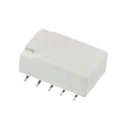
TQ2SA-L2-3V-Z
Flat, 5 mm 2 Form C, 2 A, relays Telecom Relay DPDT (2 Form C) Surface Mount The TQ2SA-L2-3V-Z is a compact surface-mount DPDT (2 Form C) telecom/signal relay from Panasonic Industry designed for low-power switching applications. It features a dual-coil latching mechanism, allowing the relay to maintain its state without continuous coil power, making it suitable for battery-powered and energy-efficient systems. This relay is commonly used in telecommunications equipment, industrial controls, measurement devices, and embedded electronic systems. Key Features DPDT (2 Form C) contact configuration 3V DC dual-coil latching relay Low power consumption: approximately 140 mW Compact SMD package: only 5.6 mm height Surface-mount gull-wing terminals Sealed construction for automatic washing compatibility High switching capability: up to 2 A Wide switching voltage range: up to 125 VAC / 220 VDC Fast operate/release time: approx. 4 ms High dielectric strength and surge resistance Wide operating temperature: −40°C to +85°C Gold-clad AgNi contacts for reliable low-level signal switching Tape-and-reel packaging (“Z” suffix) for automated assembly #CommonPartsLibrary #relay
3 Uses0 StarsLMR33630-Q1
3.8-V to 36-V, 3-A synchronous step-down voltage converter Buck Switching Regulator IC Positive Adjustable 1V 1 Output 3A 12-PowerVFQFN The LMR33630-Q1 automotive-qualified regulator is an easy-to-use, synchronous, step-down DC/DC converter that delivers best-in-class efficiency for rugged applications. The LMR33630-Q1 drives up to 3 A of load current from an input of up to 36 V. The LMR33630-Q1 provides high light load efficiency and output accuracy in a very small solution size. Features such as a power-good flag and precision enable provide both flexible and easy-touse solutions for a wide range of applications. The LMR33630-Q1 automatically folds back frequency at light load to improve efficiency. Integration eliminates most external components and provides a pinout designed for simple PCB layout. Protection features include thermal shutdown, input undervoltage lockout, cycle-by-cycle current limit, and hiccup short-circuit protection. The LMR33630-Q1 is available in a 12-pin 3 mm × 2 mm next generation VQFN package with wettable flanks • AEC-Q100 qualified for automotive applications: – Temperature grade 1: –40°C to +125°C, TA • Functional Safety-Capable – Documentation available to aid functional safety system design • Configured for rugged automotive applications – Input voltage range: 3.8 V to 36 V – Output voltage range: 1 V to 24 V – Output current: 3 A – 75-mΩ/50-mΩ RDS-ON power MOSFETs – Peak-current-mode control – Short minimum on-time of 68 ns – Frequency: 400 kHz, 1.4 MHz, 2.1 MHz – Integrated compensation network • Low EMI and switching noise – HotRod™ package – Parallel input current paths • High power conversion at all loads – Peak efficiency > 95% – Low shutdown quiescent current of 5 µA – Low operating quiescent current of 25 µA #CommonPartsLibrary #IntegratedCircuit #PowerManagement #LMR33630
277 Uses0 StarsMAX77960EFV06+
- Converter, Battery Powered Devices Voltage Regulator IC 1 Output 30-FC2QFN (4x4) The MAX77960EFV06+ is a fully integrated switching charger and power management IC that supports both step-up (boost) and step-down (buck) operation, making it suitable for USB-C PD applications where input voltage can be higher or lower than the battery voltage. It includes an internal Smart Power Selector™, which intelligently manages power flow between the input source, battery, and system load, enabling smooth system startup even with deeply discharged batteries. This device is widely used in portable electronics, battery-powered systems, drones, cameras, and USB-C PD devices requiring high power efficiency and compact design. Key Features Power & Electrical Specs Input voltage range: 3.5 V to 25.4 V High-efficiency buck-boost operation (up to ~97% peak efficiency) Programmable charging current: 100 mA to 3.15 A (MAX77960 version) Supports 2-cell and 3-cell Li-ion battery charging #CommonPartsLibrary #IntegratedCircuit #PowerManagement
0 Uses0 StarsBQ25792RQMR
Charger IC Lithium Ion/Polymer 29-VQFN-HR (4x4) The BQ25792 is a switch-mode synchronous buck-boost charger with full power-path management. It can automatically regulate power flow between the input source, system load, and battery. It supports a wide input range and is designed for USB Type-C™ / USB Power Delivery (USB-PD) systems, enabling both charging and OTG (power output from battery) operation. ⭐ Key Features ⚡ High-performance charging Up to 5 A charge current Supports 1S to 4S battery packs High efficiency (up to ~96% under typical conditions) Programmable switching frequency: 750 kHz or 1.5 MHz 🔋 Wide input support Input voltage range: 3.6 V to 24 V Absolute max rating up to 30 V Supports USB adapters and barrel jack sources Detects USB charging standards (BC1.2, DCP, CDP, HVDCP, etc.) 🔄 Buck-boost power conversion Seamless buck, boost, and buck-boost operation Maintains stable system voltage even when battery is low or input varies 🔌 USB-PD / OTG support USB Power Delivery (PD 3.0 compatible) Supports OTG output (battery powers USB port) OTG voltage range: 2.8 V to 22 V 🧠 Intelligent power management NVDC power path management (system can run without battery) Dual-input power mux controller (select between two power sources) Battery supplement mode (prevents input overload) 📊 Monitoring & control Integrated 16-bit ADC for voltage, current, temperature monitoring Fully I²C configurable Autonomous or host-controlled operation 🛡️ Protection & safety Input and battery over-voltage/over-current protection Thermal regulation and shutdown Charging safety timer MOSFET protection (internal switching FETs included) 📦 Package 29-pin VQFN (4 mm × 4 mm) package Industrial temperature range: -40°C to 85°C #CommonPartsLibrary #IntegratedCircuit #PowerManagement #Battery-charger
27 Uses0 StarsLM51772RHAR
Buck-Boost Regulator Positive Output Step-Up/Step-Down I2C DC-DC Controller IC 40-VQFN (6x6) The LM51772RHAR is a high-performance multi-phase bidirectional buck-boost controller designed for power conversion systems requiring efficient energy transfer between two voltage domains. The device supports seamless operation in both step-up and step-down modes and is optimized for battery-powered, automotive, industrial, and energy storage applications. The controller enables bidirectional current flow, making it suitable for battery charging, backup power systems, supercapacitor management, and high-power USB Type-C power delivery applications. The device integrates advanced control architecture for high efficiency across a wide operating range while supporting programmable current regulation, voltage regulation, and protection features. Multi-phase capability allows reduced input and output ripple currents, improved thermal distribution, and higher overall power capability. The controller supports external MOSFETs for scalable power design flexibility and includes comprehensive monitoring and fault management functions. The LM51772RHAR is designed for operation in demanding environments with robust protection features including overvoltage protection, undervoltage lockout, cycle-by-cycle current limiting, thermal shutdown, and fault reporting. Its flexible configuration and high integration level reduce external component count and simplify implementation in high-density power systems. Key Features Bidirectional synchronous buck-boost controller architecture Supports power transfer in both forward and reverse directions Multi-phase operation for increased power capability and reduced ripple Wide input and output voltage operating range High-efficiency synchronous control using external MOSFETs Programmable current and voltage regulation Peak and average current control capability Seamless transition between buck, boost, and buck-boost operating modes Integrated current sensing support Programmable switching frequency synchronization Phase interleaving support for thermal and ripple optimization External clock synchronization capability Soft-start and controlled startup sequencing Comprehensive fault detection and protection functions Overcurrent protection and short-circuit protection Overvoltage and undervoltage protection Thermal shutdown protection Fault status reporting and system monitoring support Designed for automotive and industrial power applications Compact thermally enhanced package Typical Applications Bidirectional battery charging systems Energy storage systems Automotive dual-battery architectures USB Type-C Power Delivery systems Backup power and UPS systems Supercapacitor charging and balancing Industrial DC power conversion Renewable energy power management High-power portable electronics Telecom and server power systems Electrical Characteristics Wide operating supply voltage range High switching frequency operation capability High-current multi-phase scalability Precision current regulation accuracy Low standby power consumption High-efficiency synchronous rectification support Programmable dead-time and switching parameters Stable operation across wide temperature range Package Information Package Type: VQFN Package Suffix: RHA Thermally enhanced exposed pad package Surface-mount implementation Suitable for automated assembly processes #commonpartslibrary #integratedcircuit #powermanagement #buckboost #dcdcswitchingcontrollers
19 Uses0 StarsMAX77958EWV+
Mobile Communications PMIC 30-WLP (2.62x3.07) The MAX77958EWV+ is a highly integrated USB Type-C and USB Power Delivery (USB PD) controller designed for portable and battery-powered electronic systems. Manufactured by Analog Devices/Maxim Integrated, the device provides complete USB Type-C Configuration Channel (CC) detection, USB PD protocol management, and power path control functionality within a compact wafer-level package. It is optimized for applications requiring flexible USB charging, power negotiation, and accessory support while minimizing external component count and system complexity. The device integrates a USB Type-C Port Controller (TCPC), Power Delivery Policy Engine, BC1.2 charger detection, VCONN management, dead battery support, and integrated protection features. It supports both sink and dual-role power operation, enabling intelligent power negotiation between connected devices and external power adapters. The controller communicates with the host processor through an I²C interface, allowing firmware-based configuration and monitoring. The MAX77958EWV+ is intended for smartphones, tablets, wearable devices, portable computing platforms, docking stations, embedded systems, and other USB Type-C enabled consumer electronics requiring reliable power delivery and advanced USB connectivity management. Electrical Characteristics The device operates from a low-voltage supply optimized for portable electronic systems. It supports USB Type-C and USB Power Delivery specifications with integrated CC line monitoring and protocol handling. The controller includes internal voltage regulation and protection mechanisms to ensure reliable operation during attachment, detachment, and fault conditions. The integrated USB Power Delivery engine supports multiple power profiles and dynamic voltage negotiation. The device supports sink functionality for charging applications and can be configured for dual-role operation depending on system requirements. Low standby current operation enables efficient battery-powered system implementation while maintaining USB attach detection capability. Functional Features Integrated USB Type-C Port Controller compliant with USB Type-C standards USB Power Delivery protocol engine supporting power negotiation and role management Support for sink and dual-role power configurations Integrated BC1.2 charger detection capability Dead battery support for autonomous attachment detection Integrated VCONN switch and cable orientation detection Automatic CC pin monitoring and cable attach detection I²C interface for host processor communication and configuration Integrated interrupt generation for event handling Support for programmable power profiles and policy management Internal fault monitoring and protection features Compact wafer-level package suitable for space-constrained applications Protection Features Overvoltage monitoring on USB Type-C interface lines Short-circuit protection support Thermal protection and fault detection mechanisms Integrated VCONN current limiting ESD protection for external USB interface connections Safe attach and detach handling during cable insertion events Interface Characteristics USB Type-C CC interface compliant with USB Type-C specifications I²C serial communication interface for host control Interrupt output for event notification Integrated support for orientation detection and cable identification Programmable configuration registers accessible through I²C Package Information Package type is wafer-level package optimized for compact portable designs RoHS compliant and suitable for lead-free manufacturing processes Designed for automated surface-mount assembly Applications Smartphones and mobile devices Tablet computers Wearable electronics Portable battery-powered equipment USB Type-C charging systems Embedded USB PD controllers Docking stations and accessories Consumer electronic products requiring USB Type-C connectivity #commonpartslibrary #integratedcircuit #powermanagement #mobilecommunications
3 Uses0 StarsLM74700QDDFRQ1
OR Controller N+1 ORing Controller N-Channel 1:1 TSOT-23-8 The LM74700QDDFRQ1 is an automotive-qualified ideal diode controller designed to provide reverse polarity protection, reverse current blocking, and input power path management in low-voltage DC power systems. The device controls an external N-channel MOSFET to emulate an ideal diode with very low forward voltage drop and reduced power dissipation compared to conventional Schottky diodes. It is optimized for automotive and industrial applications requiring robust protection against negative supply voltages, load dump conditions, and reverse battery events. The controller supports wide input voltage operation and integrates fast response circuitry for fault handling and transient protection. The device is suitable for power OR-ing, hot-swap, redundant power supply systems, and battery-connected applications where efficiency, reliability, and thermal performance are critical. Engineering Specification Device Type Automotive ideal diode controller with reverse battery and reverse current protection Qualification Standard AEC-Q100 qualified for automotive applications Control Topology External N-channel MOSFET controller for ideal diode operation Input Voltage Range Supports wide automotive and industrial supply voltage ranges Reverse Polarity Protection Provides protection against negative input voltage conditions and reverse battery connection Reverse Current Blocking Actively prevents reverse current flow during output-to-input fault conditions Forward Voltage Drop Low conduction losses through external MOSFET control for high-efficiency power delivery Transient Protection Capable of handling automotive transient events including load dump conditions Gate Drive Control Integrated gate driver optimized for fast MOSFET switching and protection response Power Path Management Supports power OR-ing and redundant supply architectures Fault Response Fast turn-off during reverse current and fault events Current Consumption Low operating quiescent current suitable for always-on systems Thermal Performance Designed for efficient thermal operation with external MOSFET-based power dissipation Operating Temperature Range Automotive-grade extended temperature operation Package Type Small-outline automotive package suitable for compact PCB layouts #commonpartsLibrary #integratedcircuit #powermanagement #orcontroller
660 Uses0 StarsBQ25302RTER
Charger IC Lithium Ion/Polymer 16-WQFN (3x3) The BQ25302RTER is a highly integrated single-cell lithium-ion and lithium-polymer battery charger and power-path management IC developed by Texas Instruments. The device is optimized for compact portable and wearable applications requiring efficient battery charging from USB or low-voltage DC power sources. It integrates a switching charger, power-path management, system voltage regulation, battery FET, and protection features into a compact package suitable for space-constrained designs. The device supports programmable charging current and voltage regulation while maintaining high power conversion efficiency through its switching charger architecture. Integrated power-path management allows the system load to operate simultaneously while charging the battery, improving system reliability and startup behavior when the battery is deeply discharged or absent. The BQ25302RTER includes input current limiting, thermal regulation, battery temperature monitoring support, and multiple safety timers to ensure safe charging operation. The charger automatically manages preconditioning, fast charging, charge termination, and recharge cycles for lithium-based battery chemistries. The device also supports USB-compliant input operation and includes configurable features through an I2C-compatible interface. Its compact WQFN package and high integration level reduce external component count and PCB area, making it suitable for wearable electronics, portable medical devices, IoT products, handheld instruments, wireless accessories, and battery-powered embedded systems. Electrical Characteristics Input operating voltage supports standard USB and low-voltage DC input sources suitable for portable electronics applications. Supports single-cell lithium-ion and lithium-polymer battery charging with programmable charge voltage regulation. Integrated high-efficiency switching charger architecture minimizes power dissipation and improves thermal performance compared to linear chargers. Programmable fast-charge current supports flexible battery capacity scaling and application-specific charging requirements. Integrated power-path management allows simultaneous battery charging and system power delivery. Includes programmable input current limiting to support USB current compliance and adapter protection. Automatic charge cycle management includes precharge, fast charge, termination, and recharge operation. Supports battery temperature qualification using external thermistor monitoring. Integrated thermal regulation dynamically reduces charge current during high-temperature operating conditions. Low quiescent current operation improves standby battery life in portable products. Protection Features Integrated overvoltage protection for input power safety. Battery overcurrent and short-circuit protection enhance system reliability. Thermal shutdown circuitry protects the device during excessive junction temperature conditions. Safety timers monitor charging duration and prevent abnormal charging operation. Input current limiting protects USB ports and weak power adapters from overload conditions. Undervoltage lockout prevents improper operation during insufficient input supply conditions. Interface and Control I2C-compatible serial interface enables configuration and monitoring of charger parameters. Status reporting supports system-level battery and charging management. Programmable charging parameters allow firmware-controlled optimization for different battery chemistries and capacities. Interrupt and status functions support embedded power management architectures. Package Information Supplied in a compact WQFN package optimized for portable and space-constrained PCB layouts. Package design supports efficient thermal dissipation and automated surface-mount assembly processes. RoHS-compliant and suitable for modern lead-free manufacturing requirements. Typical Applications Wearable electronics Wireless earbuds and audio accessories Portable medical devices IoT and embedded battery-powered systems Handheld consumer electronics Portable instrumentation Rechargeable sensor modules Compact USB-powered battery charging systems #CommonPartsLibrary #IntegratedCircuit #PowerManagement #battery charger
4 Uses0 StarsTPS62840DLCR
Buck Switching Regulator IC Positive Adjustable 1.8V 1 Output 750mA 8-VFDFN The TPS62840 is a high-efficiency step-down converter with ultra-low operating quiescent current of typically 60 nA. The device contains special circuitry to achieve just 120 nA IQ in 100% mode to further extend battery life near the end of discharge. The device uses DCS-Control to cleanly power radios and operates with a typical switching frequency of 1.8 MHz. In Power-Save Mode, the device extends the light load efficiency down to a load current range of 1 μA and below. 16 predefined output voltages can be selected by connecting a resistor to pin VSET, making the device flexible for various applications with a minimum amount of external components. The STOP pin of the device immediately eliminates any switching noise in order to take a noise-free measurement in test and measurement systems. The TPS62840 provides an output current of up to 750 mA. With an input voltage of 1.8 V to 6.5 V, the device supports multiple power sources such as 2S to 4S Alkaline, 1S to 2S Li-MnO2 , or 1S Li-Ion/LiSOCl2 Features 1• 60-nA operating quiescent current • 100% duty-cycle mode with 120-nA IQ • Input voltage range VIN from 1.8 V to 6.5 V • Output current up to 750 mA • RF friendly DCS-Control™ • 80% efficiency at 1 µA IOUT (3.6 VIN to 1.8 VOUT) • 16 selectable output voltages via VSET pin • Auto transition PFM/PWM or forced-PWM mode • Selectable forced PWM and STOP modes • Output discharge function • 25-nA shutdown current #commonpartslibrary #integratedcircuit #powermanagement #voltageregulator
284 Uses0 Stars