Interface ICs
An interface IC is a type of integrated circuit that is designed to facilitate communication between two devices or systems. These devices are commonly used in electronic systems to enable the transfer of data and control signals between different components or subsystems. Some common use cases for interface ICs include connecting microcontrollers to peripherals such as sensors or displays, linking multiple processors together in a network, and enabling communication between devices using different communication protocols. Flux.ai has the world's largest community-driven public library of interface ICs, with footprints, symbols, datasheets, and simulation models. This library is a valuable resource for engineers and designers who need access to accurate and up-to-date information on these important components. Whether you are working on a new design project or simply looking to learn more about interface ICs, Flux.ai is an excellent resource to help you find the information you need.
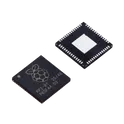
RP2040
133MHz LQFN-56(7x7) Microcontrollers (MCU/MPU/SOC) ROHS RP2040 The RP2040 is a high-performance, low-cost 32-bit microcontroller developed by Raspberry Pi Ltd.. It features dual ARM Cortex-M0+ processor cores, flexible digital interfaces, and a unique Programmable I/O (PIO) subsystem that enables custom hardware protocols and timing-critical applications. The device is widely used in embedded systems, IoT devices, robotics, industrial control, consumer electronics, and educational projects. Key Features Dual ARM Cortex-M0+ CPU cores operating up to 133 MHz (up to 200 MHz under specific conditions) 264 KB on-chip SRAM organized in six independent memory banks External QSPI Flash interface with Execute-In-Place (XIP) support and up to 16 MB Flash memory capability 30 multifunction GPIO pins with extensive peripheral multiplexing 2 × UART interfaces 2 × SPI controllers 2 × I²C controllers 16 PWM channels for motor control and signal generation USB 1.1 Host and Device support with integrated PHY 12-bit ADC with four external analog inputs and internal temperature sensor, up to 500 ksps sampling rate 12-channel DMA controller for efficient data transfers Programmable I/O (PIO) subsystem with 8 state machines for implementing custom communication interfaces and precise timing applications Integrated PLLs and programmable LDO regulator for clock and power management Operating voltage range: 1.8 V to 3.3 V Available in a compact 7 mm × 7 mm QFN-56 package Typical Applications IoT and connected devices Industrial automation Robotics and motor control Human-machine interfaces (HMI) Consumer electronics USB peripherals Sensor data acquisition systems Educational and maker projects Custom communication protocol implementations using PIO #CommonPartsLibrary #IntegratedCircuit #Microcontroller
121 Uses0 StarsSTUSB4500QTR
USB Controller USB 2.0 I2C Interface 24-QFN (4x4) Standalone USB PD sink controller with short-to-VBUS protections • Auto-run Type-C™ and USB PD sink controller • Dead battery mode support • Up to 3 sink PDO configurable profiles • Dual high power charging path support • Integrated VBUS switch gate drivers (PMOS) • Integrated VBUS voltage monitoring • Internal and/or external VBUS discharge paths • Short-to-VBUS protections on CC pins (22 V) • High voltage capability on VBUS pins (28 V) • Dual power supply (VSYS and/or VDD): – VSYS = [3.0 V; 5.5 V] – VDD = [4.1 V; 22 V] • Debug accessory mode support • Temperature range: -40 °C up to 105 °C • ESD: 3 kV HBM - 1.5 kV CDM • Certified: – USB Type-C™ rev 1.2 – USB PD rev 2.0 (TID #1000133) • Interoperable with USB PD rev 3.0 #CommonPartsLibrary #IntegratedCircuit
70 Uses0 StarsMAX31865AAP+T
15Bit 3V~3.6V SPI SSOP-20-208mil Analog to Digital Converters (ADCs) ROHS The MAX31865 is an easy-to-use resistance-to-digital converter optimized for platinum resistance temperature detectors (RTDs). An external resistor sets the sensitivity for the RTD being used and a precision delta-sigma ADC converts the ratio of the RTD resistance to the reference resistance into digital form. The MAX31865’s inputs are protected against overvoltage faults as large as Q45V. Programmable detection of RTD and cable open and short conditions is included. ● Integration Lowers System Cost, Simplifies Design Efforts, and Reduces Design Cycle Time • Simple Conversion of Platinum RTD Resistance to Digital Value • Handles 100Ω to 1kΩ (at 0°C) Platinum RTDs (PT100 to PT1000) • Compatible with 2-, 3-, and 4-Wire Sensor Connections • SPI-Compatible Interface • 20-Pin TQFN and SSOP Packages ● High Accuracy Facilitates Meeting Error Budgets • 15-Bit ADC Resolution; Nominal Temperature Resolution 0.03125NC (Varies Due to RTD Nonlinearity) • Total Accuracy Over All Operating Conditions: 0.5NC (0.05% of Full Scale) max • Fully Differential VREF Inputs • 21ms (max) Conversion Time ● Integrated Fault Detection Increases System Reliability • ±45V Input Protection • Fault Detection (Open RTD Element, RTD Shorted to Out-of-Range Voltage, or Short Across RTD Element) #CommonPartsLibrary #IntegratedCircuit #PowerManagement
158 Uses0 StarsMAX98357AETE+T
Tiny, Low-Cost, PCM Class D Amplifier with Class AB Performance The MAX98357AETE+T is a highly integrated digital input Class-D audio amplifier designed to convert digital audio streams directly into high-efficiency speaker output signals. It features an integrated digital-to-analog conversion stage and Class-D output driver, eliminating the need for an external DAC and significantly simplifying audio system design. The device accepts digital audio data through a standard I²S interface and delivers high-quality audio output suitable for portable electronics, smart speakers, embedded systems, Internet of Things devices, multimedia products, and consumer audio equipment. Its high-efficiency architecture minimizes power dissipation while maintaining excellent audio performance, making it particularly suitable for battery-powered applications. The MAX98357AETE+T incorporates advanced audio processing capabilities, low electromagnetic interference characteristics, and integrated protection features to ensure reliable operation in compact embedded audio designs. Features Digital input Class-D audio amplifier Integrated digital-to-analog conversion functionality Direct I²S audio interface support High-efficiency power amplification architecture Filterless output design Compact surface-mount package Low electromagnetic interference operation Integrated click-and-pop suppression Low power consumption High audio fidelity performance Simplified external component requirements Integrated thermal protection Short-circuit protection capability Suitable for mono speaker applications Optimized for embedded audio systems Electrical Characteristics Digital audio input architecture Class-D switching amplifier topology High-efficiency power conversion Low distortion audio reproduction Wide operating supply range Low standby power consumption Direct speaker drive capability Integrated audio signal processing functions Applications Smart speakers Embedded audio systems Internet of Things devices Portable electronics Voice-enabled products Multimedia equipment Consumer audio devices Wireless audio products Home automation systems Educational and development platforms Battery-powered audio applications Human-machine interface systems Package Information TQFN surface-mount package Compact footprint for space-constrained designs Suitable for automated PCB assembly Thermally optimized package construction High-density electronic product integration #commonpartslibrary #integratedcircuit #audio #audioamplifier #classd amplifier #digitalaudio #i2s #dac #embeddedaudio #consumerelectronics #iot #multimedia #signalprocessing #powermanagement #maximintegrated #analogdevices #electronicsdesign #audioelectronics #speakerdriver #embeddedsystems
85 Uses0 StarsUSBLC6-2P6
ESD DIODE 5VWM 14VC SOT-666-6 The USBLC6-2P6 is a dual-line, rail-to-rail transient voltage suppressor (TVS) diode array in a compact SOT-666 package. It is specifically optimized for protecting USB D+ and D− lines (and similar high-speed differential pairs) while maintaining very low signal distortion due to its low capacitance design. It clamps high-voltage ESD events to safe levels, protecting sensitive ICs such as MCUs, USB PHYs, and transceivers. Designed for USB and high-speed data protection Ideal for USB 2.0 (480 Mbps) interfaces Very low line capacitance Minimizes signal distortion on high-speed differential pairs Bidirectional ESD protection Protects both positive and negative voltage transients Low clamping voltage Typical clamp around ~17 V during surge events High peak pulse current capability Handles ESD strikes (IEC 61000-4-2 compliant, typically ±15 kV air / ±8 kV contact in similar ST USBLC family devices) Rail-to-rail protection structure Protects signal lines relative to VCC and GND Compact SOT-666 package Suitable for very small PCB layouts (phones, USB ports, embedded systems) 2-channel configuration Typically used for D+ / D− pair protection Typical Applications USB 2.0 ports (D+ / D− protection) Smartphones and tablets Embedded systems with external connectors HDMI / Ethernet signal protection (low-capacitance variants also used) Any exposed high-speed data interface requiring ESD protection #CommonPartsLibrary #Diode
432 Uses0 StarsPESD2CAN
8A@8/20us 54V 26.7V 24V SOT-23 ESD and Surge Protection ESD DIODE 24VWM 41VC SOT-23 PESD2CAN is a dual-line ESD protection diode designed to protect automotive Controller Area Network (CAN) bus interfaces from Electrostatic Discharge (ESD), surge events, and other transient voltage disturbances. It is housed in a compact SOT-23 package and provides protection for both CANH and CANL lines using a single device. Key Features Dual CAN bus line protection in a single SOT-23 package Maximum peak pulse power: 230 W (8/20 μs surge waveform) Low clamping voltage: 41 V at 5 A surge current Ultra-low leakage current: < 1 nA ESD protection up to 30 kV Compliant with IEC 61000-4-2 Level 4 ESD standard Compliant with IEC 61000-4-5 surge immunity standard AEC-Q101 qualified for automotive applications Reverse standoff voltage: 24 V Low capacitance (typically 25 pF) to minimize impact on CAN signal integrity Suitable for both high-speed and fault-tolerant CAN networks Typical Applications Automotive CAN bus networks Industrial CAN communication systems Automotive electronic control units (ECUs) CAN transceivers requiring ESD and surge protection Any differential communication interface exposed to external connectors Package SOT-23 (3-pin) Surface-Mount Device (SMD) package. #CommonPartsLibrary #Diode
190 Uses0 Stars