Top Organization Components
Curated collection features components used in significant projects by various businesses and institutions, reflecting the current trends and high standards of the industry. From basic electronic elements to advanced modules, these components are selected for their superior quality, efficiency, and adaptability in diverse applications. It offers a glimpse into the components that are shaping the future of PCB design in professional settings. It serves as a vital resource for designers and organizations looking to stay ahead of the curve, providing insights into the component choices that lead to successful and innovative designs. By showcasing the preferred components of leading organizations, Flux.ai creates an avenue for knowledge exchange and benchmarking within the electronics design community. This subcategory is more than just a list of components; it's a reflection of industry-leading practices and a source of inspiration for those striving for excellence in PCB design.
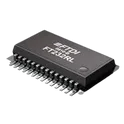
FT232RL
USB to Serial Interface, SSOP-28 FTDI USB Serial SSOP*5.3x10.2mm*P0.65mm* The FT232RL is a full-speed USB 2.0 to asynchronous serial data transfer IC. It integrates all the necessary USB protocol handling and UART interface logic, making it very easy to add USB connectivity to embedded devices without requiring complex firmware development. It is commonly used in development boards (like Arduino clones), USB-to-TTL converters, and debugging interfaces. Key Features USB Interface Fully compliant with USB 2.0 Full-Speed (12 Mbps) Integrated USB transceiver (no external components required) Supports USB suspend/resume modes Internal EEPROM for storing USB descriptors (no external EEPROM needed) Serial (UART) Interface Supports standard UART communication (TX, RX) Configurable baud rates from 300 bps up to 3 Mbps Supports hardware flow control (RTS/CTS, DTR/DSR) Bit-bang mode for simple GPIO control Integrated Components Built-in clock generator (no external crystal required) Internal EEPROM for configuration Integrated voltage regulator (3.3V output available for external use) Power Features Operates from 3.3V to 5V Can be powered directly from USB (bus-powered) Low power consumption with sleep mode Driver Support Virtual COM Port (VCP) drivers available for: Windows Linux macOS Also supports direct D2XX driver for advanced applications Package Typically available in SSOP-28 package Common Applications USB-to-serial converters (TTL/RS232) Microcontroller programming and debugging Embedded system communication Industrial and instrumentation interfaces
157 Uses1 StarsPeakNode 1
Ruggedized battery-powered PeakNode 1 LoRa PWAN node with SX1262 LoRa mesh over SPI, LTE Cat-M1/NB-IoT modem, GNSS, LPCNet-capable audio path, USB-C charging and LiFePO4 power management. Targets a 4-layer 90 mm x 60 mm IPC Class 2 layout with 3.3 V main and 1.8 V I/O rails, dual SMA antennas, two RGB status LEDs, three tactile buttons, low-leakage power architecture for sub-10 uA sleep, and defined RF keep-out zones under the LoRa and LTE antenna regions.
0 Uses1 StarsMini UPS 42V to 12V
Mini UPS PCB for a 42 V external adapter and external 10S lithium battery pack. Includes adapter-priority source selection with automatic switchover, input protection, ideal-diode OR-ing, a 30 V to 42 V HV bus, and a regulated 12 V output stage. Includes status LEDs and battery monitor pads. Excludes onboard charger circuitry and excludes adapter or battery source design.
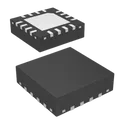
0 Uses1 StarsADXL335BCPZ
Accelerometer X, Y, Z Axis ±3g 1.6kHz (X,Y), 550Hz (Z) 16-LFCSP-LQ (4x4) The ADXL335BCPZ is a small, thin, low-power, complete 3-axis accelerometer with signal-conditioned voltage outputs. It measures acceleration with a minimum full-scale range of ±3 g. The device outputs analog voltages proportional to acceleration in each of the three orthogonal axes (X, Y, and Z). The accelerometer is designed for low power consumption and high resolution, making it suitable for mobile devices, tilt sensing, motion detection, and vibration monitoring. It operates over a wide temperature range and requires minimal external components, enabling easy integration into compact systems. Functional Overview The ADXL335 uses a capacitive sensing structure to detect acceleration. Changes in acceleration result in differential capacitance changes, which are converted into voltage outputs through an internal signal conditioning circuit. Each axis provides an independent analog output that can be directly interfaced with ADC inputs of microcontrollers or other processing units. Bandwidth for each axis can be adjusted using external capacitors, allowing flexibility depending on application requirements. Electrical Characteristics Supply Voltage Range: 1.8 V to 3.6 V Supply Current: Typical: 350 µA Measurement Range: ±3 g Sensitivity (Typical): 300 mV/g Zero-g Bias Level: Approximately mid-supply voltage Bandwidth: User-selectable via external capacitors Typical range: X, Y axes: up to 1600 Hz Z axis: up to 550 Hz Output Characteristics Output Type: Analog voltage (ratiometric to supply voltage) Number of Axes: Three (X, Y, Z) Output Noise: Low noise suitable for precision motion sensing Cross-Axis Sensitivity: Typically ±1% Mechanical Characteristics Package Type: 16-lead LFCSP (Lead Frame Chip Scale Package) Dimensions: Approximately 4 mm × 4 mm × 1.45 mm Mounting: Surface mount Environmental Specifications Operating Temperature Range: −40°C to +85°C Shock Survivability: Up to 10,000 g Interface Requirements External Components: Requires capacitors for bandwidth setting (one per axis) Output Interface: Direct analog output compatible with ADC inputs Applications Mobile devices and handheld electronics Tilt and orientation sensing Vibration monitoring systems Gaming and motion input devices Industrial instrumentation Wearable electronics Key Features Low power consumption Compact form factor High resolution analog outputs User-adjustable bandwidth Wide operating temperature range Simple integration with minimal external components #commonpartslibrary #sensor #transducer #motionsensor #accelerometer
58 Uses1 StarsESP32 Robot Controller | AI Design Review Tutorial [Example]
Spot the mistake! Learn how to use AI to conduct a design review on an ESP32-based control board. This project is ideal for autonomous or radio-controller robots featuring inputs for sensors, encoders, and a Flysky RC receiver, plus an I2C display for configuration.
0 Uses1 StarsPCB Business Card V2
Change History from V1: -13.56MHz tuning -larger instruction font -put some stuff on the back #template I wanted to create a business card that has some functionality and shows off a bit of my portfolio IRL: -NFC to my flux page -here's the [instructables](https://www.instructables.com/PCB-Business-Card-With-NFC-Make-Yours-With-NFC-QR-/) -Put a bunch of modules on it Find the BoM [here](https://www.digikey.com/short/2db2vnmp)
0 Uses1 StarsPTS810SJK250SMTRLFS
PTS 810 Series Microminiature SMT Top Actuated Features/Benefits - 4.2 x 3.2 mm footprint - 2.5 mm thickness - High number of cycles - Color coded actuators Typical Applications - Control panels - Nomad devices - Remote controls - Keyless entry system 3.2mm 2.5mm Round Button 50mA Brick nogging 4.2mm SPST 16V SMD Tactile Switch SPST-NO Top Actuated Surface Mount.
1.9k Uses1 Stars
NE555P
The NE555 devices are precision timing circuits capable of producing accurate time delays or oscillation. In time-delay or monostable operating modes, the timed interval is controlled by a single external resistor and capacitor network. In the astable mode of operation, the frequency and duty cycle are controlled independently with two external resistors and a single external capacitor. Each timer has a trigger level equal to approximately one-third of the supply voltage and a threshold level equal to approximately two-thirds of the supply voltage. These levels can be altered by use of the control voltage pin (CONT). When the trigger input (TRIG) is less than the trigger level, the flip-flop is set and the output goes high. If TRIG is greater than the trigger level and the threshold input (THRES) is greater than the threshold level, the flip-flop is reset and the output is low. The reset input (RESET) overrides all other inputs and is used to initiate a new timing cycle. If RESET is low, the flip-flop is reset and the output is low. Whenever the output is low, a lowimpedance path is provided between the discharge pin (DISCH) and the ground pin (GND). Tie all unused inputs to an appropriate logic level to prevent false triggering. The output circuit is capable of sinking or sourcing current up to 200mA. Operation is specified for supplies of 5V to 15V. With a 5V supply, output levels are compatible with TTL inputs. Features - Timing from microseconds to hours - Astable or monostable operation - Adjustable duty cycle - TTL-compatible output can sink or source up to 200mA - On products compliant to MIL-PRF-38535, all parameters are tested unless otherwise noted. Applications - Pulse-shaping circuits - Missing-pulse detectors - Pulse-width modulators - Pulse-position modulators - Sequential timers - Pulse generators -F requency dividers - Industrial controls
2.3k Uses1 StarsLTST-C190KRKT
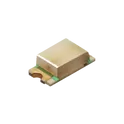
Red 631nm LED Indication - Discrete 2V 0603 (1608 Metric) The LTST-C190KRKT is a surface-mount red LED designed for compact electronic applications requiring reliable visual indication. It is housed in a standard chip LED package, making it suitable for automated assembly processes. This device offers high luminous intensity with low power consumption, ideal for status indicators, backlighting, and display applications. Key Features High brightness red LED Compact surface-mount package (0603 / 1608 metric) Low forward voltage and low power consumption Wide viewing angle for uniform illumination Compatible with automated placement equipment RoHS compliant and lead-free Electrical Characteristics (Typical @ 25°C) Forward Voltage (Vf): 2.0 V (typ), 2.4 V (max) Forward Current (If): 20 mA (recommended) Luminous Intensity: ~100–180 mcd Wavelength (Peak): ~631 nm (red) Optical Characteristics Color: Red Viewing Angle: 120° (typ) Absolute Maximum Ratings Forward Current: 30 mA (continuous) Peak Forward Current: 100 mA (pulse) Power Dissipation: ~75 mW Operating Temperature Range: -40°C to +85°C Storage Temperature Range: -40°C to +100°C Mechanical Characteristics Package Type: SMD Chip LED Package Size: 0603 (1.6 mm × 0.8 mm) Mounting Type: Surface Mount Lens Type: Clear Applications Status indicators in electronic devices Backlighting for displays and keypads Consumer electronics Industrial control panels Portable and battery-powered devices #commonpartslibrary #optoelectronic #led #red
3.1k Uses1 Stars

![ESP32 Robot Controller | AI Design Review Tutorial [Example]](https://img-cdn.flux.ai/eyJidWNrZXQiOiJncmF2aXRvbi1lbGVjdHJpYy1zeW1ib2xzIiwia2V5IjoiZG9jdW1lbnRfYXNzZXRzL1RodW1ibmFpbC1FU1AzMi0tMS0tZTNjNjM0OGEtYjEzMy00YjliLWEyYTItMzY1MGNiMjgyYWJiLnBuZyIsImVkaXRzIjp7InJlc2l6ZSI6eyJ3aWR0aCI6MTI0LCJoZWlnaHQiOjEyNCwiZml0IjoiY29udGFpbiIsImJhY2tncm91bmQiOnsiciI6MCwiZyI6MCwiYiI6MCwiYWxwaGEiOjB9fX0sIm91dHB1dEZvcm1hdCI6IndlYnAifQ==)