shivam101 / Vivid Coffee Mr. Fusion

Loaded

0

0

Files

Schematic

Code

PCB

Log InSign Up

Chat

Welcome to Flux

Treat Flux like your intern. Tell it what you'd like to build and it'll get to work. You can also ask it questions, brainstorm ideas, and teach it your preferences. Learn More

Explain project
Write a project description
Find schematic issues
Create a test plan
Simulate a circuit
Prepare for Manufacturing
Component Selection Workflow
New Subsystem Wizard

​
Sign up to send
hey, I want to make a home automation circuit by using esp32 , with a 8 channel ...

shivam101

shivam101

@copilot components that are available in flux.ai required to make a home automation system using esp32.
2y

copilot

Designing a home automation system around an ESP32 involves incorporating a variety of components to control and monitor different elements in the home environment effectively. Assuming you're looking to cover a broad range of functionalities, here is a list of components you might consider incorporating into your Flux project alongside the ESP32. While I can't access the Flux.ai database directly, these components are commonly used in home automation projects and should be available in a comprehensive electronics CAD tool like Flux:
  1. ESP32 Module: The core microcontroller module providing WiFi and Bluetooth connectivity. This will act as the brain of your home automation system.
  2. Relays: For controlling high-power devices such as lamps, heaters, or fans. You would typically use a relay module that can be driven directly by the ESP32's GPIO pins.
    • e.g., 5V Relay Module
  3. Sensors:
    • Temperature and Humidity Sensor: For environmental monitoring. A common choice is the DHT22 or the more precise BME280.
    • Motion Sensors (PIR): For detecting movement within the house. Useful for security and for automating lights.
    • Light Sensors (Photodetectors): To measure light intensity, allowing for automatic adjustment of indoor lighting.
    • Door/Window Sensors (Magnetic Reed Switches): To monitor whether doors or windows are open or closed.
  4. Actuators:
    • Servos: To control mechanisms like automatic pet feeders or smart blinds.
  5. LEDs/RGB LEDs: For status indicators or for creating ambient lighting systems.
  6. Power Supply Components:
    • Voltage Regulator: To ensure the ESP32 and other components receive a steady and suitable voltage, particularly if you're powering your system from a source greater than 3.3V. A common choice is the AMS1117 3.3V regulator.
    • Capacitors: To smooth out power supply fluctuations. Both electrolytic and ceramic capacitors are useful in different parts of the circuit.
    • Diodes: For protection against reverse polarity connection.
  7. Push Buttons: For manual control and input to the ESP32.
  8. Resistors: For pull-up/pull-down on GPIO pins and current limiting for LEDs.
  9. Breadboard and/or Prototyping PCB: For initial development before finalizing your design into a printed circuit board (PCB).
  10. Connectors and Cables: For connecting sensors, actuators, and other modules to the ESP32 without soldering, allowing for easy modifications and troubleshooting.
Please note, when selecting components, it's critical to consider compatibility with the ESP32's 3.3V logic levels, especially for direct GPIO interfacing. For any components not directly compatible, logic level converters might be necessary.
This is a generalized list, and based on your specific requirements for your home automation project, you might need additional or different components. Always refer to the datasheets for detailed specifications and wiring guidance.
2y
shivam101

shivam101

give me the module name for 8 channel relay module.
2y

copilot

There isn't a universal naming convention for 8-channel relay modules, as different manufacturers might use different model names or numbers. However, a typical and commonly used model for home automation projects, compatible with microcontrollers like the ESP32, is often referred to as:
  • 8-Channel 5V Relay Module
When searching in electronics CAD tools like Flux or in component databases, you may also encounter these modules under generic names like:
  • "8-Channel Relay Board"
  • "Relay Module 5V 8-Channel"
These modules are designed to be driven by 5V signals, which makes them suitable for use with many microcontrollers for controlling higher power devices. To use it with the ESP32, ensure you understand whether your ESP32 operates at 3.3V logic and if so, whether the relay module in question can be reliably triggered by 3.3V logic levels. Some modules are specifically designed to work with both 3.3V and 5V logic levels for broader compatibility.
If interfacing a 5V relay module with a 3.3V logic microcontroller, always check the module's datasheet or technical specifications to ensure proper operation. In some cases, you might need logic level shifters to interface between the ESP32 and the relay module safely.
2y
shivam101

shivam101

@copilot hey, I want to make a home automation circuit by using esp32 , with a 8 channel relay module , What components do i need?
2y

copilot

For a home automation project using an ESP32 and an 8-channel relay module, here's a basic list of components you might need:
  1. ESP32 Module: This will be the brain of your project, handling WiFi connectivity and control logic.
  2. 8-Channel Relay Module: To control high-power devices like lights and motors. Make sure it's suitable for the voltage and current ratings of the devices you want to control.
  3. Power Supply:
    • For the ESP32: Typically, ESP32 boards can be powered directly via USB, or you can use a regulated 3.3V power source if your board supports it.
    • For the Relay Module: The power requirements depend on the relay coil voltage (often 5V). Ensure the power supply can handle the current draw of all eight relays being active simultaneously.
  4. Level Shifter (if necessary): If your relay module operates at 5V and your ESP32 operates at 3.3V, you might need a level shifter to safely interface between the two voltages.
  5. Jumper Wires: For making connections between the ESP32, relay module, and any sensors or additional components.
  6. Resistors: For pull-up/pull-down resistors on the ESP32 inputs, if necessary.
  7. Capacitors: To smooth out any voltage spikes, especially for the power supply.
  8. Prototyping Board or PCB: If you want to make a more permanent solution beyond a breadboard setup.
  9. Connectors and Terminals: For connecting your appliances or devices to the relay module safely.
  10. Enclosure: To house your project, especially important for safety with high voltage applications.
  11. Various Sensors (optional): Based on your home automation needs, such as temperature sensors, motion sensors, light sensors, etc.
  12. Buttons/Switches (optional): For manual control override.
Remember to follow all safety guidelines when working with high voltage and to ensure that your relay module is capable of handling the load of the devices you intend to control. Let me know if you need guidance on how to connect these components together in your schematic.
2y
shivam101

shivam101

give me the list of components required to make a Home automation system using esp32 and 8 channel relay module in flux.
2y

copilot

Certainly! To design a Home Automation system using an ESP32 and an 8-channel relay module in Flux.ai, here's a detailed list of components you'll need to add to your project:
  1. ESP32 Development Board:
    • Description: A powerful microcontroller with WiFi and Bluetooth capabilities.
    • Quantity: 1
  2. 8-Channel Relay Module:
    • Description: Used for controlling up to 8 different high-power devices.
    • Quantity: 1
  3. Power Supply for ESP32:
    • Description: 3.3V regulated power source or a micro USB cable to power the ESP32.
    • Quantity: Depends on how you plan to power the ESP32. 1 for a direct power source, or 1 USB cable.
  4. Power Supply for Relay Module:
    • Description: 5V regulated power source capable of supplying enough current for all relays if activated simultaneously.
    • Quantity: 1
  5. Level Shifter (Optional, check your relay module specifications):
    • Description: 3.3V to 5V level shifter, if your relay module requires 5V logic levels.
    • Quantity: Depends on the number of channels you plan to use. Generally, an 8-channel level shifter would work.
  6. Jumper Wires:
    • Description: For making connections between the ESP32, relay module, level shifter (if used), and power supplies.
    • Quantity: Varies depending on setup complexity.
  7. Pull-up/Pull-down Resistors (Optional):
    • Description: Typically 10kΩ for input pins to stabilize the logic level.
    • Quantity: Depends on the number of GPIO pins you use.
  8. Decoupling Capacitors:
    • Description: Generally, 0.1μF for noise suppression on power supply lines.
    • Quantity: A few, to place near the power supply pins of ESP32 and possibly the relay module.
  9. PCB or Prototyping Board:
    • Description: For a permanent setup, you might want to design a PCB or use a prototyping board.
    • Quantity: 1
  10. Connectors and Terminals:
    • Description: For secure and safe connections to the relay module for the high-power devices.
    • Quantity: According to the number of devices you plan to control.
  11. Enclosure:
    • Description: To safely house all components, especially important for projects dealing with high voltage.
    • Quantity: 1
  12. Sensors and Actuators (Optional):
    • Description: Depending on your automation needs, e.g., temperature sensors, motion detectors, light sensors, etc.
    • Quantity: As per the requirement.
  13. Buttons/Switches (Optional):
    • Description: For manual control or inputs to the system.
    • Quantity: As per the requirement.
This list forms a basic framework to start designing your home automation system in Flux.ai. Depending on the specific functionalities you wish for your system, you might need to add or remove components. Remember, safety should always be a priority, especially when dealing with mains electricity and high-load appliances.
2y
1
K1

Reviews


  • Ground
    Ground
    A common return path for electric current. Commonly known as ground.
    jharwinbarrozo
    20.5M
  • Net Portal
    Net Portal
    Wirelessly connects nets on schematic. Used to organize schematics and separate functional blocks. To wirelessly connect net portals, give them same designator. #portal
    jharwinbarrozo
    43.0M
  • Power Net Portal
    Power Net Portal
    Wirelessly connects power nets on schematic. Identical to the net portal, but with a power symbol. Used to organize schematics and separate functional blocks. To wirelessly connect power net portals, give them the same designator. #portal #power
    jharwinbarrozo
    11.4M
  • Generic Resistor
    Generic Resistor
    A generic fixed resistor ideal for rapid circuit topology development. Its footprint automatically adapts based on the selected package case code—supporting 0402, 0603, 0805, 1203, and many other standard SMD packages, as well as axial horizontal and vertical configurations. Save precious design time by seamlessly add more information to this part (value, footprint, etc.) as it becomes available. Standard resistor values: 1.0 ohm, 10 ohm, 100 ohm, 1.0k ohm, 10k ohm, 100k ohm, 1.0M ohm 1.1 ohm, 11 ohm, 110 ohm, 1.1k ohm, 11k ohm, 110k ohm, 1.1M ohm 1.2 ohm, 12 ohm, 120 ohm, 1.2k ohm, 12k ohm, 120k ohm, 1.2M ohm 1.3 ohm, 13 ohm, 130 ohm, 1.3k ohm, 13k ohm, 130k ohm, 1.3M ohm 1.5 ohm, 15 ohm, 150 ohm, 1.5k ohm, 15k ohm, 150k ohm, 1.5M ohm 1.6 ohm, 16 ohm, 160 ohm, 1.6k ohm, 16k ohm, 160k ohm, 1.6M ohm 1.8 ohm, 18 ohm, 180 ohm, 1.8K ohm, 18k ohm, 180k ohm, 1.8M ohm 2.0 ohm, 20 ohm, 200 ohm, 2.0k ohm, 20k ohm, 200k ohm, 2.0M ohm 2.2 ohm, 22 ohm, 220 ohm, 2.2k ohm, 22k ohm, 220k ohm, 2.2M ohm 2.4 ohm, 24 ohm, 240 ohm, 2.4k ohm, 24k ohm, 240k ohm, 2.4M ohm 2.7 ohm, 27 ohm, 270 ohm, 2.7k ohm, 27k ohm, 270k ohm, 2.7M ohm 3.0 ohm, 30 ohm, 300 ohm, 3.0K ohm, 30K ohm, 300K ohm, 3.0M ohm 3.3 ohm, 33 ohm, 330 ohm, 3.3k ohm, 33k ohm, 330k ohm, 3.3M ohm 3.6 ohm, 36 ohm, 360 ohm, 3.6k ohm, 36k ohm, 360k ohm, 3.6M ohm 3.9 ohm, 39 ohm, 390 ohm, 3.9k ohm, 39k ohm, 390k ohm, 3.9M ohm 4.3 ohm, 43 ohm, 430 ohm, 4.3k ohm, 43K ohm, 430K ohm, 4.3M ohm 4.7 ohm, 47 ohm, 470 ohm, 4.7k ohm, 47k ohm, 470k ohm, 4.7M ohm 5.1 ohm, 51 ohm, 510 ohm, 5.1k ohm, 51k ohm, 510k ohm, 5.1M ohm 5.6 ohm, 56 ohm, 560 ohm, 5.6k ohm, 56k ohm, 560k ohm, 5.6M ohm 6.2 ohm, 62 ohm, 620 ohm, 6.2k ohm, 62K ohm, 620K ohm, 6.2M ohm 6.8 ohm, 68 ohm, 680 ohm, 6.8k ohm, 68k ohm, 680k ohm, 6.8M ohm 7.5 ohm, 75 ohm, 750 ohm, 7.5k ohm, 75k ohm, 750k ohm, 7.5M ohm 8.2 ohm, 82 ohm, 820 ohm, 8.2k ohm, 82k ohm, 820k ohm, 8.2M ohm 9.1 ohm, 91 ohm, 910 ohm, 9.1k ohm, 91k ohm, 910k ohm, 9.1M ohm #generics #CommonPartsLibrary
    jharwinbarrozo
    1.5M
  • Generic Capacitor
    Generic Capacitor
    A generic fixed capacitor ideal for rapid circuit topology development. You can choose between polarized and non-polarized types, its symbol and the footprint will automatically adapt based on your selection. Supported options include standard SMD sizes for ceramic capacitors (e.g., 0402, 0603, 0805), SMD sizes for aluminum electrolytic capacitors, and through-hole footprints for polarized capacitors. Save precious design time by seamlessly add more information to this part (value, footprint, etc.) as it becomes available. Standard capacitor values: 1.0pF, 10pF, 100pF, 1000pF, 0.01uF, 0.1uF, 1.0uF, 10uF, 100uF, 1000uF, 10000uF 1.1pF, 11pF, 110pF, 1100pF 1.2pF, 12pF, 120pF, 1200pF 1.3pF, 13pF, 130pF, 1300pF 1.5pF, 15pF, 150pF, 1500pF, 0.015uF, 0.15uF, 1.5uF, 15uF, 150uF, 1500uF 1.6pF, 16pF, 160pF, 1600pF 1.8pF, 18pF, 180pF, 1800pF 2.0pF, 20pF, 200pF, 2000pF 2.2pF, 22pF, 220pF, 2200pF, 0.022uF, 0.22uF, 2.2uF, 22uF, 220uF, 2200uF 2.4pF, 24pF, 240pF, 2400pF 2.7pF, 27pF, 270pF, 2700pF 3.0pF, 30pF, 300pF, 3000pF 3.3pF, 33pF, 330pF, 3300pF, 0.033uF, 0.33uF, 3.3uF, 33uF, 330uF, 3300uF 3.6pF, 36pF, 360pF, 3600pF 3.9pF, 39pF, 390pF, 3900pF 4.3pF, 43pF, 430pF, 4300pF 4.7pF, 47pF, 470pF, 4700pF, 0.047uF, 0.47uF, 4.7uF, 47uF, 470uF, 4700uF 5.1pF, 51pF, 510pF, 5100pF 5.6pF, 56pF, 560pF, 5600pF 6.2pF, 62pF, 620pF, 6200pF 6.8pF, 68pF, 680pF, 6800pF, 0.068uF, 0.68uF, 6.8uF, 68uF, 680uF, 6800uF 7.5pF, 75pF, 750pF, 7500pF 8.2pF, 82pF, 820pF, 8200pF 9.1pF, 91pF, 910pF, 9100pF #generics #CommonPartsLibrary
    jharwinbarrozo
    1.5M
  • Generic Inductor
    Generic Inductor
    A generic fixed inductor suitable for rapid circuit topology development. The footprint automatically adapts based on the selected package, supporting standard SMD sizes (e.g., 0402, 0603, 0805) as well as well-known inductor packages such as SDR1806, PA4320, SRN6028, and SRR1260. Standard inductor values: 1.0 nH, 10 nH, 100 nH, 1.0 µH, 10 µH, 100 µH, 1.0 mH 1.2 nH, 12 nH, 120 nH, 1.2 µH, 12 µH, 120 µH, 1.2 mH 1.5 nH, 15 nH, 150 nH, 1.5 µH, 15 µH, 150 µH, 1.5 mH 1.8 nH, 18 nH, 180 nH, 1.8 µH, 18 µH, 180 µH, 1.8 mH 2.2 nH, 22 nH, 220 nH, 2.2 µH, 22 µH, 220 µH, 2.2 mH 2.7 nH, 27 nH, 270 nH, 2.7 µH, 27 µH, 270 µH, 2.7 mH 3.3 nH, 33 nH, 330 nH, 3.3 µH, 33 µH, 330 µH, 3.3 mH 3.9 nH, 39 nH, 390 nH, 3.9 µH, 39 µH, 390 µH, 3.9 mH 4.7 nH, 47 nH, 470 nH, 4.7 µH, 47 µH, 470 µH, 4.7 mH 5.6 nH, 56 nH, 560 nH, 5.6 µH, 56 µH, 560 µH, 5.6 mH 6.8 nH, 68 nH, 680 nH, 6.8 µH, 68 µH, 680 µH, 6.8 mH 8.2 nH, 82 nH, 820 nH, 8.2 µH, 82 µH, 820 µH, 8.2 mH #generics #CommonPartsLibrary
    jharwinbarrozo
    15.9k
  • Terminal
    Terminal
    An electrical connector acting as reusable interface to a conductor and creating a point where external circuits can be connected.
    natarius
  • RMCF0805JT47K0
    RMCF0805JT47K0
    General Purpose Thick Film Standard Power and High-Power Chip Resistor 47 kOhms ±5% 0.125W, 1/8W Chip Resistor 0805 (2012 Metric) Automotive AEC-Q200 Thick Film Features: - RMCF – standard power ratings - RMCP – high power ratings - Nickel barrier terminations standard - Power derating from 100% at 70ºC to zero at +155ºC - RoHS compliant, REACH compliant, and halogen free - AEC-Q200 compliant
    jharwinbarrozo
    1.2M
  • 875105359001
    875105359001
    10 µF 16 V Aluminum - Polymer Capacitors Radial, Can - SMD 30mOhm 2000 Hrs @ 105°C #commonpartslibrary #capacitor #aluminumpolymer #radialcan
    jharwinbarrozo
    1.2M
  • CTL1206FYW1T
    CTL1206FYW1T
    Yellow 595nm LED Indication - Discrete 1.7V 1206 (3216 Metric)
    jharwinbarrozo
    1.1M

Vivid Coffee Mr. Fusion

Vivid Coffee Mr. Fusion thumbnail
Welcome to your new project. Imagine what you can build here.

Properties

Properties describe core aspects of the project.

Pricing & Availability

Distributor

Qty 1

Controls

Welcome 👋

Flux helps you build PCBs faster with an AI teammate!

Create your account to collaborate, stay updated, fork your own version, and get instant answers from our AI agent.
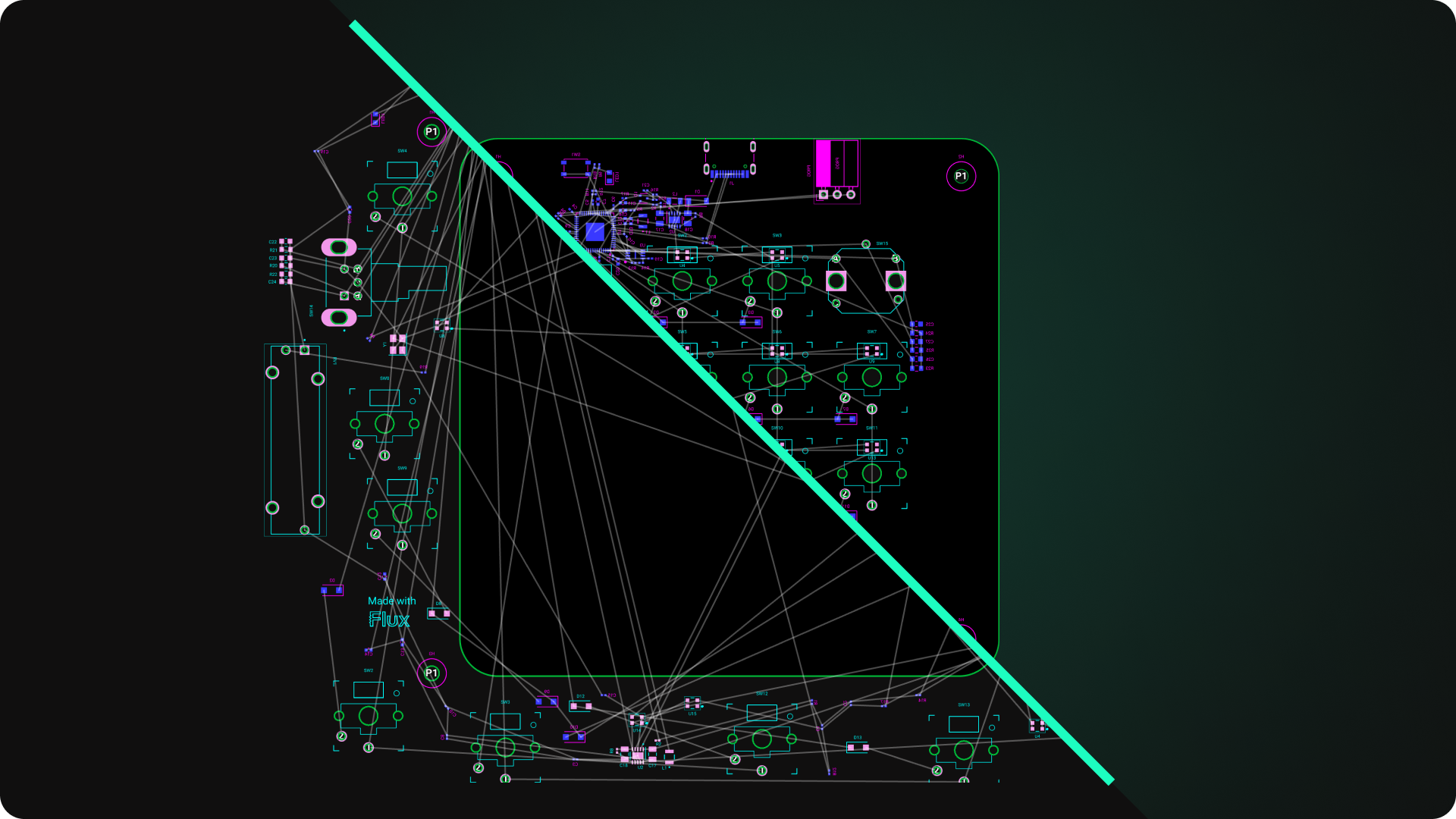
      Introducing AI Placement!
      AI Placement Demo

      AI-Powered Component Placement

      Let AI place your components intelligently. AI Placement analyzes your schematic and positions components for optimal routing, signal integrity, and board density.

      From Schematic to Layout in Seconds

      Skip the tedious manual placement. AI Placement generates a starting layout you can refine, saving hours of repetitive work on every new design.

      Works With Auto-Layout

      Pair AI Placement with Auto-Layout for a complete AI-driven PCB design flow — from component placement through trace routing, all with one click.

      Try it