Project Overview and Design Insights
2:20
Project
Schematic
Clarifying project details.
Understanding linking components.
Revising component mentions.
Identifying core component.
Using Knowledge Base Tool.
Using Schematic Tool.
Preparing project explanation and suggestions.
Here’s a concise technical overview of your project as it stands in Flux.
Overview and purpose
- This project defines a reusable carrier/module for the Seeed XIAO ecosystem built around the Seeed Studio XIAO RP2350, exposing power, control, and GPIO pins as individual terminals so it can be integrated into other designs with minimal effort.
- The underlying SoC is the Raspberry Pi RP2350; the module form factor targets ultra‑compact applications (21 x 17.5 mm) with XIAO add‑on compatibility.
- The project currently serves as a pin breakout without defined interconnections, acting as a foundation for downstream designs.
Core components and how they interact
- Microcontroller module: Seeed Studio XIAO RP2350 (RP2350-based).
- Exposed power rails and controls:
- 3V3, 3V3 1: regulated 3.3 V rail from the module.
- 5V: USB/5 V system rail (usage depends on module specifications and power path).
- GND, GND 1: ground return.
- Battery: BAT and -BAT for Li‑ion cell connection (as exposed by the XIAO module).
- Control pins: RST (reset) and BOOT (boot/bootloader selection).
- Clock/Debug: CLK (named clock; exact function depends on firmware/debug configuration).
- General‑purpose I/O breakouts:
Design, implementation, and current functionality
- Schematic status: The canvas contains terminals for each relevant pin, but there are currently no nets defined. It’s a pinout scaffold ready to be wired into a host design.
- Functionality path:
Key technologies and dependencies
- XIAO ecosystem: compact carrier with standard padout enabling drop‑in compatibility with XIAO shields/add‑ons.
- RP2350 microcontroller: dual‑core architecture supported by MicroPython, C, and C++ toolchains (per project description).
- On‑module features (per project description): RGB LED and battery management; ultra‑low power consumption quoted as 27 μA in deep sleep contexts—verify exact conditions in the module docs when budgeting power.
Design choices, trade‑offs, and optimizations
- Using a module vs. bare MCU:
- Pros: faster integration, known power path, built‑in boot/reset UX, minimal bring‑up risk, very small footprint.
- Cons: less flexibility for custom power trees and analog routing; thermal/power limits are tied to module implementation; cost can be higher than a bare‑metal design.
- Breakout via discrete terminals:
- Pros: maximum integration flexibility; you can wire only what you need.
- Cons: requires careful documentation and net naming; more manual effort than a pre‑defined connector mapping.
- Small form factor:
- Aligns with “designing tiny boards” guidance: keep the solution compact while meeting requirements; pushes you to select compact downstream parts and tight routing clearances.
Potential challenges and performance considerations
- Power topology and limits:
- Signal integrity and grounding:
- For digital designs, prefer a solid ground plane to ensure clean return paths and minimize EMI (knowledge base guidance).
- Interface level compatibility:
- Ensure peripheral logic levels match the MCU I/O domain (knowledge base guidance).
- Unused pins:
- Terminate or leave as specified by the datasheet; do not float pins that require defined states (knowledge base guidance).
- ESD/IO protection:
- For exposed connectors or long leads, add TVS diodes and appropriate series resistors/filters as needed (knowledge base guidance).
- Low‑power behavior:
- If targeting deep sleep, audit all pull‑ups/downs, sensor leakages, and regulator quiescent currents, and confirm wake sources.
Real‑world applications
- Wearables and compact controllers, battery‑powered data loggers, IoT nodes using I2C/SPI/UART sensors, matrix keyboards, small displays, and XIAO add‑ons.
Areas for improvement and future enhancements
- Define nets and naming:
- Connect power rails and name peripheral nets to establish a clear system architecture.
- Power entry and protection:
- Add input protection (fuse/TVS/reverse‑polarity where relevant), inrush control if needed, and bulk capacitance at the entry point of your carrier.
- I/O readiness:
- Add pull‑ups for I2C if you’ll use it; consider series terminations for fast edges; provide ESD for external connectors (knowledge base).
- Connectivity strategy:
- Standardize on one or more connectors (e.g., a header or board‑to‑board) mapping key pins to speed downstream integration.
- Test and debug:
- Documentation:
- Include a pin map and a short design note stating acceptable power modes and the intended boot/reset usage so downstream teams connect correctly.
- Scalability:
- Create multiple “profile” variants of the module carrier (e.g., battery‑only, USB‑only, sensor‑dense) sharing the same padout to scale across products.
Current schematic highlights (subset of terminals)
- Power and control:
- GPIO examples:
If you share how you plan to power the carrier (USB, battery, or both) and which peripherals you want (I2C/SPI/UART/ADC/PWM), I can outline concrete next steps, including which nets to define, protection to add, and any pull‑ups or terminations to include.
Power path review
Add I2C sensors
Low-power constraints
Debug/program access
ESD/connector strategy
19 days
Ready.
Reviews

- Wirelessly connects nets on schematic. Used to organize schematics and separate functional blocks. To wirelessly connect net portals, give them same designator. #portaljharwinbarrozo43.0M
- Wirelessly connects power nets on schematic. Identical to the net portal, but with a power symbol. Used to organize schematics and separate functional blocks. To wirelessly connect power net portals, give them the same designator. #portal #powerjharwinbarrozo11.4M
- A generic fixed resistor for rapid developing circuit topology. Save precious design time by seamlessly add more information to this part (value, footprint, etc.) as it becomes available. Standard resistor values: 1.0Ω 10Ω 100Ω 1.0kΩ 10kΩ 100kΩ 1.0MΩ 1.1Ω 11Ω 110Ω 1.1kΩ 11kΩ 110kΩ 1.1MΩ 1.2Ω 12Ω 120Ω 1.2kΩ 12kΩ 120kΩ 1.2MΩ 1.3Ω 13Ω 130Ω 1.3kΩ 13kΩ 130kΩ 1.3MΩ 1.5Ω 15Ω 150Ω 1.5kΩ 15kΩ 150kΩ 1.5MΩ 1.6Ω 16Ω 160Ω 1.6kΩ 16kΩ 160kΩ 1.6MΩ 1.8Ω 18Ω 180Ω 1.8KΩ 18kΩ 180kΩ 1.8MΩ 2.0Ω 20Ω 200Ω 2.0kΩ 20kΩ 200kΩ 2.0MΩ 2.2Ω 22Ω 220Ω 2.2kΩ 22kΩ 220kΩ 2.2MΩ 2.4Ω 24Ω 240Ω 2.4kΩ 24kΩ 240kΩ 2.4MΩ 2.7Ω 27Ω 270Ω 2.7kΩ 27kΩ 270kΩ 2.7MΩ 3.0Ω 30Ω 300Ω 3.0KΩ 30KΩ 300KΩ 3.0MΩ 3.3Ω 33Ω 330Ω 3.3kΩ 33kΩ 330kΩ 3.3MΩ 3.6Ω 36Ω 360Ω 3.6kΩ 36kΩ 360kΩ 3.6MΩ 3.9Ω 39Ω 390Ω 3.9kΩ 39kΩ 390kΩ 3.9MΩ 4.3Ω 43Ω 430Ω 4.3kΩ 43KΩ 430KΩ 4.3MΩ 4.7Ω 47Ω 470Ω 4.7kΩ 47kΩ 470kΩ 4.7MΩ 5.1Ω 51Ω 510Ω 5.1kΩ 51kΩ 510kΩ 5.1MΩ 5.6Ω 56Ω 560Ω 5.6kΩ 56kΩ 560kΩ 5.6MΩ 6.2Ω 62Ω 620Ω 6.2kΩ 62KΩ 620KΩ 6.2MΩ 6.8Ω 68Ω 680Ω 6.8kΩ 68kΩ 680kΩ 6.8MΩ 7.5Ω 75Ω 750Ω 7.5kΩ 75kΩ 750kΩ 7.5MΩ 8.2Ω 82Ω 820Ω 8.2kΩ 82kΩ 820kΩ 8.2MΩ 9.1Ω 91Ω 910Ω 9.1kΩ 91kΩ 910kΩ 9.1MΩ #generics #CommonPartsLibraryjharwinbarrozo1.5M
- A generic fixed capacitor ideal for rapid circuit topology development. You can choose between polarized and non-polarized types, its symbol and the footprint will automatically adapt based on your selection. Supported options include standard SMD sizes for ceramic capacitors (e.g., 0402, 0603, 0805), SMD sizes for aluminum electrolytic capacitors, and through-hole footprints for polarized capacitors. Save precious design time by seamlessly add more information to this part (value, footprint, etc.) as it becomes available. Standard capacitor values: 1.0pF 10pF 100pF 1000pF 0.01uF 0.1uF 1.0uF 10uF 100uF 1000uF 10,000uF 1.1pF 11pF 110pF 1100pF 1.2pF 12pF 120pF 1200pF 1.3pF 13pF 130pF 1300pF 1.5pF 15pF 150pF 1500pF 0.015uF 0.15uF 1.5uF 15uF 150uF 1500uF 1.6pF 16pF 160pF 1600pF 1.8pF 18pF 180pF 1800pF 2.0pF 20pF 200pF 2000pF 2.2pF 22pF 20pF 2200pF 0.022uF 0.22uF 2.2uF 22uF 220uF 2200uF 2.4pF 24pF 240pF 2400pF 2.7pF 27pF 270pF 2700pF 3.0pF 30pF 300pF 3000pF 3.3pF 33pF 330pF 3300pF 0.033uF 0.33uF 3.3uF 33uF 330uF 3300uF 3.6pF 36pF 360pF 3600pF 3.9pF 39pF 390pF 3900pF 4.3pF 43pF 430pF 4300pF 4.7pF 47pF 470pF 4700pF 0.047uF 0.47uF 4.7uF 47uF 470uF 4700uF 5.1pF 51pF 510pF 5100pF 5.6pF 56pF 560pF 5600pF 6.2pF 62pF 620pF 6200pF 6.8pF 68pF 680pF 6800pF 0.068uF 0.68uF 6.8uF 68uF 680uF 6800uF 7.5pF 75pF 750pF 7500pF 8.2pF 82pF 820pF 8200pF 9.1pF 91pF 910pF 9100pF #generics #CommonPartsLibraryjharwinbarrozo1.5M
- A generic fixed inductor for rapid developing circuit topology. *You can now change the footprint and 3D model at the top level anytime you want. This is the power of #genericsjharwinbarrozo15.5k
- An electrical connector acting as reusable interface to a conductor and creating a point where external circuits can be connected.Terminal
- 47 kOhms ±5% 0.125W, 1/8W Chip Resistor 0805 (2012 Metric) Automotive AEC-Q200 Thick Film #forLedBlinkjharwinbarrozo1.2M
- 10uF Capacitor Aluminum Polymer 20% 16V SMD 5x5.3mm #forLedBlink #commonpartslibrary #capacitor #aluminumpolymer #radialcanjharwinbarrozo1.2M
- Yellow 595nm LED Indication - Discrete 1.7V 1206 (3216 Metric) #forLedBlinkjharwinbarrozo1.1M


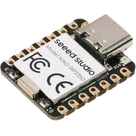
The XIAO RP2350 packs the power of the Raspberry Pi RP2350 (switchable architecture of dual Arm Cortex-M33 cores running at 150MHz with FPU, and dual open-hardware Hazard3 RISC‑V cores, enhanced security and encryption) into the classic XIAO form factor. Measuring just 21x17.5mm, it features 19 multifunction GPIOs, an RGB LED, and a Battery Management System with ultra-low power consumption of 27μA, battery power supply, and direct battery voltage measurement. Thanks to the XIAO ecosystem, the XIAO RP2350 is compatible with a wide range of add-ons, including displays, LED matrix, Grove modules, CAN Bus, Vision AI sensors, and mmWave sensors. With native support for MicroPython, C, and C++, the XIAO RP2350 is perfect for developers of all levels looking to create compact, battery-powered applications for smart control, wearables, DIY keyboards, and more.
Pricing & Availability
Distributor | Qty 1 |
|---|
Assets

image.png
imageThumbnailXIAO RP2350_.step
XIAO RP2350_3D Model
rp2350.svg
rp2350DefaultControls
Welcome 👋
Flux accelerates your PCB design with AI.
Create your account to start using this component and bring your ideas to life.