MAX7219 8x8 Dot Matrix Display Module_Vertical
The 8x8 Dot Matrix Display Module has a MAX7219 driver IC and an 8x8 LED Matrix. All common microcontrollers can be connected to this module by using a 4-wire serial interface. This 8x8 DMD Module requires only 3 I/O lines for driving the display. #Module #Display #Matrix... show more88 Uses
0 Stars

SIWG917Y111MGABAR
Bluetooth, WiFi 802.11b/g/n/ax, Bluetooth v5.4 Transceiver Module 2.4GHz Integrated, Chip Surface Mount Silicon Labs SiWG917 module is our lowest power Wi-Fi 6 plus Bluetooth LE 5.4, ideal for ultra-low power IoT wireless devices using Wi-Fi®, Bluetooth, Matter, and IP networking for secure cloud connectivity. It is optimal for developing battery operated devices that need long battery life. SiWG917 module includes an ultra-low power Wi-Fi 6 plus Bluetooth Low Energy (LE) 5.4 wireless CPU subsystem, and an integrated micro-controller (MCU) application subsystem, security, peripherals and power management subsystem all in a single 16 x 21.1 x 2.3 mm package. The wireless subsystem consists of a multi-threaded Network Wireless Processor (NWP) running up to 160 MHz, baseband digital signal processing, analog front end, 2.4 GHz RF transceiver and integrated power amplifier. The application subsystem consists of an ARM® Cortex®-M4 running up to 180 MHz, embedded SRAM, flash, ultra-low power sensor hub, and matrix vector processor. The ARM® Cortex®-M4 is dedicated for peripheral and application-related processing, while the NWP runs the wireless and networking stacks on independent threads, thus providing a fully integrated solution that is ready for a wide range of embedded wireless IoT applications. The modules come with modular radio type approvals for various countries, including USA (FCC), Canada (IC/ISED) and Japan (MIC), and are in compliance with the relevant EN standards (including EN 300 328 v2.2.2) for the conformity with the directives and regulations in EU and UK. KEY FEATURES • Wi-Fi 6 Single Band 2.4 GHz 20 MHz 1x1 stream IEEE 802.11 b/g/n/ax • Bluetooth LE 5.4 • Single chip Matter Over Wi-Fi Solution • ARM® Cortex® M4 Processor with FPU subsystem up to 180 MHz with rich set of Digital and Analog Peripherals. • Wi-Fi 6 Benefits: TWT for improved efficiency and longer battery life, MUMIMO/OFDMA for Higher Throughput, network capacity and low latency • Best in Class Device and Wireless Security • WLAN Tx power up to +17.5 dBm with integrated PA • Bluetooth LE Tx power up to +17 dBm with integrated PA • WLAN Rx sensitivity as low as -95.5 dBm • Wi-Fi 4 Standby Associated mode current: 71 μA @ 1-second listen interval • Embedded Flash option up to 8 MB/ optional external Flash up to 16 MB • Embedded PSRAM option up to 2 MB/ optional external PSRAM option up to 16 MB • Ultra-low power sensor hub peripherals • Matrix Vector Processor (MVP) • Embedded Wi-Fi, Bluetooth LE, Matter, and networking stacks supporting wireless coexistence • Three software-configurable MCU application memory options for sharing the RAM between the wireless, system, and application (192/256/320 KB) • Operating temperature: -40 to +85 ºC • Operating supply range: 3.0 to 3.63 V • Supply voltage for GPIOs: 1.71 to 3.63 V #WiFi6 #BluetoothLE54 #IoTModule #WirelessSoC #SiliconLabs #EmbeddedSystems #SmartHome #IndustrialIoT #LowPowerDesign #RFModule #ConnectedDevices #EdgeComputing #MatterReady #PCBDesign #ElectronicsEngineering... show more611 Uses
0 Stars
Seeed Studio XIAO RP2350
The XIAO RP2350 packs the power of the Raspberry Pi RP2350 (switchable architecture of dual Arm Cortex-M33 cores running at 150MHz with FPU, and dual open-hardware Hazard3 RISC‑V cores, enhanced security and encryption) into the classic XIAO form factor. Measuring just 21x17.5mm, it features 19 multifunction GPIOs, an RGB LED, and a Battery Management System with ultra-low power consumption of 27μA, battery power supply, and direct battery voltage measurement. Thanks to the XIAO ecosystem, the XIAO RP2350 is compatible with a wide range of add-ons, including displays, LED matrix, Grove modules, CAN Bus, Vision AI sensors, and mmWave sensors. With native support for MicroPython, C, and C++, the XIAO RP2350 is perfect for developers of all levels looking to create compact, battery-powered applications for smart control, wearables, DIY keyboards, and more.... show more32 Uses
5 Stars
MGM240SD22VNA2
802.15.4, Bluetooth Bluetooth v5.3, Thread, Zigbee® Transceiver Module 2.4GHz PCB Trace, Antenna Not Included, U.FL Surface Mount with Matrix Vector Processor #MCU #RF #arduino #arduino-matter... show more2 Uses
0 Stars
Keypad lock Module
This module involves the design of a keypad lock system. It utilizes an ATMEGA328P microcontroller, buzzers, LEDs for indicator functions and a 4x3 matrix keypad. An in-circuit serial programming (ISP) header is also present for programming the microcontroller. #template #lock #keypad #reusable #module #simple-embedded #microchip #arduino #atmega328 #TPS613222A #ISP #buzzer #sublayout... show more222 Uses
2 Stars
Snowshoe MX
Very basic PCB for a single Kailh MX hot swap socket in a keyboard matrix. Designed for COL2ROW diode direction.... show more836 Uses
0 Stars
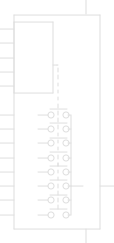
ADG728
Single 8-to-1 CMOS Low Voltage 2-Wire Serially Controlled, Matrix Switches analog switch selector multiplexer TWI I2C IIC 8-to-1 TSSOP*4.4x5mm*P0.65mm*... show more9 Uses
0 Stars
444
The XIAO RP2350 packs the power of the Raspberry Pi RP2350 (switchable architecture of dual Arm Cortex-M33 cores running at 150MHz with FPU, and dual open-hardware Hazard3 RISC‑V cores, enhanced security and encryption) into the classic XIAO form factor. Measuring just 21x17.5mm, it features 19 multifunction GPIOs, an RGB LED, and a Battery Management System with ultra-low power consumption of 27μA, battery power supply, and direct battery voltage measurement. Thanks to the XIAO ecosystem, the XIAO RP2350 is compatible with a wide range of add-ons, including displays, LED matrix, Grove modules, CAN Bus, Vision AI sensors, and mmWave sensors. With native support for MicroPython, C, and C++, the XIAO RP2350 is perfect for developers of all levels looking to create compact, battery-powered applications for smart control, wearables, DIY keyboards, and more.... show more3 Uses
0 Stars




Page 1 of 3
Next