USB Security Token
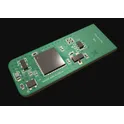
This design implements a USB security token powered by an STM32 microcontroller. The device is engineered for compactness and efficient PCB integration while ensuring robust security features. Key elements of the design include: - **Microcontroller Core:** A STM32F103T8U6 serves as the primary processing unit, handling USB communication and security protocols. - **USB Interface:** A USB-A plug provides connectivity to the host. Dedicated net portals ensure proper routing of the VBUS, D+, D–, and ground signals. - **Power Regulation:** A low-dropout regulator supplies a stable 3.3V operating voltage, ensuring low noise and proper current supply to the microcontroller and peripherals. - **Signal Conditioning and EMI Filtering:** An EMI filter is used to maintain signal integrity and reduce interference while preserving the security token’s functionality. - **Synchronous Elements:** A ceramic resonator is incorporated to provide a precise clock source for USB data transfer and microcontroller operations. - **Additional Components:** Surface-mount resistors, capacitors, and LED indicators are deployed to ensure proper conditioning, decoupling, and status feedback. Their compact 0402 packages facilitate a highly integrated design. - **Connectivity and Net Portals:** Custom net portals are used throughout the schematic to streamline connectivity and PCB layout, keeping the design modular and easy to modify. This USB security token is designed with industry-standard components and robust connectivity to ensure secure, reliable operation in portable security applications. #USBToken #STM32 #PCBDesign #SecurityTechnology #PortableSecurity #Microcontrollers #USBInterface #PowerRegulation #EMIProtection #CompactDesign... show more0 Uses
255 Comments
30 Stars
TPS54331 Buck converter 3.3V
This project appears to be a power supply circuit using the TPS54331 step-down (Buck) converter from Texas Instruments. The target output voltage is 3.3V. It also features electromagnetic interference (EMI) mitigation components such as an inductor, capacitors and a diode. An LED is included for indication purposes. #Buck #TPS54331 #project... show more0 Uses
8 Comments
1 Star

EMISOR SISMAAI
Welcome to your new project. Imagine what you can build here.... show more0 Uses
0 Comments
1 Star
Realistic Brown Battle Mech
Nice — you can do a clean pulse + latch using a single quad Schmitt-NAND chip: 74HC132 (or 74LVC132 for 3.3 V systems). The HC132 contains four 2-input NAND gates with Schmitt inputs so you can both clean a noisy SYN480R DATA line and build an SR latch (NAND SR is active-LOW) inside one package. Only a few passives and a driver transistor are needed. Below is a ready-to-build recipe (parts, wiring, explanation, tuning tips, and an ASCII schematic) — no extra logic ICs required. Parts (per latch) 1 × 74HC132 (quad 2-input NAND with Schmitt inputs). If your system is 3.3 V use 74LVC132 / 74HC132 rated for 3.3 V. Rin = 47 kΩ (input series) Cfilter = 10 nF (input RC to ground) — tweak for debounce/clean time Rpulldown = 100 kΩ (pull-down at input node, optional) Rpullup = 100 kΩ (pull-up for active-LOW R input so reset is idle HIGH) Rbase = 10 kΩ, Q = 2N2222 (NPN) or small N-MOSFET (2N7002) to drive your load Diode for relay flyback (1N4001) if you drive a coil Optional small cap 0.1 µF decoupling at VCC of IC Concept / how it works (short) Use Gate1 (G1) of 74HC132 as a Schmitt inverter by tying its two inputs together and feeding a small RC filter from SYN480R.DATA. This removes HF noise and provides a clean logic transition. Because it's a NAND with tied inputs its function becomes an inverter with Schmitt behavior. Use G2 & G3 as the cross-coupled NAND pair forming an SR latch (active-LOW inputs S̄ and R̄). A low on S̄ sets Q = HIGH. A low on R̄ resets Q = LOW. Wire the cleaned/inverted output of G1 to S̄. A valid received pulse (DATA high) produces a clean LOW on S̄ (because G1 inverts), setting the latch reliably even if the pulse is brief. R̄ is your reset input (pushbutton, HT12D VT, MCU line, etc.) — idle pulled HIGH. Q drives an NPN/MOSFET to switch your load (relay, LED, etc.). Recommended wiring (pin mapping, assume one chip; use datasheet pin numbers) I’ll refer to the 4 gates as G1, G2, G3, G4. Use G4 optionally for additional conditioning or to build a toggler later. SYN480R.DATA --- Rin (47k) ---+--- Node A ---||--- Cfilter (10nF) --- GND | Rpulldown (100k) --- GND (optional, keeps node low) Node A -> both inputs of G1 (tie inputs A and B of Gate1 together) G1 output -> S̄ (S_bar) (input1 of Gate2) Gate2 (G2): inputs = S̄ and Q̄ -> output = Q Gate3 (G3): inputs = R̄ and Q -> output = Q̄ R̄ --- Rpullup (100k) --- VCC (reset is idle HIGH; pull low to reset) (optional) R̄ can be wired to a reset pushbutton to GND or to an MCU pin Q -> Rbase (10k) -> base of 2N2222 (emitter GND; collector to one side of relay coil) Other side of relay coil -> +V (appropriate coil voltage) Diode across coil If you prefer MOSFET low side switching: Q -> gate resistor 100Ω -> gate of 2N7002 2N7002 source -> GND ; drain -> relay coil low side... show more0 Uses
0 Comments
1 Star
Fast Silver Flubber
Create a schematic diagram of an electric fence controller using the NE556 dual timer IC. The circuit must include all components with clear electronic symbols (resistors, capacitors, transistors, diode, relay) connected by lines as in a real circuit diagram. Specifications: 1. Power supply: - Vcc = +12V connected to pin 14 of the NE556. - Pin 1 of the NE556 to ground. 2. Timer A (active 10 seconds): - Pin 2 (Trigger A) receives a pulse from transistor Q2 (contact detector). - Pin 6 (Threshold A) connected to Pin 7 (Discharge A). - R1 = 1 MΩ between Pin 7 and +12V. - C1 = 10 µF between Pin 6 and ground. - Pin 3 (Out A) goes through a 4.7 kΩ resistor to the base of Q1 (BC547 NPN transistor). - Pin 3 also connected via a 100 nF capacitor to Pin 13 (Trigger B of Timer B). 3. Timer B (rest 10 seconds): - Pin 9 (Discharge B) and Pin 8 (Threshold B) connected together. - R2 = 1 MΩ between Pin 9 and +12V. - C2 = 10 µF between Pin 8 and ground. - Pin 12 (Out B) can be optionally used to block retrigger of Timer A. 4. Relay driver stage: - Q1 = BC547 NPN transistor. - Base connected through 4.7 kΩ resistor to Pin 3 (Out A). - Emitter to ground. - Collector connected to one side of the relay coil. - Other side of relay coil connected to +12V. - A diode 1N4007 placed in parallel with the relay coil (cathode to +12V, anode to collector of Q1). - Relay contacts switch the +12V supply to the electric fence energizer. 5. Contact detector: - Shunt resistor ≈0.1 Ω placed in series with the fence output. - Q2 = BC547 NPN transistor, base connected to the shunt, emitter to ground, collector to Pin 2 (Trigger A). - When current flows through the shunt, Q2 provides a trigger pulse to Timer A. Please draw the schematic in a standard style with components connected by straight lines, not in block diagrams. Show clear pin numbers of the NE556 and all external components.... show more0 Uses
0 Comments
1 Star
STM32H7 PZT EMI Impedance Meter
STM32H743VIT6 기반 PZT EMI 임피던스 측정 회로... show more0 Uses
0 Comments
0 Stars
TPA3140D2PWP
The Texas Instruments TPA3140D2 is a high-efficiency, Class-D audio power amplifier designed for driving bridged-tied stereo speakers with outputs up to 10 W per channel into 6 Ω or 8 Ω loads. With advanced EMI suppression technology, including spread spectrum control and a 1SPW modulation scheme, the TPA3140D2 ensures robust performance while minimizing electromagnetic interference. Operating within a wide supply voltage range from 4.5 V to 14.4 V, this amplifier eliminates the need for heat sinks due to its up to 90% efficient Class-D operation. Integrated SpeakerGuard™ protection features such as automatic gain limit (AGL), adjustable power limiter, and DC protection enhance speaker safety and audio quality. Additionally, the TPA3140D2 includes comprehensive protection against pin-to-pin, pin-to-ground, and pin-to-power short circuits, as well as thermal protection with auto recovery. The device offers four selectable fixed gain settings and supports both single-ended and differential analog inputs, making it suitable for a variety of consumer audio applications including televisions, wireless speakers, mini speakers, and USB speakers. The TPA3140D2 is available in a 28-pin HTSSOP package, ensuring ease of integration into compact designs.... show more0 Uses
13 Comments
0 Stars
PAM8610TR 9dA5 6b24
The PAM8610, manufactured by Power Analog Microelectronics, is a high-performance, 10W (per channel) stereo class-D audio amplifier featuring DC volume control. This component is designed to deliver low THD+N (0.1%), low EMI, and high efficiency (>90%), making it ideal for high-quality sound reproduction in a variety of applications such as flat monitor/LCD TVs, multi-media speaker systems, DVD players, game machines, boomboxes, and musical instruments. Operating off a 7V to 15V supply, the PAM8610 distinguishes itself with its 32-step DC volume control ranging from -75dB to 32dB, shutdown/mute/fade functions, and comprehensive protection against overcurrent, thermal, and short-circuit conditions. Its low quiescent current, pop noise suppression, and minimal external component requirement further enhance its appeal for compact and efficient audio solutions. The PAM8610 is available in a compact 40-pin QFN 6mm*6mm package, ensuring a small footprint for space-constrained applications. Compliance with RoHS standards underscores its environmental consideration. With its advanced features and high integration level, the PAM8610 offers a compelling option for designers seeking to incorporate robust audio amplification with fine-grained volume control in their electronic projects.... show more0 Uses
1 Comment
0 Stars
PlantINT
## PROJECT OVERVIEW Design a compact, battery-powered, IoT-connected plant monitoring PCB sensor node. The board combines WiFi/BLE connectivity, multi-sensor I2C acquisition, LiPo battery management with USB-C charging, and partially weatherproof design for outdoor/planter use. The physical form factor is a FORK (forcina) shape: a wider rectangular head section (~32×30mm) housing all the electronics, and two narrow prongs (~10×45mm each, 8mm gap between them) extending downward to form the capacitive soil moisture electrodes. Reference: the shape resembles a plant stake that is pushed into soil. I trust Flux AI's routing and placement judgment. Please apply your full expertise. The guidance below defines constraints — treat them as requirements, not suggestions. --- ## BOARD SPECIFICATIONS - Layers: 2 (Top + Bottom copper) - Dimensions: Head 32×30mm + two prongs 10×45mm (total board ~32×75mm) - PCB thickness: 1.6mm FR4 - Surface finish: ENIG (Electroless Nickel Immersion Gold) — MANDATORY Reason: the soil prong traces must be gold-plated for corrosion resistance - Min trace width: 0.15mm signal, 0.5mm power - Min clearance: 0.15mm - Soldermask: GREEN on both sides Exception: NO soldermask on the interdigital soil electrode traces on the prongs (the copper must be fully exposed to contact the soil) - Via: min hole 0.3mm, pad 0.6mm - 4× M2.5 mounting holes (2.7mm drill, 5mm annular copper ring) at corners of head section - Conformal coating keep-out zones: SHT40-AD1F-R2 (U8), VEML7700 (U2), soil electrode traces on prongs, USB-C connector J1 --- ## COMPLETE BILL OF MATERIALS ### Active ICs **U1 — ESP32-C3-MINI-1** (Espressif, LCSC C2838502) - Main microcontroller: RISC-V 32-bit 160MHz, 4MB flash, 400KB RAM - WiFi 802.11b/g/n 2.4GHz + BLE 5.0 - Package: SMD module 13.2×16.6×2.4mm, castellated edges - Operating voltage: 3.0–3.6V from VCC rail - I2C: SDA=GPIO8, SCL=GPIO9 - USB: D+=IO19, D-=IO18 - Status outputs: CHG_STATUS=IO2, PG_STATUS=IO3, LOAD_EN=IO4 - CRITICAL placement: antenna area (rightmost ~3mm of module) must hang over board edge OR have copper keepout zone (no copper top or bottom under antenna area). This is mandatory for RF performance. - Add 100nF + 10µF decoupling on 3V3 pin, placed within 1mm of pin **U2 — VEML7700-TT** (Vishay, LCSC C78606) - Ambient light sensor, 0.0036–120,000 lux, I2C address 0x10 - Package: ODFN-6, 2.0×2.0×0.5mm - Operating voltage: 2.5–3.6V - Current: 90µA active, 0.2µA power-down - CRITICAL placement: position at TOP EDGE of head section, centered horizontally. The sensor photodiode window (top of package) must face upward toward the case lid. A transparent PMMA optical window (Ø10mm) in the case will be positioned directly above this IC. Leave 0mm clearance to board edge on that side if possible. The VEML7700 has ±45° field of view, so alignment does not need to be perfect, but centering under the window opening is preferred. - Add 100nF decoupling on VDD, placed within 1mm **U3 — SHT40-AD1B** (Sensirion, LCSC C1550099) — INTERNAL sensor - Temperature + relative humidity sensor, I2C address 0x44 - Package: DFN-4, 1.5×1.5×0.5mm — extremely small, requires careful pad design - Operating voltage: 1.8–3.6V - Current: 3.2µA per measurement (1ms active), 0.1µA sleep - PURPOSE: measures temperature and humidity INSIDE the case (ambient reference) - CRITICAL placement: position in CENTER of head section PCB, far from all heat sources. Minimum 8mm distance from BQ24090 (U6) and ME6211 (LDO1). The SHT40 chip surface IS the sensor — the hygroscopic polymer capacitor is on the top face of the IC. It must NOT be covered by conformal coating. However, for the internal sensor (U3), it can be in a slightly ventilated cavity inside the case to measure internal temperature drift compensation. - Add 100nF decoupling on VDD within 1mm **U8 — SHT40-AD1F-R2** (Sensirion, LCSC C5155469) — EXTERNAL sensor - Same electrical specs as U3 (SHT40 family), I2C address 0x44 - Package: DFN-4 with integrated PTFE filter cap for dust/water protection The filter cap allows vapor to reach the sensor while blocking liquid water - PURPOSE: measures EXTERNAL ambient temperature and humidity (outside the case) - CRITICAL placement: position on the SIDE or BOTTOM EDGE of head section. This sensor must be accessible from outside the case through a ventilated chamber (labyrinth vent structure in case design). It must NOT be covered by conformal coating. The sensor's filter cap must face the vent opening direction. Minimum 10mm distance from BQ24090 and LDO thermal zone. - Connected via TCA9548A channel 1 (see below) — NOT directly on main I2C bus **U4 — FDC1004DGST** (Texas Instruments, LCSC C266239) - 4-channel capacitance-to-digital converter, I2C address 0x50 - Package: WSON-8, 2.0×2.0×0.8mm - Operating voltage: 3.3V - Current: 750µA active, 300nA shutdown - PURPOSE: reads capacitance of interdigital PCB traces immersed in soil. The IC itself is NOT the soil sensor — it measures the capacitance of external electrodes. CIN1 and CIN2 connect to the interdigital copper traces on the prong section. - CRITICAL placement: position at BOTTOM of head section, closest to prong entry point. This minimizes trace length to CIN1/CIN2, reducing parasitic capacitance pickup. Keep CIN1 and CIN2 traces short, wide (0.3mm+), shielded by GND guard rings on both sides of each trace. Route CIN1/CIN2 on the SAME layer (Bottom preferred) as the interdigital electrodes to avoid via parasitic capacitance. - SHLD1 and SHLD2 pins connect to GND (guard shield) - Add 100nF decoupling on VDD within 1mm **U5 — TCA9548A** (Texas Instruments, LCSC C130026) — NEW COMPONENT vs previous schema - 8-channel I2C multiplexer, I2C address 0x70 - Package: SOIC-24 or TSSOP-24, select smallest available footprint - Operating voltage: 1.65–5.5V - PURPOSE: MANDATORY to resolve I2C address conflict between U3 and U8, both of which have fixed address 0x44. Without this IC the two SHT40 sensors will collide on the bus and produce corrupt readings. Channel 0: connects to U3 (SHT40 internal) Channel 1: connects to U8 (SHT40 external) Main I2C bus (from ESP32): connects to TCA9548A upstream SDA/SCL - Add 100nF decoupling on VCC within 1mm - Reset pin (active low): connect to VCC via 10kΩ (always enabled) OR connect to a GPIO for software reset capability **U6 — BQ24090DGQT** (Texas Instruments, LCSC C179663) - Single-cell LiPo/Li-ion battery charger, input 4.5–6.5V, charge voltage 4.2V - Package: DSBGA-9 (wafer-level), extremely small ~1.6×1.6mm - CRITICAL THERMAL: this IC dissipates up to 0.5W during charging. Place a copper thermal pad area ≥1cm² on BOTH layers under the IC. Add minimum 4 thermal vias (0.3mm hole, 0.6mm pad) under thermal exposed pad. Keep this IC at MAXIMUM distance from both SHT40 sensors. Thermal isolation: route at least 10mm of thin trace (~0.2mm) between BQ24090 thermal zone and any temperature-sensitive component. - ISET pin: connect to R3 (1.8kΩ) to set Icharge ≈ 494mA (C/4 for 2000mAh) - PRETERM pin: connect to R2 (5.1kΩ — keep existing value, sets termination threshold) - ISET2 pin: connect per datasheet recommendation (typically VSYS or VBAT) - TS pin: connect to R4 (10kΩ NTC thermistor or static resistor to GND) If using static resistor: 10kΩ to GND disables thermal protection RECOMMENDATION: add NTC 10kΩ B=3950 near battery for thermal protection - CHG# (open drain): connect to LED_RED via 330Ω to VCC, and to U1 IO2 via 10kΩ - PG# (open drain): connect to LED_GREEN via 330Ω to VCC, and to U1 IO3 via 10kΩ - OUT pin: VBAT rail (to battery positive and to LDO input) **LDO1 — ME6211C33M5G-N** (Nanjing Micro One, LCSC C82942) - LDO regulator, Vin 2.0–6.0V → Vout 3.3V fixed - Package: SOT-23-5, 2.9×1.6mm - Quiescent current: 55µA (higher than MCP1700, but adequate) - Dropout: 300mV @ 100mA - CE pin: connect to VCC (always enabled) or to ESP32 GPIO for power gating - THERMAL NOTE: at full system load (~100mA), dissipation = (Vbat-3.3)×0.1 ≈ 40–90mW. Low risk, but keep minimum 5mm from SHT40 sensors. - Vin decoupling: C2 1µF + C1 100nF - Vout decoupling: C3 10µF (electrolytic or ceramic) + additional 100nF ceramic **O1 — SI2301CDS** (Vishay, LCSC C10487) - P-channel MOSFET, Vds=-20V, Id=-3A, Vgs(th)=-0.4V typ - Package: SOT-23, 2.9×1.6mm - PURPOSE: load switch between VBAT and LDO1 input, controlled by ESP32 This allows the ESP32 to cut power to all sensors during deep sleep for maximum battery life (if desired — optional feature) - Gate connection: 10kΩ pull-up resistor from Gate to VBAT (MOSFET OFF by default) + GPIO IO4 from ESP32 drives Gate to GND through 1kΩ series resistor to turn ON IMPORTANT: this was missing from previous schema — gate must NOT float. Series 1kΩ on gate limits gate charge current and protects GPIO. Pull-up 10kΩ to VBAT ensures MOSFET stays OFF during ESP32 boot/reset. - Source: VBAT (battery positive) - Drain: LDO1 VIN ### Connectors and Passive Components **J1 — USBC_C165948** (USB Type-C SMD receptacle, LCSC C165948) - USB-C connector for 5V power input and ESP32 programming - Position: TOP EDGE of head section (accessible when device is in soil) - VBUS pins → BQ24090 IN (via R_protection 1Ω/1A fuse resistor optional) - D+ → ESP32 IO19, D- → ESP32 IO18 - GND → GND plane - All CC pins → GND via 5.1kΩ resistors (CC1: R_CC1 5.1kΩ, CC2: R_CC2 5.1kΩ) These are MANDATORY for USB-C to deliver 5V (tells charger it is a sink device) WITHOUT these resistors the USB-C port will NOT receive power from modern chargers. **U_BAT — LiPo 2000mAh connector** - Use JST PH 2.0mm 2-pin connector (standard LiPo connector) - Position: head section, easily accessible for battery replacement - Polarity protection: the SI2301 load switch also provides polarity protection if wired with Source=Drain correctly (P-FET body diode blocks reverse current) **R1 — 4.7kΩ ±1% 0402** (CHANGED from 5.1kΩ in previous schema) - I2C SDA pull-up: connects VCC to SDA bus - Reason for change: 4.7kΩ is the standard I2C pull-up value per NXP I2C spec. 5.1kΩ causes slower rise times at 400kHz fast-mode, risking data errors. **R2 — 4.7kΩ ±1% 0402** (CHANGED from 5.1kΩ in previous schema) - I2C SCL pull-up: connects VCC to SCL bus **R3 — 1.8kΩ ±1% 0402** - BQ24090 ISET: sets charge current to ~494mA (Ichg = 890/R3) **R4 — 10kΩ 0402** - BQ24090 TS pin bias or NTC resistor (see BQ24090 notes above) **R5, R6 — 5.1kΩ 0402** (NEW — not in previous schema) - USB-C CC1 and CC2 pull-down resistors (MANDATORY for USB-C power delivery) **R7 — 10kΩ 0402** (NEW) - SI2301 Gate pull-up to VBAT **R8 — 1kΩ 0402** (NEW) - SI2301 Gate series resistor from ESP32 GPIO IO4 **R9, R10 — 330Ω 0402** (NEW) - Current limiting for LED_RED and LED_GREEN (status LEDs) **C1 — 100nF 0402 X5R** — LDO Vin decoupling **C2 — 1µF 0402 X5R** — LDO Vin bulk **C3 — 10µF 0805 X5R** — LDO Vout bulk **C4 — 100nF 0402** — ESP32 VCC decoupling **C5–C9 — 100nF 0402** — Per-IC VCC decoupling (one per U2/U3/U4/U5/U8) **C10 — 4.7µF 0402** — BQ24090 IN bypass **C11 — 4.7µF 0402** — BQ24090 OUT bypass **LED1 — Green 0402** — USB power good / charging complete indicator **LED2 — Red 0402** — Charging in progress indicator **BTN1 — 3×3mm SMD tactile switch** (optional, recommended) - Connected between ESP32 EN pin and GND, with 100nF debounce cap - Allows manual reset without USB for field use --- ## ELECTRICAL NETS SUMMARY | Net Name | Description | Connected to | |----------|-------------|--------------| | VBUS_5V | USB-C 5V input | J1 VBUS, BQ24090 IN | | VBAT | Battery voltage 3.2–4.2V | U_BAT+, BQ24090 OUT, O1 Source | | VCC | Regulated 3.3V | LDO1 OUT, all IC VDD/VCC pins | | GND | Common ground | All GND pins, copper pour both layers | | SDA | I2C data (main bus) | ESP32 IO8, TCA9548A SDA_A, VEML7700 SDA, FDC1004 SDA, R1 pull-up | | SCL | I2C clock (main bus) | ESP32 IO9, TCA9548A SCL_A, VEML7700 SCL, FDC1004 SCL, R2 pull-up | | SDA_CH0 | I2C mux channel 0 | TCA9548A SD0, SHT40-internal SDA | | SCL_CH0 | I2C mux channel 0 | TCA9548A SC0, SHT40-internal SCL | | SDA_CH1 | I2C mux channel 1 | TCA9548A SD1, SHT40-external SDA | | SCL_CH1 | I2C mux channel 1 | TCA9548A SC1, SHT40-external SCL | | SOIL_A | Soil electrode set A | FDC1004 CIN1, interdigital traces prong (even fingers) | | SOIL_B | Soil electrode set B | FDC1004 CIN2, interdigital traces prong (odd fingers) | | USB_DP | USB D+ | J1 D+, ESP32 IO19 | | USB_DM | USB D- | J1 D-, ESP32 IO18 | | CHG_STATUS | Charger status | BQ24090 CHG#, LED_RED, ESP32 IO2 | | PG_STATUS | Power good | BQ24090 PG#, LED_GREEN, ESP32 IO3 | | LOAD_EN | Load switch control | ESP32 IO4 via R8, SI2301 Gate | --- ## PARASITIC AND SIGNAL INTEGRITY CONSTRAINTS Please consider the following parasitic effects when placing components and routing: **I2C bus parasitics:** The I2C specification allows maximum 400pF total bus capacitance. With 4 devices on the main bus (ESP32, VEML7700, FDC1004, TCA9548A) plus the multiplexed sub-buses, keep total SDA/SCL trace length under 50mm. Route SDA and SCL as a parallel differential pair with 0.15mm clearance between them. Do not route I2C traces near switching power lines or under the antenna keep-out zone. **FDC1004 CIN1/CIN2 parasitic capacitance — CRITICAL:** Any stray capacitance on CIN1/CIN2 traces directly offsets the soil measurement. Each picofarad of parasitic capacitance reduces measurement range. Requirements: - Keep CIN1/CIN2 trace length under 15mm from FDC1004 pins to prong entry point - Route on Bottom layer only, no layer changes (vias add ~0.5pF each) - Add copper guard ring (connected to SHLD1/SHLD2=GND) completely surrounding each CIN trace on the same layer — this shields the trace from external fields - Maintain 0.5mm spacing between CIN1 trace and CIN2 trace (and their guard rings) - The interdigital soil electrodes on the prongs: finger width 0.8mm, gap 0.8mm, finger length 25mm, approximately 15–20 alternating fingers per electrode These traces have NO soldermask (fully exposed copper, ENIG finish) **BQ24090 switching node:** The BQ24090 is a linear charger, NOT a switching regulator, so there is no switching noise. However, it dissipates power as heat. The primary constraint is thermal, not EMI. Keep input/output bypass capacitors (C10, C11) within 2mm. **ESP32-C3 antenna zone:** Mandatory keepout: no copper, no traces, no vias, no components in the area directly beneath and 3mm around the ESP32 module antenna. The antenna is on the left side of the module. Orient the module so the antenna faces toward the top or side edge of the board. **Power supply decoupling placement:** All 100nF decoupling capacitors MUST be placed within 1mm of their associated VCC/VDD pin. The parasitic inductance of a longer connection nullifies the effect. Place decoupling on the same layer as the IC where possible. The 10µF bulk cap (C3) can be up to 5mm from the LDO output. **Thermal gradients and temperature sensor placement:** The two SHT40 sensors measure temperature via an on-chip bandgap reference. Self-heating of nearby components creates a thermal offset error. Known heat sources on this board and their typical power dissipation: - BQ24090: up to 500mW during USB charging - ME6211 LDO: 40–90mW at typical load - ESP32-C3: 15–25mW in active mode (WiFi), 0.02mW in deep sleep Required minimum distances from any SHT40: - From BQ24090: ≥12mm (critical) - From ME6211 LDO: ≥8mm - From ESP32-C3: ≥5mm (less critical — low dissipation) --- ## THERMAL MANAGEMENT REQUIREMENTS The device will be used outdoors in ambient temperatures from -10°C to +50°C. The case is a sealed or semi-sealed plastic enclosure approximately 35×35×80mm. Internal temperature rise above ambient must be kept below +8°C during USB charging. **BQ24090 thermal design:** - Thermal pad (exposed pad on DSBGA package): connect to copper area on both layers - Top layer: copper fill area ≥ 1cm² directly under and around IC - Bottom layer: mirrored copper fill area ≥ 1cm² connected via thermal vias - Minimum 4 thermal vias under pad: 0.3mm drill, 0.6mm pad, evenly distributed - These thermal vias conduct heat to bottom layer copper which acts as a heatsink - In the case design (outside scope of PCB): a thermally conductive pad between the PCB bottom copper and the plastic case back wall improves heat transfer **ME6211 LDO thermal design:** - Low dissipation at typical 50–80mA load: (4.0V - 3.3V) × 0.075A ≈ 52mW - This is well within SOT-23 package limits (max ~300mW at 25°C ambient) - Standard copper pour around package is sufficient - No additional thermal vias required unless load consistently exceeds 150mA **Fire safety note:** At no point should any trace carry more than its rated current. Power traces (VBAT, VCC) should be minimum 0.5mm for up to 500mA. The USB VBUS trace from J1 to BQ24090 carries up to 500mA — use 0.8mm trace. Add a polyfuse (PTC resettable fuse) 500mA on VBUS line between J1 and BQ24090 for short-circuit protection (LCSC C178886, 0805 package). --- ## WEATHERPROOFING DESIGN GUIDANCE (for PCB layout decisions) The board will be coated with conformal coating after assembly, EXCEPT: 1. SHT40-AD1F-R2 (U8 external sensor) — the PTFE filter cap must remain uncoated 2. VEML7700 (U2) — photodiode window must remain uncoated and unobstructed 3. Interdigital soil traces on prongs — must remain bare copper (ENIG) for soil contact 4. USB-C connector J1 — coating would block the port 5. Battery JST connector — coating would block connector mating For the PCB layout, implement the following to support weatherproofing: - Place U8 (SHT40 external) and U2 (VEML7700) in designated "coating exclusion zones" clearly marked on the silkscreen layer with dashed boundary lines - Add silkscreen labels: "NO COAT" next to U8 and U2 - Add silkscreen label: "EXPOSED — SOIL ELECTRODES" on the prong traces - The board outline on the prong section must have no sharp corners — use R1mm rounded corners where prongs meet the head section to prevent cracking when the device is pushed into soil --- ## INTERDIGITAL SOIL ELECTRODE SPECIFICATION (prong section) The bottom two prongs of the board ARE the soil moisture sensor. Trace parameters for the interdigital (comb/fork) capacitive electrodes: - Layer: Bottom copper - Trace width: 0.8mm - Gap between adjacent fingers: 0.8mm - Number of fingers per electrode: 16 (8 connected to CIN1, 8 to CIN2, alternating) - Finger length: 25mm - Connection point: at the top of the prongs where they join the head section - Guard ring: GND copper guard ring around the entire interdigital pattern on Bottom layer - NO soldermask over any part of the interdigital pattern - The two electrodes (SOIL_A and SOIL_B) must be symmetrically distributed so that a uniform electric field forms between them when immersed in soil - Add stitching GND vias around the prong perimeter every 8mm --- ## SILKSCREEN AND REFERENCE DESIGNATORS All components must have visible reference designators on the silkscreen layer. Minimum text size 0.6mm height. Add the following board information: - Top left: "SmartPlant v1.0" - Top right: "riccardo.schiavo.1" - Date code placeholder: "DATE: ______" - Near J1: PIN 1 marker and "USB-C POWER + FLASH" - Near U8: "EXTERNAL SENSOR — NO COAT" - Near prong junction: "SOIL ELECTRODES — NO MASK — ENIG" - Near ESP32 antenna area: keepout boundary marker --- ## I2C DEVICE MAP (for firmware reference) | Address | Device | Bus | Notes | |---------|--------|-----|-------| | 0x10 | VEML7700 (U2) | Main I2C | Direct connection | | 0x50 | FDC1004 (U4) | Main I2C | Direct connection | | 0x70 | TCA9548A (U5) | Main I2C | I2C multiplexer | | 0x44 ch.0 | SHT40 internal (U3) | TCA9548A channel 0 | Via mux | | 0x44 ch.1 | SHT40 external (U8) | TCA9548A channel 1 | Via mux | --- ## FINAL NOTES FOR FLUX AI I trust Flux AI's judgment on: - Exact component placement optimization within the constraints above - Via placement and layer assignments for non-critical signals - Polygon fill strategy and via stitching density - Any minor trace re-routing needed to clear DRC errors - Silkscreen label exact positioning to avoid overlap with pads Please prioritize in this order: 1. Electrical correctness (no DRC errors, no antenna violations) 2. Thermal management (BQ24090 copper, SHT40 distance from heat) 3. Signal integrity (FDC1004 CIN guard rings, I2C trace length) 4. Manufacturability (SMT assembly friendly, no isolated pads, no acute angles) 5. Physical compactness within the fork shape outline Generate a complete 2-layer PCB ready for Gerber export to PCBWay.... show more0 Uses
0 Comments
0 Stars
Handicapped Salmon Lightcycle
USB-C to SATA portable external hard drive enclosure controller. Architecture includes USB Type-C 5 V sink input with 5.1 kΩ CC pull-downs, VBUS ESD/TVS and overcurrent protection, USB 3.2 Gen1 SuperSpeed differential pairs into a USB-to-SATA bridge, SATA data and power output for a 2.5-inch drive, regulated 3.3 V logic rail with optional 1.8 V rail if required by the bridge, 25 MHz reference clock, power/activity LEDs, and test points. Design target is compact portable use with stable spin-up power delivery, low EMI, controlled-impedance high-speed routing, and production-grade BOM options.... show more0 Uses
0 Comments
0 Stars
Modest Purple Replicator
System Architecture Overview with PWM Interface, Power Stage, Protections, EMI Filters, Connectors, Hall-Effect Current Monitoring, 4-pin JST-XH Control Header, Isolation & Default-OFF PWM Behavior, Compact Mechanical Layout #hall-sensing #isolated-control #compact-layout... show more0 Uses
0 Comments
0 Stars
Desirable Apricot Holodeck
Optimized EMI Synchronous Buck Converter for CC/CV 4S4P Li-ion Battery Charging & Load Testing (150W, 18–60V to 16.8V/11.5A)... show more0 Uses
0 Comments
0 Stars
Proposed Sapphire X-Wing
Robust 24V-to-5V, 2A Synchronous Buck Converter with EMI, Surge, and Noise Protection Using TPS54336A... show more0 Uses
0 Comments
0 Stars
TPSM64406RCHR
The TPSM64404, TPSM64406, and TPSM64406E from Texas Instruments are highly integrated synchronous buck power modules designed for high power density and low EMI performance. These modules feature integrated MOSFETs, inductors, and controllers within a compact 6.5mm × 7.0mm × 2mm overmolded package, making them ideal for space-constrained applications. They support a wide input voltage range of 3V to 36V and deliver adjustable output voltages from 0.8V to 16V. The TPSM64404 offers dual 2A outputs or a stackable 4A output, while the TPSM64406 and TPSM64406E provide dual 3A outputs or a stackable 6A output, with the TPSM64406E rated for extended temperature ranges down to -55℃. These modules achieve peak efficiencies exceeding 93.5% and feature ultra-low quiescent current, making them suitable for battery-powered applications. Designed to meet stringent EMI standards, the modules include features such as dual input paths, integrated capacitors, spread spectrum modulation, and low-noise packaging. Additional functionalities include precision enable inputs, power-good indicators, overcurrent protection, thermal shutdown, and the ability to configure for multiphase operation up to 18A. The TPSM6440xx series is optimized for test and measurement, aerospace, defense, and factory automation applications.... show more0 Uses
0 Comments
0 Stars
TPSM64406EXTRCHR
Texas Instruments' TPSM6440xx series, including the TPSM64404, TPSM64406, and TPSM64406E, are highly integrated synchronous buck power modules designed for applications requiring high power density and low EMI. These modules support dual output or multiphase single output configurations, operating over a wide input voltage range from 3V to 36V and delivering adjustable output voltages from 0.8V to 16V. Encased in a compact 6.5mm x 7.0mm x 2mm overmolded package, they feature integrated MOSFETs, inductors, and controllers, ensuring ease of design and high efficiency with peak performance exceeding 93.5%. The TPSM6440xx modules are optimized for low noise and EMI, meeting CISPR 11 and 32 Class B emissions standards. They include robust protection features like precision enable inputs, power good indicators, overcurrent, and thermal shutdown protections, making them suitable for demanding applications in test and measurement, aerospace, defense, and factory automation. With a flexible design approach, these modules can be easily configured using Texas Instruments' WEBENCH® Power Designer tool.... show more0 Uses
0 Comments
0 Stars
PAM8610TR 9dA5 0ec4
The PAM8610, manufactured by Power Analog Microelectronics, is a high-performance, 10W (per channel) stereo class-D audio amplifier featuring DC volume control. This component is designed to deliver low THD+N (0.1%), low EMI, and high efficiency (>90%), making it ideal for high-quality sound reproduction in a variety of applications such as flat monitor/LCD TVs, multi-media speaker systems, DVD players, game machines, boomboxes, and musical instruments. Operating off a 7V to 15V supply, the PAM8610 distinguishes itself with its 32-step DC volume control ranging from -75dB to 32dB, shutdown/mute/fade functions, and comprehensive protection against overcurrent, thermal, and short-circuit conditions. Its low quiescent current, pop noise suppression, and minimal external component requirement further enhance its appeal for compact and efficient audio solutions. The PAM8610 is available in a compact 40-pin QFN 6mm*6mm package, ensuring a small footprint for space-constrained applications. Compliance with RoHS standards underscores its environmental consideration. With its advanced features and high integration level, the PAM8610 offers a compelling option for designers seeking to incorporate robust audio amplification with fine-grained volume control in their electronic projects.... show more0 Uses
0 Comments
0 Stars
Common Emitter Audio Amplifier PCB
12 V 2N2222 common-emitter audio amplifier PCB based on the uploaded reference diagram, with AC input coupling, adjustable base bias, emitter bypass, collector load, output coupling capacitor, and speaker connector.... show more0 Uses
0 Comments
0 Stars
Common Emitter Amplifier
Welcome to your new project. Imagine what you can build here.... show more0 Uses
2 Comments
0 Stars
Emision Acustica Ultrasonido
Welcome to your new project. Imagine what you can build here.... show more0 Uses
0 Comments
0 Stars
Emitter V1 final
Welcome to your new project. Imagine what you can build here.... show more0 Uses
0 Comments
0 Stars
emitter section
Welcome to your new project. Imagine what you can build here.... show more0 Uses
0 Comments
0 Stars
Circuito EMISOR
Welcome to your new project. Imagine what you can build here.... show more0 Uses
0 Comments
0 Stars

Haptic Glove Controller Board Rev2 764b
Haptic Glove Controller Board NUCLEO-F411RE based Fixed Servo Connections to match standard servo wiring Revised footprint of 2n3904s transistors since base and emitter footprint were swapped Larger power traces Swapped SDO and SDI of SPI Lines to the FPC connector so it matches with peripheral.... show more0 Uses
1 Comment
0 Stars


Page 1 of 2
Next