Hacer Agujeros en PCB

0:21
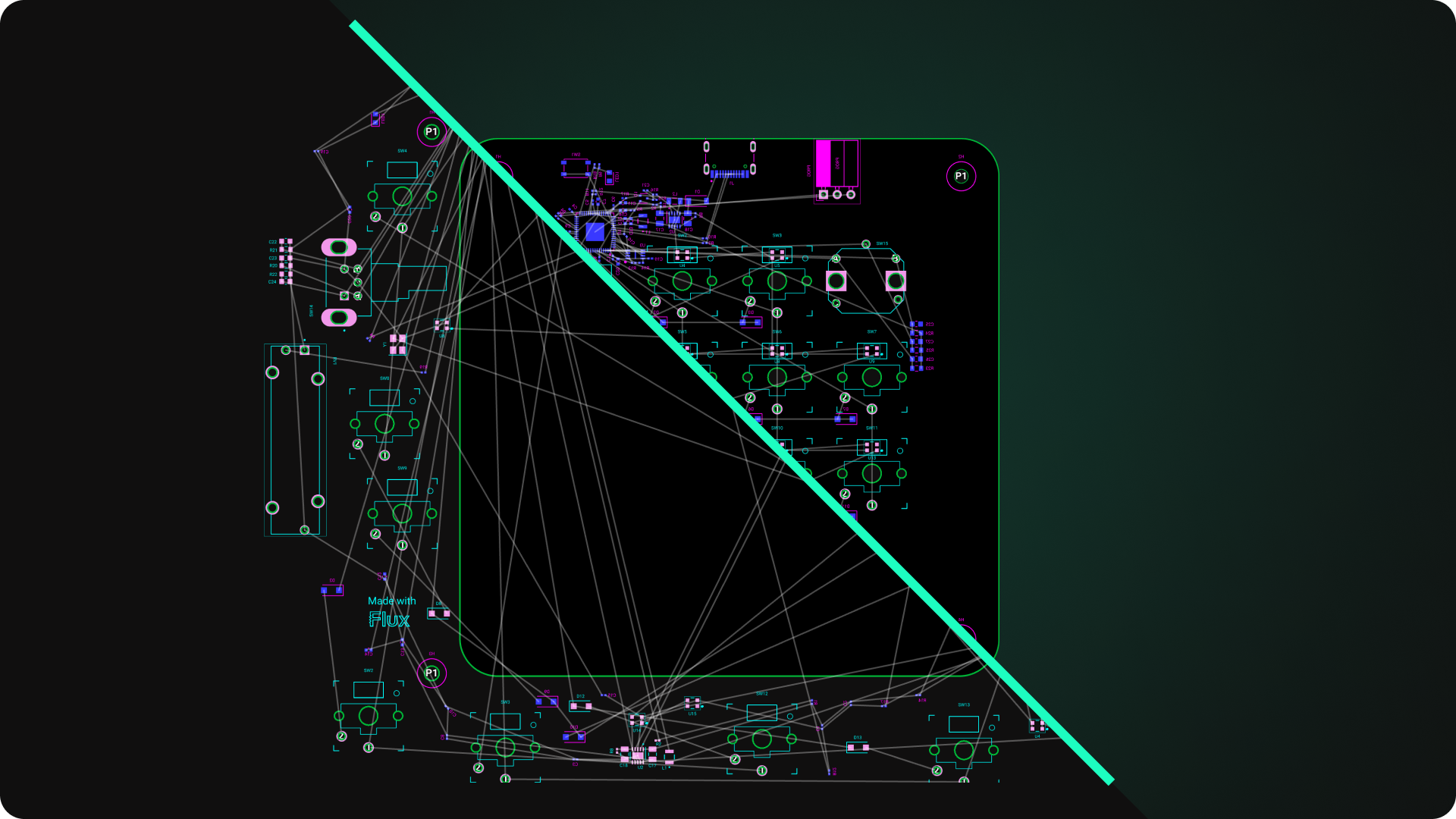
En Flux puedes agregar agujeros para tornillería utilizando un componente de "mounting hole" o "screw hole" de la librería de footprints. Sigue estos pasos:
- Cambiar a la pestaña PCB: Abre el editor de PCB en el flujo de trabajo.
- Agregar un footprint de agujero de montaje: Utiliza la herramienta de "Agregar componente" y busca en la librería términos como "Mounting Hole" o "Screw Hole". Esto te permitirá colocar un componente específico para agujeros de tornillería.
- Definir dimensiones: Una vez colocado, ajusta el tamaño del orificio (diámetro del taladro) y si es necesario, indica que se trate de un agujero no metalizado (no plated) según las especificaciones de tus tornillos.
- Revisa las reglas de fabricación: Asegúrate de que las dimensiones cumplen con los requisitos del fabricante antes de exportar los Gerbers.
Si requieres crear uno desde cero, puedes dibujar un círculo en la capa mecánica y definirlo para que sea perforado según tus necesidades; sin embargo, utilizar un footprint predefinido facilita la validación y compatibilidad con los procesos de fabricación.
¿Necesitas más detalles sobre algún paso en particular?
Add Mounting Holes
Specify Screw Dimensions
Double-Check Design Rules
426 days
U1
preguntar si le pongo resistencia tmb
preguntar si le pongo resistencia tmb
1y
Someone is typing...
4
are there any issues in this project?
1y
I've reviewed your project, and here are a few observations and potential issues you might want to consider:
-
Unconnected Pins:
-
Power Connections:
- Ensure all power connections are correctly established. For example, the ESP32-DEVKIT-V1 (U1) should have its 3V3 and VIN pins properly connected to appropriate power supplies. It seems the VIN pin is connected to net 30, which includes a +5V supply. Make sure you need 5V for this project.
-
Duplicate Nets and Unused Nets:
- Ensure that duplicate nets like
+3.3vand nets with similar names (e.g.,PrX_dir,PrX_Gimball) are intentional. - Check if nets such as
Boton_dir,Boton_Gimballare serving their intended purpose since they are repeated without additional context.
- Ensure that duplicate nets like
-
Component Values:
-
Part Specifications:
- Confirm that all parts have the correct footprint, especially if they're being ordered or reused from a previous project.
-
Net Connections:
- For ease of troubleshooting, ensure that all intended connections are visible and logically structured in the schematic. Particularly, nets marked like
Net 4orNet 6should be verified against your design intent.
- For ease of troubleshooting, ensure that all intended connections are visible and logically structured in the schematic. Particularly, nets marked like
-
General Review:
- Ensure that all components that require connections to ground, such as decoupling capacitors, are properly grounded.
- Double-check your component library to ensure all parts have been loaded with the correct specifications.
Do these points align with your project's expectations? Let me know if there's a specific area you'd like to dive into or correct!
1y
Someone is typing...
3
Cuál de sus conexiones es tierra?
1y
En el proyecto actual, tienes un pin de tierra etiquetado como GND en el módulo ESP32-DEVKIT-V1 con el designador U1. Los pines de tierra son:
Si necesitas conectar otros componentes a tierra, utiliza uno de estos pines. Si tienes más preguntas o necesitas ayuda para realizar las conexiones, házmelo saber.
1y
me refiero al joystick
1y
Entendido, los componentes etiquetados como U2 y U3 son joysticks con el MPN COM-09032. En estos, los pines correspondientes a tierra serían:
Si deseas conectar estos joysticks a tierra, puedes conectar el pin V- de cada joystick a uno de los pines GND del ESP32-DEVKIT-V1. Si necesitas más información, solo pregunta.
1y
cuáles son los pines de Vrx y Vry?
1y
Los joysticks U2 y U3 con el MPN COM-09032 tienen los siguientes pines que normalmente se utilizan para las salidas analógicas correspondientes a los ejes:
- Vrx $($Eje X$)$: Pin H
- Vry $($Eje Y$)$: Pin V
Por lo tanto, las designaciones para los joysticks serían:
Si tienes más preguntas sobre cómo hacer las conexiones o integrarlos en tu proyecto, no dudes en preguntar.
1y
a qué voltaje opera este componente si consideramos que lo vamos a utilizar con un esp32 el cuál va aser el que reciba las señales analógicas?
1y
Cuando utilizas un joystick como el COM-09032 con un ESP32-DEVKIT-V1, generalmente operas los joysticks con el mismo voltaje de operación que el ESP32. El ESP32 típicamente opera a un voltaje de 3.3V. Por lo tanto, es recomendable alimentar los pines V+ de los joysticks con 3.3V.
Aquí te doy algunas sugerencias para las conexiones:
-
Asegúrate de conectar también los pines V- de los joysticks a la tierra común del sistema:
Siguiendo estas recomendaciones te asegurarás que los joysticks puedan enviar las señales analógicas adecuadamente al ESP32. Si necesitas más asistencia, no dudes en preguntar.
1y
Someone is typing...
1
Preguntar si ve combeniente poner diodos aquí o no
Preguntar si ve combeniente poner diodos aquí o no
1y
Someone is typing...
5
R3
Resistance
330 Ω
SCK_D18
Conector para antena WIFI/Bluetooth
PrX_Dir
Tx_display
D4
HS_DATA0_D2
PrX_Gimball
Tx_display
+5v
D34
D7
D3
PrY_Gimball
SCK_D18
Boton_Gimball
+3.3v
+3.3v
B1
+3.3v
tX_D13
CNS_D4
CNS_D4
B2
HS_DATA0_D2
rX_D12
D35
MOSI_D23
D35
Rx_display
D27
D6
Rx_display
Boton_RESET
MOSI_D23
HS_CMD_D15
+3.3v
SCL_D22
MISO_D19
tX_D13
B0
SDA_D21
D34
Net2
+5v
MOSI_D19
PrY_Dir
Boton_Dir
+3.3v
rX_D12
B3
Canal de comunicación RX/TX
Conector Display
Reviews

- Wirelessly connects nets on schematic. Used to organize schematics and separate functional blocks. To wirelessly connect net portals, give them same designator. #portaljharwinbarrozo43.0M
- Wirelessly connects power nets on schematic. Identical to the net portal, but with a power symbol. Used to organize schematics and separate functional blocks. To wirelessly connect power net portals, give them the same designator. #portal #powerjharwinbarrozo11.4M
- A generic fixed resistor ideal for rapid circuit topology development. Its footprint automatically adapts based on the selected package case code—supporting 0402, 0603, 0805, 1203, and many other standard SMD packages, as well as axial horizontal and vertical configurations. Save precious design time by seamlessly add more information to this part (value, footprint, etc.) as it becomes available. Standard resistor values: 1.0 ohm, 10 ohm, 100 ohm, 1.0k ohm, 10k ohm, 100k ohm, 1.0M ohm 1.1 ohm, 11 ohm, 110 ohm, 1.1k ohm, 11k ohm, 110k ohm, 1.1M ohm 1.2 ohm, 12 ohm, 120 ohm, 1.2k ohm, 12k ohm, 120k ohm, 1.2M ohm 1.3 ohm, 13 ohm, 130 ohm, 1.3k ohm, 13k ohm, 130k ohm, 1.3M ohm 1.5 ohm, 15 ohm, 150 ohm, 1.5k ohm, 15k ohm, 150k ohm, 1.5M ohm 1.6 ohm, 16 ohm, 160 ohm, 1.6k ohm, 16k ohm, 160k ohm, 1.6M ohm 1.8 ohm, 18 ohm, 180 ohm, 1.8K ohm, 18k ohm, 180k ohm, 1.8M ohm 2.0 ohm, 20 ohm, 200 ohm, 2.0k ohm, 20k ohm, 200k ohm, 2.0M ohm 2.2 ohm, 22 ohm, 220 ohm, 2.2k ohm, 22k ohm, 220k ohm, 2.2M ohm 2.4 ohm, 24 ohm, 240 ohm, 2.4k ohm, 24k ohm, 240k ohm, 2.4M ohm 2.7 ohm, 27 ohm, 270 ohm, 2.7k ohm, 27k ohm, 270k ohm, 2.7M ohm 3.0 ohm, 30 ohm, 300 ohm, 3.0K ohm, 30K ohm, 300K ohm, 3.0M ohm 3.3 ohm, 33 ohm, 330 ohm, 3.3k ohm, 33k ohm, 330k ohm, 3.3M ohm 3.6 ohm, 36 ohm, 360 ohm, 3.6k ohm, 36k ohm, 360k ohm, 3.6M ohm 3.9 ohm, 39 ohm, 390 ohm, 3.9k ohm, 39k ohm, 390k ohm, 3.9M ohm 4.3 ohm, 43 ohm, 430 ohm, 4.3k ohm, 43K ohm, 430K ohm, 4.3M ohm 4.7 ohm, 47 ohm, 470 ohm, 4.7k ohm, 47k ohm, 470k ohm, 4.7M ohm 5.1 ohm, 51 ohm, 510 ohm, 5.1k ohm, 51k ohm, 510k ohm, 5.1M ohm 5.6 ohm, 56 ohm, 560 ohm, 5.6k ohm, 56k ohm, 560k ohm, 5.6M ohm 6.2 ohm, 62 ohm, 620 ohm, 6.2k ohm, 62K ohm, 620K ohm, 6.2M ohm 6.8 ohm, 68 ohm, 680 ohm, 6.8k ohm, 68k ohm, 680k ohm, 6.8M ohm 7.5 ohm, 75 ohm, 750 ohm, 7.5k ohm, 75k ohm, 750k ohm, 7.5M ohm 8.2 ohm, 82 ohm, 820 ohm, 8.2k ohm, 82k ohm, 820k ohm, 8.2M ohm 9.1 ohm, 91 ohm, 910 ohm, 9.1k ohm, 91k ohm, 910k ohm, 9.1M ohm #generics #CommonPartsLibraryjharwinbarrozo1.5M
- A generic fixed capacitor ideal for rapid circuit topology development. You can choose between polarized and non-polarized types, its symbol and the footprint will automatically adapt based on your selection. Supported options include standard SMD sizes for ceramic capacitors (e.g., 0402, 0603, 0805), SMD sizes for aluminum electrolytic capacitors, and through-hole footprints for polarized capacitors. Save precious design time by seamlessly add more information to this part (value, footprint, etc.) as it becomes available. Standard capacitor values: 1.0pF, 10pF, 100pF, 1000pF, 0.01uF, 0.1uF, 1.0uF, 10uF, 100uF, 1000uF, 10000uF 1.1pF, 11pF, 110pF, 1100pF 1.2pF, 12pF, 120pF, 1200pF 1.3pF, 13pF, 130pF, 1300pF 1.5pF, 15pF, 150pF, 1500pF, 0.015uF, 0.15uF, 1.5uF, 15uF, 150uF, 1500uF 1.6pF, 16pF, 160pF, 1600pF 1.8pF, 18pF, 180pF, 1800pF 2.0pF, 20pF, 200pF, 2000pF 2.2pF, 22pF, 220pF, 2200pF, 0.022uF, 0.22uF, 2.2uF, 22uF, 220uF, 2200uF 2.4pF, 24pF, 240pF, 2400pF 2.7pF, 27pF, 270pF, 2700pF 3.0pF, 30pF, 300pF, 3000pF 3.3pF, 33pF, 330pF, 3300pF, 0.033uF, 0.33uF, 3.3uF, 33uF, 330uF, 3300uF 3.6pF, 36pF, 360pF, 3600pF 3.9pF, 39pF, 390pF, 3900pF 4.3pF, 43pF, 430pF, 4300pF 4.7pF, 47pF, 470pF, 4700pF, 0.047uF, 0.47uF, 4.7uF, 47uF, 470uF, 4700uF 5.1pF, 51pF, 510pF, 5100pF 5.6pF, 56pF, 560pF, 5600pF 6.2pF, 62pF, 620pF, 6200pF 6.8pF, 68pF, 680pF, 6800pF, 0.068uF, 0.68uF, 6.8uF, 68uF, 680uF, 6800uF 7.5pF, 75pF, 750pF, 7500pF 8.2pF, 82pF, 820pF, 8200pF 9.1pF, 91pF, 910pF, 9100pF #generics #CommonPartsLibraryjharwinbarrozo1.5M
- A generic fixed inductor suitable for rapid circuit topology development. The footprint automatically adapts based on the selected package, supporting standard SMD sizes (e.g., 0402, 0603, 0805) as well as well-known inductor packages such as SDR1806, PA4320, SRN6028, and SRR1260. Standard inductor values: 1.0 nH, 10 nH, 100 nH, 1.0 µH, 10 µH, 100 µH, 1.0 mH 1.2 nH, 12 nH, 120 nH, 1.2 µH, 12 µH, 120 µH, 1.2 mH 1.5 nH, 15 nH, 150 nH, 1.5 µH, 15 µH, 150 µH, 1.5 mH 1.8 nH, 18 nH, 180 nH, 1.8 µH, 18 µH, 180 µH, 1.8 mH 2.2 nH, 22 nH, 220 nH, 2.2 µH, 22 µH, 220 µH, 2.2 mH 2.7 nH, 27 nH, 270 nH, 2.7 µH, 27 µH, 270 µH, 2.7 mH 3.3 nH, 33 nH, 330 nH, 3.3 µH, 33 µH, 330 µH, 3.3 mH 3.9 nH, 39 nH, 390 nH, 3.9 µH, 39 µH, 390 µH, 3.9 mH 4.7 nH, 47 nH, 470 nH, 4.7 µH, 47 µH, 470 µH, 4.7 mH 5.6 nH, 56 nH, 560 nH, 5.6 µH, 56 µH, 560 µH, 5.6 mH 6.8 nH, 68 nH, 680 nH, 6.8 µH, 68 µH, 680 µH, 6.8 mH 8.2 nH, 82 nH, 820 nH, 8.2 µH, 82 µH, 820 µH, 8.2 mH #generics #CommonPartsLibraryjharwinbarrozo15.9k
- An electrical connector acting as reusable interface to a conductor and creating a point where external circuits can be connected.Terminal
- General Purpose Thick Film Standard Power and High-Power Chip Resistor 47 kOhms ±5% 0.125W, 1/8W Chip Resistor 0805 (2012 Metric) Automotive AEC-Q200 Thick Film Features: - RMCF – standard power ratings - RMCP – high power ratings - Nickel barrier terminations standard - Power derating from 100% at 70ºC to zero at +155ºC - RoHS compliant, REACH compliant, and halogen free - AEC-Q200 compliantjharwinbarrozo1.2M
- 10 µF 16 V Aluminum - Polymer Capacitors Radial, Can - SMD 30mOhm 2000 Hrs @ 105°C #commonpartslibrary #capacitor #aluminumpolymer #radialcanjharwinbarrozo1.2M


Welcome to your new project. Imagine what you can build here.
Properties
Properties describe core aspects of the project.
Pricing & Availability
Distributor | Qty 1 |
|---|---|
Arrow | $9.92–$11.12 |
Digi-Key | $12.84–$15.52 |
LCSC | $11.29 |
Mouser | $12.96 |
Verical | $1.73–$3.02 |
Controls
Welcome 👋
Flux helps you build PCBs faster with an AI teammate!
Create your account to collaborate, stay updated, fork your own version, and get instant answers from our AI agent.
lalo0802
copilot
VINpin and a3V3pin. Ensure that these pins are connected to appropriate power sources.V+,V,H+, andHpins. Double-check if these are powered correctly according to your requirements.GNDnet is connected to U1, U2, and U3, which is good. Ensure that every device or module that requires a ground reference is connected to this net.