Chat
Welcome to Flux
Treat Flux like your intern. Tell it what you'd like to build and it'll get to work. You can also ask it questions, brainstorm ideas, and teach it your preferences. Learn More
Explain project
Write a project description
Find schematic issues
Create a test plan
Simulate a circuit
Prepare for Manufacturing
Component Selection Workflow
New Subsystem Wizard
Ready.
please explain what U1 does.

1y
The component U1 in your schematic is a MAX2606EUT+T from Maxim Integrated. This part is a VHF/UHF oscillator designed specifically for FM radio transmitter applications. It generates a frequency modulated signal which can be broadcast over FM radio frequencies.
Here's a brief explanation of the pins and their likely connections in an FM transmitter circuit:
-
IND (Pin 1): This pin connects to an external inductor, which together with an internal capacitor, determines the frequency of oscillation.
-
GND (Pin 2): The ground pin for the IC, connected to system ground.
-
TUNE (Pin 3): This pin adjusts the tuning of the oscillator frequency. It can be connected to a resistor network or variable resistor to allow for frequency adjustments.
-
OUT- (Pin 4) & OUT+ (Pin 6): These are differential outputs that provide the frequency modulated signal. The outputs can be connected to an antenna circuit, probably through some matching network.
-
VCC (Pin 5): The power supply pin providing the necessary voltage for the oscillator to function, typically 3.3V or 5V.
The use of U1 in your circuit implies you want to create an FM signal, which can then be transmitted via an antenna (like ANT1) and received by FM radios.
1y
Someone is typing...
5
@copilot, develop an FMEA (Failure Mode and Effects Analysis) report in a table ...

@copilot, develop an FMEA (Failure Mode and Effects Analysis) report in a table format that analyzes the systems schematic, each unique component specification, and operational parameters. It should identify critical failure modes, assess their impact, and recommend mitigation actions based on severity, occurrence probability, and detectability. Include columns such as: process step, potential failure mode, potential failure effect, S, O, D, RPN, Action Recommended, and any other you see fit.
1y
Certainly! Below is a Failure Mode and Effects Analysis (FMEA) report for your FM transmitter project, including the process steps, potential failure modes, their effects, and recommended actions.
Table
| Process Step | Component | Potential Failure Mode | Potential Failure Effect | S (Severity) | O (Occurrence) | D (Detectability) | RPN (Risk Priority Number) | Action Recommended |
|---|---|---|---|---|---|---|---|---|
| Power Supply | U2 | Over-voltage | Damage to components | 9 | 3 | 4 | 108 | Use over-voltage protection, e.g., zener diode |
| Power Supply | U2 | Under-voltage | System malfunction | 7 | 4 | 5 | 140 | Use proper power regulation and capacitors |
| Oscillator | U1 | Frequency drift | Poor transmission quality | 8 | 3 | 6 | 144 | Use high-precision components, add thermal compensation |
| Oscillator | L1 | Inductor open circuit | No signal generation | 10 | 2 | 3 | 60 | Use quality inductors, conduct thorough testing |
| Oscillator | C5 | Capacitor failure | Unstable frequency | 8 | 3 | 5 | 120 | Use high-quality, low ESR capacitors |
| Modulator | MK1 | Microphone failure | No audio input | 7 | 2 | 2 | 28 | Choose robust microphones, run diagnostics |
| Modulator | R4 | Resistor value change | Incorrect tuning | 6 | 3 | 5 | 90 | Select precision resistors, in-circuit testing |
| RF Output | ANT1 | Antenna disconnect | No signal transmission | 8 | 2 | 4 | 64 | Secure connections, inspect connectors |
| General | Any | Solder joint failure | Intermittent connections | 9 | 4 | 3 | 108 | Quality soldering, visual and X-ray inspection |
| General | Entire Circuit | EMI/RFI interference | Signal distortion | 7 | 4 | 2 | 56 | Proper shielding, layout optimization |
| General | Entire Circuit | Thermal issues | Component damage | 9 | 3 | 3 | 81 | Thermal management, use heat sinks |
- Process Step: The stage or component in the system being analyzed.
- Component: Specific component in the schematic, represented by its designator and part number.
- Potential Failure Mode: The way in which the component could potentially fail.
- Potential Failure Effect: The impact on the overall system caused by the failure mode.
- S (Severity): Ranked from 1 (least severe) to 10 (most severe).
- O (Occurrence): The likelihood of the failure mode occurring, ranked from 1 (least likely) to 10 (most likely).
- D (Detectability): The likelihood of detecting the failure before it causes harm, ranked from 1 (most likely to detect) to 10 (least likely to detect).
- RPN (Risk Priority Number): Calculated as RPN=S×O×D.
- Action Recommended: Suggested action to mitigate the risk.
Feel free to modify or add more components and failure modes as needed.
1y
Someone is typing...
3
create a high level mermaid block diagram of this project. Include key component...

1y
Here's a high-level mermaid block diagram of your FM transmitter project, featuring key components and their manufacturer part numbers.
Diagram
This diagram displays the main components of your FM transmitter project and their connections. Let me know if there's anything you'd like to adjust or focus on!
1y
Someone is typing...
6
create a high level mermaid block diagram of U1. Include key component's manufac...
1y
Here is a Mermaid block diagram for the MAX2606EUT+T, which is your FM transmitter IC.
Diagram
This diagram shows the pin connections for the MAX2606EUT+T. There is:
- VCC connected to Pin 5 for power supply.
- OUT+ and OUT-, represented by Pins 6 and 4, connected to the antenna circuit.
- TUNE at Pin 3 for frequency adjustment, possibly connected to a potentiometer or a digital control circuit.
- IND to which an external inductor is connected, used for frequency stabilization.
- GND at Pin 2, which should be connected to the ground plane of your PCB.
Let me know if you need more details or modifications!
1y
Someone is typing...
4
MK1
C1
Capacitance
2.2u F
3V3
TUNEPAD
C4
Capacitance
1n F
R3
Resistance
500 Ω
C3
Capacitance
2.2u F
R4
Resistance
100k Ω
L1
Inductance
390n H
U1
5
New Comment
Someone is typing...
Reviews

- Wirelessly connects nets on schematic. Used to organize schematics and separate functional blocks. To wirelessly connect net portals, give them same designator. #portaljharwinbarrozo43.0M
- Wirelessly connects power nets on schematic. Identical to the net portal, but with a power symbol. Used to organize schematics and separate functional blocks. To wirelessly connect power net portals, give them the same designator. #portal #powerjharwinbarrozo11.4M
- A generic fixed resistor for rapid developing circuit topology. Save precious design time by seamlessly add more information to this part (value, footprint, etc.) as it becomes available. Standard resistor values: 1.0Ω 10Ω 100Ω 1.0kΩ 10kΩ 100kΩ 1.0MΩ 1.1Ω 11Ω 110Ω 1.1kΩ 11kΩ 110kΩ 1.1MΩ 1.2Ω 12Ω 120Ω 1.2kΩ 12kΩ 120kΩ 1.2MΩ 1.3Ω 13Ω 130Ω 1.3kΩ 13kΩ 130kΩ 1.3MΩ 1.5Ω 15Ω 150Ω 1.5kΩ 15kΩ 150kΩ 1.5MΩ 1.6Ω 16Ω 160Ω 1.6kΩ 16kΩ 160kΩ 1.6MΩ 1.8Ω 18Ω 180Ω 1.8KΩ 18kΩ 180kΩ 1.8MΩ 2.0Ω 20Ω 200Ω 2.0kΩ 20kΩ 200kΩ 2.0MΩ 2.2Ω 22Ω 220Ω 2.2kΩ 22kΩ 220kΩ 2.2MΩ 2.4Ω 24Ω 240Ω 2.4kΩ 24kΩ 240kΩ 2.4MΩ 2.7Ω 27Ω 270Ω 2.7kΩ 27kΩ 270kΩ 2.7MΩ 3.0Ω 30Ω 300Ω 3.0KΩ 30KΩ 300KΩ 3.0MΩ 3.3Ω 33Ω 330Ω 3.3kΩ 33kΩ 330kΩ 3.3MΩ 3.6Ω 36Ω 360Ω 3.6kΩ 36kΩ 360kΩ 3.6MΩ 3.9Ω 39Ω 390Ω 3.9kΩ 39kΩ 390kΩ 3.9MΩ 4.3Ω 43Ω 430Ω 4.3kΩ 43KΩ 430KΩ 4.3MΩ 4.7Ω 47Ω 470Ω 4.7kΩ 47kΩ 470kΩ 4.7MΩ 5.1Ω 51Ω 510Ω 5.1kΩ 51kΩ 510kΩ 5.1MΩ 5.6Ω 56Ω 560Ω 5.6kΩ 56kΩ 560kΩ 5.6MΩ 6.2Ω 62Ω 620Ω 6.2kΩ 62KΩ 620KΩ 6.2MΩ 6.8Ω 68Ω 680Ω 6.8kΩ 68kΩ 680kΩ 6.8MΩ 7.5Ω 75Ω 750Ω 7.5kΩ 75kΩ 750kΩ 7.5MΩ 8.2Ω 82Ω 820Ω 8.2kΩ 82kΩ 820kΩ 8.2MΩ 9.1Ω 91Ω 910Ω 9.1kΩ 91kΩ 910kΩ 9.1MΩ #generics #CommonPartsLibraryjharwinbarrozo1.5M
- A generic fixed capacitor ideal for rapid circuit topology development. You can choose between polarized and non-polarized types, its symbol and the footprint will automatically adapt based on your selection. Supported options include standard SMD sizes for ceramic capacitors (e.g., 0402, 0603, 0805), SMD sizes for aluminum electrolytic capacitors, and through-hole footprints for polarized capacitors. Save precious design time by seamlessly add more information to this part (value, footprint, etc.) as it becomes available. Standard capacitor values: 1.0pF 10pF 100pF 1000pF 0.01uF 0.1uF 1.0uF 10uF 100uF 1000uF 10,000uF 1.1pF 11pF 110pF 1100pF 1.2pF 12pF 120pF 1200pF 1.3pF 13pF 130pF 1300pF 1.5pF 15pF 150pF 1500pF 0.015uF 0.15uF 1.5uF 15uF 150uF 1500uF 1.6pF 16pF 160pF 1600pF 1.8pF 18pF 180pF 1800pF 2.0pF 20pF 200pF 2000pF 2.2pF 22pF 20pF 2200pF 0.022uF 0.22uF 2.2uF 22uF 220uF 2200uF 2.4pF 24pF 240pF 2400pF 2.7pF 27pF 270pF 2700pF 3.0pF 30pF 300pF 3000pF 3.3pF 33pF 330pF 3300pF 0.033uF 0.33uF 3.3uF 33uF 330uF 3300uF 3.6pF 36pF 360pF 3600pF 3.9pF 39pF 390pF 3900pF 4.3pF 43pF 430pF 4300pF 4.7pF 47pF 470pF 4700pF 0.047uF 0.47uF 4.7uF 47uF 470uF 4700uF 5.1pF 51pF 510pF 5100pF 5.6pF 56pF 560pF 5600pF 6.2pF 62pF 620pF 6200pF 6.8pF 68pF 680pF 6800pF 0.068uF 0.68uF 6.8uF 68uF 680uF 6800uF 7.5pF 75pF 750pF 7500pF 8.2pF 82pF 820pF 8200pF 9.1pF 91pF 910pF 9100pF #generics #CommonPartsLibraryjharwinbarrozo1.5M
- A generic fixed inductor for rapid developing circuit topology. *You can now change the footprint and 3D model at the top level anytime you want. This is the power of #genericsjharwinbarrozo15.5k
- An electrical connector acting as reusable interface to a conductor and creating a point where external circuits can be connected.Terminal
- 47 kOhms ±5% 0.125W, 1/8W Chip Resistor 0805 (2012 Metric) Automotive AEC-Q200 Thick Film #forLedBlinkjharwinbarrozo1.2M
- 10uF Capacitor Aluminum Polymer 20% 16V SMD 5x5.3mm #forLedBlink #commonpartslibrary #capacitor #aluminumpolymer #radialcanjharwinbarrozo1.2M
- Yellow 595nm LED Indication - Discrete 1.7V 1206 (3216 Metric) #forLedBlinkjharwinbarrozo1.1M


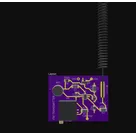
An FM transmitter allows a phone to broadcast music stored in its memory on FM frequencies, so that it can be tuned into a nearby FM receiver such as a a car radio.
Properties
Properties describe core aspects of the project.
Pricing & Availability
Distributor | Qty 1 |
|---|---|
Digi-Key | $3.47–$5.63 |
LCSC | $1.89–$2.49 |
Mouser | $5.58 |
Assets

FM TRANSMITTER.PNG
FM TRANSMITTERThumbnailControls
Welcome 👋
Flux helps you build PCBs faster with an AI teammate!
Create your account to collaborate, stay updated, fork your own version, and get instant answers from our AI agent.
kasenge1
copilot
-
Antenna (ANT1):
- Pin: ANT_IN
- Purpose: Transmits the FM signal generated by the circuit.
- Connections:
- Connect ANT1:ANTIN to C5:P1.
-
Voltage Regulator (U2):
- Part Number: AP2210N-3.3TRG1
- Purpose: Provides stable 3.3V output required by other components.
- Pins: VIN, GND, VOUT
- Connections:
- Connect U2:VIN to power source.
- Connect U2:VOUT to R4:P1, R3:P1, C1:P2, U1:VCC, R2:P1, R1:P2.
- Connect U2:GND to C1:P1.
-
FM Oscillator (U1):
- Part Number: MAX2606EUT+T
- Purpose: Generates and modulates the FM signal.
- Pins: IND, GND, TUNE, OUT-, VCC, OUT+
- Connections:
- Connect U1:IND to L1:P2.
- Connect U1:GND to GND.
- Connect U1:TUNE to R4:P3, C3:P1, C4:P1.
- Connect U1:OUT− to R2:P2.
- Connect U1:OUT+ to R1:P1, C5:P2.
- Connect U1:VCC to the 3.3V rail.
-
Microphone (MK1):
- Part Number: POM-3042P-R
- Purpose: Captures audio signals to be transmitted.
- Pins: N, P
- Connections:
- Connect MK1:N to GND.
- Connect MK1:P to C3:P2.
Supporting Components-
Resistors:
- R1: 1K ohm:
- Connect R1:P1 to U1:OUT+.
- R2: 1K ohm
- Connect R2:P1 to the 3.3V rail.
- R3: 500 ohm
- Connect R3:P1 to the 3.3V rail.
- R4: 100K potentiometer
- Connect R4:P1 to the 3.3V rail.
- Connect R4:P2 to GND.
-
Capacitors:
- C1: 2.2μF
- Connect C1:P2 to the 3.3V rail.
- Connect C1:P1 to GND.
- C3: 2.2μF
- Connect C3:P1 to R4:P3.
- Connect C3:P2 to R3:P2.
- C4: 1nF
- Connect C4:P1 to the tuning circuit.
- C5: 100pF
- Connect C5:P1 to ANT1.
-
Inductor (L1):
- Part Number: AISC-0805-R39J-T
- Inductance: 390nH
- Purpose: Forms part of the oscillator circuit.
- Connections:
- Connect L1:P1 to GND.
- Connect L1:P2 to U1:IND.
Power and Ground Connections