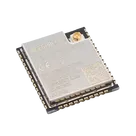
Marauder Project Setup
- Add parts plus USB-C connector and 3.3V regulator.
- Power: 100 nF decoupling + 10 uF bulk; EN pull-up + 0.1 uF.
- Interfaces: shared SPI (separate CS, 22-33 ohm series); joystick GPIOs; GPS UART+PPS; avoid boot pins.
- Programming pads; RF/antenna keepouts.
Started implementing a plan
# Goal
- Design a Marauder-style ESP32 board that integrates an ESP32-WROOM-32UE with a 1.44 inch ST7735 128x128 SPI RGB TFT LCD, a 5-way joystick switch, an ATGM336H GPS module, and a microSD card socket. The board will be powered via a USB-C 5V input regulated to 3.3V with proper decoupling, include programming pads (EN, IO0, RX0, TX0, GND), and use shared SPI for the LCD and microSD with series resistors. Additional interfaces include UART for the GPS (TX, RX, PPS) and proper handling of antenna and GPS keepouts.
# Implementation plan
1. **Core Components and Power Setup**
1. Add the ESP32-WROOM-32UE module ensuring terminal placeholders are replaced with proper connections.
2. Add the 1.44" ST7735 128x128 SPI RGB TFT LCD and configure its SPI interface with dedicated CS.
3. Add the 5-way joystick switch and connect each direction to ESP32 GPIOs with onboard pull-ups.
4. Add the ATGM336H GPS module and connect its UART TX/RX pins (plus PPS) to non-bootstrapped ESP32 UART pins.
5. Add a microSD card socket module and integrate it on the shared SPI bus (with separate CS) with 22–33 Ω series resistors on SPI lines.
6. Integrate a USB-C power input with a 5V supply routed through a 3.3V regulator. Add decoupling (100 nF) and a bulk 10 µF cap on the 3.3V rail and an EN pull-up resistor with a 0.1 µF capacitor.
2. **Interface Connections and Signal Routing**
1. Connect the SPI lines (SCK, MOSI, MISO) for the LCD and microSD. Add series termination resistors (22–33 Ω) on these lines.
2. Connect the 5-way joystick to selected GPIO pins avoiding ESP32 bootstrapped pins.
3. Connect the GPS module UART to the ESP32 UART interface and ensure the PPS signal is connected to a proper GPIO pin.
4. Provide programming/debug pads for EN, IO0, U0RXD, U0TXD, and GND.
3. **PCB and Schematic Considerations**
1. Update the schematic to label all nets appropriately and guarantee that high-speed and power integrity requirements are met (including proper decoupling and filtering for the GPS module).
2. Place footprints considering antenna and RF keepouts for both the ESP32 and GPS signals.
3. Prepare the PCB layout ensuring proper ground strategy, EMI control, and keepout zones for the antenna areas.
4. **Review and Final Checks**
1. Review the schematic for completeness: all interfaces, power supplies, and critical decoupling elements should be correctly added.
2. Prepare the board for PCB layout review checking component placement and ensuring that all nets are connected for production.
# Success criteria
- The ESP32, LCD, joystick, GPS module, and microSD are correctly added with proper interfaces and powered from a regulated 3.3V rail.
- The shared SPI bus for the ST7735 and microSD includes separate CS signals with series resistors, and the GPS UART is connected to the appropriate ESP32 GPIOs with PPS.
- The board includes proper programming pads and adheres to RF/antenna keepout strategies with sufficient decoupling and filtering.
- The schematic and PCB layout are complete, meeting both functional and electrical design goals.

- Add USB-C connector and 3.3V regulator; apply EN pull-up with 0.1 µF.
- Wire shared SPI with separate CS and series terminations; GPS on UART (TX, RX, PPS) to non-boot pins; joystick to safe GPIOs; add programming pads.
- Define RF and GPS antenna keepouts and place decoupling close to pins.
Started implementing a plan
#Goal
- Design a Marauder-style board using the ESP32-WROOM-32UE that integrates a 1.44" ST7735 (128x128) SPI TFT, 5-way joystick, ATGM336H GPS (UART with PPS), and a microSD socket sharing an SPI bus with separate CS lines. The board must include USB-C 5V input regulated to 3.3V with proper decoupling and an EN pull-up (with 0.1 μF cap), programming pads (EN, IO0, U0RXD, U0TXD, GND), and defined RF/GPS antenna keepouts.
#Implementation plan
1. Add Core Components
1. Add and configure the ESP32-WROOM-32UE ensuring antenna layout constraints.
2. Add the ST7735 1.44" TFT display and configure its SPI interface.
3. Add a 5-way joystick and assign directional GPIO connections.
4. Add the ATGM336H GPS module; connect its UART and PPS outputs to chosen non-bootstrapped ESP32 pins.
5. Add a microSD socket and configure it for SPI operation with its own chip select.
6. Add a USB-C connector with a 5V input stage, and integrate a 3.3V regulator with proper decoupling capacitors (0.1 μF on the EN line and additional decoupling at power pins).
2. Connect Interfaces and Signals
1. Wire the shared SPI bus for the ST7735 and microSD, ensuring each device uses its own CS line and series resistors (22–33 Ω) are placed on SCK, MOSI, and MISO lines.
2. Connect the GPS module’s UART and PPS signals to designated non-bootsrtap pins on the ESP32, avoiding conflicts with boot configuration requirements.
3. Connect the 5-way joystick to its respective ESP32 GPIOs.
4. Create dedicated programming pads for EN, IO0, U0RXD, U0TXD, and GND to support firmware flashing.
3. Add Supporting Circuitry and Layout Considerations
1. Set up decoupling capacitors for all ICs, ensuring them to be placed close to each power pin.
2. Implement an EN pull-up network with a 0.1 μF capacitor for reliable regulator and module reset function.
3. Define RF/GPS antenna keepout areas in the PCB layout to minimize interference.
4. Implement any required filtering on the GPS module power supply.
4. Finalize and Validate Design
1. Review the schematic for correct signal routing, especially ensuring the ESP32 bootstrapped pins are not inadvertently used.
2. Perform ERC/DRC checks to validate design integrity.
3. Confirm that all components, especially the shared SPI bus and programming interfaces, are correctly connected and meet the system requirements.
#Success criteria
- Successful integration of ESP32, ST7735 TFT, ATGM336H GPS, microSD, and 5-way joystick with proper shared SPI configuration and isolation (via series resistors).
- Accurate implementation of USB-C 5V input with 3.3V regulator and decoupling, including an EN pull-up circuit.
- Accessible and correctly routed programming pads (EN, IO0, U0RXD, U0TXD, GND).
- Maintained RF/GPS antenna keepouts ensuring minimal interference.
- Schematic and PCB layout pass ERC/DRC checks without errors.