ESP32 Robot Controller Overview
0:39
General
Project
Here’s a concise technical walkthrough of your “ESP32 Robot Controller” project based on the current schematic and nets.
Purpose
- An ESP32-based control board for autonomous or RC robots.
- Interfaces:
- Dual DC motors via an H-bridge driver.
- Quadrature encoders for closed-loop control.
- Flysky RC receiver via IBUS.
- I2C OLED display for configuration/telemetry.
- Several push-buttons and multi-pin headers/terminal blocks for external wiring.
- Power: External supply feeds a 5 V rail (via a 7805-style regulator), with local bulk and decoupling capacitors.
Core components and roles
- MCU: U1 (ESP32-DEVKIT-V1)
- Provides Wi-Fi/BLE, GPIOs, UART, I2C, PWM.
- Key nets:
- Motor control: D27→AIN1, D14→AIN2, D4→BIN1, D13→BIN2; and D32/D33 used with resistors (likely as inputs for buttons or encoders).
- IBUS: RX2/ TX2 brought to J14 and RC signal conditioning via R18/R19.
- I2C/OLED: J13 labeled OLED-Display-0.96 uses SCK/SDA pins tied to D21/D22.
- Buttons: routed to VP, VN, D26 via resistor networks.
- 3V3 rail is sourced from the ESP32 module’s onboard regulator and is also used to power the motor driver logic and OLED (see “Net (SW1 - P)”: includes U1:3V3, U2:VCC, J13:VDD).
- Motor driver: U2 (TB6612FNG)
- Dual H-bridge for two DC motors.
- Power:
- Control:
- AIN1/AIN2 (D27/D14), BIN1/BIN2 (D4/D13) for direction.
- PWMA, PWMB, STBY appear on the 3.3 V net “Net (SW1 - P)” alongside U1:3V3, indicating they may be pulled high (always enabled) unless switched.
- Outputs:
- Power entry and regulation
- Connectors and headers
- User inputs
- Protection and filtering
- Reverse-polarity/ORing diode D1 on input path.
- Bulk decoupling on motor VM and regulator input/output.
- Resistor networks likely used as pull-ups/downs/debounce.
How it interacts (signal and power flow)
- Power path: External VIN→SW8→D1. From there:
- Control path:
- The ESP32 GPIOs drive the TB6612FNG’s AINx/BINx and (effectively) PWMA/PWMB/STBY if not tied high.
- Encoders (provisioned by net portals and headers) connect to GPIOs for speed/position feedback.
- IBUS receiver connects to RX2 (with resistor interface) for RC commands.
- I2C OLED shares D21/D22 with display connector.
Key technologies, dependencies, and design choices
- ESP32-DEVKIT-V1 module: fast iteration and Wi-Fi/BLE built-in; dependency on module’s onboard 3.3 V regulator and pinout.
- TB6612FNG H-bridge: low-Ron, efficient vs classic L298N; logic at 3.3 V compatible with ESP32; needs good VM bulk caps and ground return management.
- Linear 7805 regulator: simple and low-noise but dissipates heat at high VIN and load. This is a conscious simplicity trade-off versus a buck regulator.
- SS34 Schottky on input: protects from reverse polarity and isolates motor VM from backfeeding 5 V path; introduces ~0.2–0.5 V drop trade-off.
- Terminal blocks for field wiring: robust but larger footprint; simplifies integration in robots.
- Shared 3.3 V net for OLED and motor driver logic: convenient but must ensure ESP32 3.3 V rail has adequate current margin.
Implementation overview
- Nets show complete routing of motor control, motor outputs, power rails, and interface buses.
- Multiple GND tie points; PGND pins of the driver are grouped.
- Resistor ladder/pairs around GPIOs for inputs and pull configurations.
- OLED header pre-wired to D21/D22 (I2C), with VDD and GND.
Performance considerations and challenges
- 7805 thermal dissipation: If VIN is high (e.g., 12 V) and 5 V load is significant (ESP32 VIN + any 5 V peripherals on terminal blocks), P = (VIN − 5 V) × I can exceed safe limits. Consider airflow, heatsinking, or replacing with a buck.
- ESP32 VIN path: Taking 5 V into VIN relies on module’s onboard 3.3 V converter. Ensure total 3.3 V load (ESP32 + OLED + TB6612 logic + pull-ups) fits that regulator’s spec.
- Grounding and noise:
- IBUS signal integrity: Ensure correct logic level to ESP32 RX2 (3.3 V); many receivers are 5 V powered but output 3.3 V logic—verify or add a divider/level shifting if not guaranteed.
- OLED/I2C pull-ups: Confirm presence and value of I2C pull-ups (typically 4.7 k–10 k to 3.3 V). They are not clearly visible in the current net list; if the OLED module includes pull-ups, avoid duplicating.
- STBY/PWM control: If PWMA/PWMB/STBY are tied to 3.3 V, you lose dynamic control of standby and duty in firmware. Consider explicit GPIOs for PWM and STBY with proper pull defaults.
- Diode drop on VM: Reduces effective motor voltage; for low-voltage motors, this can reduce torque/speed.
Real-world applications
- Differential drive robots, line-followers, small rovers.
- RC-to-autonomous hybrid: IBUS for manual override; ESP32 for closed-loop motor control using encoder feedback; OLED for setup and live telemetry.
Trade-offs and optimizations
- Simplicity (linear 7805, module-based ESP32, Schottky protection) vs efficiency and thermal performance.
- Terminal blocks and discrete headers improve serviceability at the cost of size.
- Using the DevKit module accelerates development but is larger and may limit power rail flexibility vs bare ESP32-WROOM.
Recommendations and future enhancements
Power and robustness
- Replace U3 with a synchronous buck (e.g., 12 V to 5 V) for efficiency and thermal headroom; keep 5 V VIN for the ESP32 and accessories.
- Add input TVS diode and a PI filter if operating in noisy environments.
- Add reverse-voltage protection using a high-side ideal diode controller/MOSFET to reduce drop vs Schottky, or place the Schottky only on VM while feeding the 5 V buck pre-diode. Signal integrity and control
- Ensure I2C pull-ups on 3.3 V are present and sized (4.7 k typical). If relying on the OLED’s pull-ups, document it on the schematic.
- Bring PWMA, PWMB, STBY to dedicated ESP32 pins with pull-ups/downs for predictable boot behavior and full motor control in firmware.
- Add RC snubbers or flyback diodes are not needed for TB6612 (has internal diodes), but layout attention is still critical. Encoders and IO
- Add ESD protection arrays on external headers.
- Consider adding level shifting or clamping if any external devices might be 5 V logic into 3.3 V GPIOs.
- Provide dedicated encoder connectors labeled for 5 V/3.3 V/GND/SIG A/SIG B. Power budgeting and telemetry
- Budget current for 3.3 V rail; if OLED and other sensors grow, add a dedicated 3.3 V buck/LDO from 5 V.
- Add voltage/current sensing (e.g., resistor divider to an ADC for battery voltage; INA219/INA260 on the supply for current/voltage monitoring). Scalability
- Break out a spare UART/I2C header for future sensors.
- Consider swapping the DevKit for a module (ESP32-WROOM/WROVER) to shrink the board and better manage power domains when moving toward production.
If you want, I can review ERC/DRC results, verify presence of I2C pull-ups and PWM/STBY wiring, and propose concrete part swaps (e.g., buck regulator) and net changes.
7805 dissipation
synchronous buck search
I2C pull-up resistors
wire STBY to GPIO
battery divider values
75 days
Ready.
MotorA_IN1
J5
MotorA_IN1
J11
MotorB_IN1
Encoder2_ChA
Encoder2_ChA
I2C_SCL
Encoder2_ChB
J4
MotorA_IN2
Button3
QTR1
J9
S4
QTR1
I2C_SDA
I2C_SCL
MotorB_IN1
S1
Button2
MotorB_IN2
Encoder1_ChA
J6
S4
J7
Button3
S5
MotorB_IN2
Button2
IBUS_TX
Button1
IBUS_RX
S3
J12
IBUS_RX
S5
MotorA_IN2
Button1
QTR2
S2
S3
Encoder2_ChB
Encoder1_ChA
IBUS_TX
Encoder1_ChB
S1
Encoder1_ChB
J8
J10
S2
I2C_SCL
J14
+3.3V
R6
Resistance
10K Ω
R19
Resistance
10K Ω
+VBAT
+3.3V
R11
Resistance
20K Ω
R14
Resistance
10K Ω
R2
Resistance
10K Ω
R7
Resistance
20K Ω
+5V
R10
Resistance
10K Ω
R5
Resistance
20K Ω
+3.3V
R13
Resistance
20K Ω
+5V
+5V
+5V
+5V
+3.3V
+VBAT
R18
Resistance
20K Ω
+3.3V
R3
Resistance
10K Ω
+3.3V
R9
Resistance
2 Ω
+5V
+5V
R8
Resistance
10K Ω
+VBAT
+5V
+3.3V
R15
Resistance
20K Ω
R1
Resistance
10K Ω
R4
Resistance
10K Ω
+3.3V
+5V
+5V
R12
Resistance
10K Ω
+3.3V
C2
Capacitance
Capacitance
Capacitance
100u F
C1
Capacitance
Capacitance
Capacitance
100u F
C4
Capacitance
Capacitance
U2
C3
Capacitance
Capacitance
U3
Manufacturer Part Number
7805
U1
Manufacturer Part Number
ESP32-DEVKIT-V1
J1
SW3
SW1
J2
SW2
D1
SW8
J13
Reviews
Electrical Rule Checks
Missing Footprints
Reports parts that have no footprint.
Design Rule Checks
Overlapping Copper
Reports copper elements that are shorting.
Invalid Layer
Reports nodes that are assigned to a layer that doesn't exist in the layout stackup.
Component Overrides • 7
Airwires
Reports missing routed traces between pads in a net.
Deprecated Rules
Reports nodes that are using rules that are not supported anymore.
Layers with Multiple Fills
Reports layers that have multiple copper fills of different nets. Make sure the Connected Layers rule value of nets with fills is valid.
Floating Copper
Detect any via, trace or copper fill island that is not connected to any net.
Protected Intrusions
Reports intrusions from objects of other nets into polygons or fills that have the Protected layout rule applied.
Manufacturing
Manufacturer Part Number • 32
Parts Available
BetaChecks that all parts have a part number and are available from distributors.
System Checks
Auto-Layout
BetaReports issues with Auto-Layout if Flux cannot route something or must ignore a configuration.
Passive Components
Resistor Power Rating
BetaChecks that the power traveling across a given resistor is under its rating with 50% headroom.
Learn morePull Up/Pull Down Presence
BetaChecks that IC pins that require pull up or pull down resistors have them.
Learn moreCapacitor Voltage Rating
BetaChecks that capacitors have appropriate voltage ratings to prevent overheating and ensure reliable circuit operation.

- Wirelessly connects nets on schematic. Used to organize schematics and separate functional blocks. To wirelessly connect net portals, give them same designator. #portaljharwinbarrozo43.0M
- Wirelessly connects power nets on schematic. Identical to the net portal, but with a power symbol. Used to organize schematics and separate functional blocks. To wirelessly connect power net portals, give them the same designator. #portal #powerjharwinbarrozo11.4M
- A generic fixed resistor for rapid developing circuit topology. Save precious design time by seamlessly add more information to this part (value, footprint, etc.) as it becomes available. Standard resistor values: 1.0Ω 10Ω 100Ω 1.0kΩ 10kΩ 100kΩ 1.0MΩ 1.1Ω 11Ω 110Ω 1.1kΩ 11kΩ 110kΩ 1.1MΩ 1.2Ω 12Ω 120Ω 1.2kΩ 12kΩ 120kΩ 1.2MΩ 1.3Ω 13Ω 130Ω 1.3kΩ 13kΩ 130kΩ 1.3MΩ 1.5Ω 15Ω 150Ω 1.5kΩ 15kΩ 150kΩ 1.5MΩ 1.6Ω 16Ω 160Ω 1.6kΩ 16kΩ 160kΩ 1.6MΩ 1.8Ω 18Ω 180Ω 1.8KΩ 18kΩ 180kΩ 1.8MΩ 2.0Ω 20Ω 200Ω 2.0kΩ 20kΩ 200kΩ 2.0MΩ 2.2Ω 22Ω 220Ω 2.2kΩ 22kΩ 220kΩ 2.2MΩ 2.4Ω 24Ω 240Ω 2.4kΩ 24kΩ 240kΩ 2.4MΩ 2.7Ω 27Ω 270Ω 2.7kΩ 27kΩ 270kΩ 2.7MΩ 3.0Ω 30Ω 300Ω 3.0KΩ 30KΩ 300KΩ 3.0MΩ 3.3Ω 33Ω 330Ω 3.3kΩ 33kΩ 330kΩ 3.3MΩ 3.6Ω 36Ω 360Ω 3.6kΩ 36kΩ 360kΩ 3.6MΩ 3.9Ω 39Ω 390Ω 3.9kΩ 39kΩ 390kΩ 3.9MΩ 4.3Ω 43Ω 430Ω 4.3kΩ 43KΩ 430KΩ 4.3MΩ 4.7Ω 47Ω 470Ω 4.7kΩ 47kΩ 470kΩ 4.7MΩ 5.1Ω 51Ω 510Ω 5.1kΩ 51kΩ 510kΩ 5.1MΩ 5.6Ω 56Ω 560Ω 5.6kΩ 56kΩ 560kΩ 5.6MΩ 6.2Ω 62Ω 620Ω 6.2kΩ 62KΩ 620KΩ 6.2MΩ 6.8Ω 68Ω 680Ω 6.8kΩ 68kΩ 680kΩ 6.8MΩ 7.5Ω 75Ω 750Ω 7.5kΩ 75kΩ 750kΩ 7.5MΩ 8.2Ω 82Ω 820Ω 8.2kΩ 82kΩ 820kΩ 8.2MΩ 9.1Ω 91Ω 910Ω 9.1kΩ 91kΩ 910kΩ 9.1MΩ #generics #CommonPartsLibraryjharwinbarrozo1.5M
- A generic fixed capacitor ideal for rapid circuit topology development. You can choose between polarized and non-polarized types, its symbol and the footprint will automatically adapt based on your selection. Supported options include standard SMD sizes for ceramic capacitors (e.g., 0402, 0603, 0805), SMD sizes for aluminum electrolytic capacitors, and through-hole footprints for polarized capacitors. Save precious design time by seamlessly add more information to this part (value, footprint, etc.) as it becomes available. Standard capacitor values: 1.0pF 10pF 100pF 1000pF 0.01uF 0.1uF 1.0uF 10uF 100uF 1000uF 10,000uF 1.1pF 11pF 110pF 1100pF 1.2pF 12pF 120pF 1200pF 1.3pF 13pF 130pF 1300pF 1.5pF 15pF 150pF 1500pF 0.015uF 0.15uF 1.5uF 15uF 150uF 1500uF 1.6pF 16pF 160pF 1600pF 1.8pF 18pF 180pF 1800pF 2.0pF 20pF 200pF 2000pF 2.2pF 22pF 20pF 2200pF 0.022uF 0.22uF 2.2uF 22uF 220uF 2200uF 2.4pF 24pF 240pF 2400pF 2.7pF 27pF 270pF 2700pF 3.0pF 30pF 300pF 3000pF 3.3pF 33pF 330pF 3300pF 0.033uF 0.33uF 3.3uF 33uF 330uF 3300uF 3.6pF 36pF 360pF 3600pF 3.9pF 39pF 390pF 3900pF 4.3pF 43pF 430pF 4300pF 4.7pF 47pF 470pF 4700pF 0.047uF 0.47uF 4.7uF 47uF 470uF 4700uF 5.1pF 51pF 510pF 5100pF 5.6pF 56pF 560pF 5600pF 6.2pF 62pF 620pF 6200pF 6.8pF 68pF 680pF 6800pF 0.068uF 0.68uF 6.8uF 68uF 680uF 6800uF 7.5pF 75pF 750pF 7500pF 8.2pF 82pF 820pF 8200pF 9.1pF 91pF 910pF 9100pF #generics #CommonPartsLibraryjharwinbarrozo1.5M
- A generic fixed inductor for rapid developing circuit topology. *You can now change the footprint and 3D model at the top level anytime you want. This is the power of #genericsjharwinbarrozo15.1k
- An electrical connector acting as reusable interface to a conductor and creating a point where external circuits can be connected.Terminal
- 47 kOhms ±5% 0.125W, 1/8W Chip Resistor 0805 (2012 Metric) Automotive AEC-Q200 Thick Film #forLedBlinkjharwinbarrozo1.2M
- 10uF Capacitor Aluminum Polymer 20% 16V SMD 5x5.3mm #forLedBlink #commonpartslibrary #capacitor #aluminumpolymer #radialcanjharwinbarrozo1.2M
- Yellow 595nm LED Indication - Discrete 1.7V 1206 (3216 Metric) #forLedBlinkjharwinbarrozo1.1M


Inspect
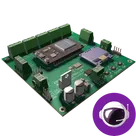
ESP32 Robot Controller
Controls
Properties
Availability & Pricing
| Distributor | Qty 1 | |
|---|---|---|
| Arrow | $0.98–$2.75 | |
| Digi-Key | $4.73–$6.55 | |
| LCSC | $3.31–$4.08 | |
| Mouser | $6.43–$6.64 | |
| Verical | $32.30–$32.95 | |
Assets
- Thumbnail ESP32.png
id=Thumbnail ESP32
Thumbnail

Welcome 👋
Flux helps you build PCBs faster with an AI teammate!
Create your account to collaborate, stay updated, fork your own version, and get instant answers from our AI agent.
nico
copilot
- ESP32 Microcontroller: At the core, providing versatile connectivity options and GPIOs.
- Motor Control: Inputs for controlling two motors (MotorA and MotorB).
- Encoders: Interfaces to read signals from encoders for feedback.
- I2C Display: To allow configuration and display status.
- Flysky RC Receiver: For receiving radio control signals.
- Power Regulation: Power nets like +3.3V, +5V, and +VBAT.
- Buttons: Multiple buttons for user input.
Components Explanation: Microcontroller- U1: ESP32-DEVKIT-V1: Provides the main processing and communication capabilities.
Motor Control- U2: TB6612FNG: Motor driver IC to handle MotorA and MotorB.
Power Regulation- U3: 7805: A voltage regulator to provide a stable +5V output.
- D1: SS34: A Schottky diode for protection and rectification.
Connectors- Various connectors (e.g., J3, J5) for interfacing sensors, encoders, and the RC receiver.
Passive Components- Resistors (R6, R19), capacitors (C1, C2) for filtering, pull-up/pull-down functions, and stabilization.
Buttons and Switches- User input components for various functionalities like resetting, manual control, etc.
Key Connections:- Motor Control:
- Connect U2:AIN1 to U1:D27.
- Connect U2:AIN2 to MotorA_IN2:P1, MotorB_IN2:P1 to U1:D13.
- Power Regulation:
- Connect U3: VO to 5V:P1.
- Encoders and Sensors:
- Connect Encoder1_ChA:P1 to U1:D5.
- Connect Encoder2_ChA:P1 to U1:D19.
Possible Errors: