hasoni / Mid Red Esper Photo Analyser

Loaded

0

0

Files

Schematic

PCB

Log InSign Up

Temperature and Humidity Sensor Design

hasoni

hasoni

Make me a temperature and humidity sensor node with Wifi and Bluetooth, powered by USB-C (5V) for consumer use.
It should be a low-power environmental node with a digital T/RH sensor, ultra-low-power MCU with Wi-Fi + Bluetooth (dual-radio) — 2.4 GHz 802.11 b/g/n plus BLE 5.x powered by USB-C (5 V) — USB-C receptacle 5 V default; include reverse/OVP/UVLO/OCP protection and plan for 0.5–3 A sources.
17 days

flux

1:00

Thinking deeply about your request.

Creating a high-level plan.

Working on your request.

Searching for files and context.

You want a low-power consumer temperature/humidity sensor node with dual-radio Wi-Fi + BLE and protected USB-C 5 V input.
  • I’ve created a plan covering architecture, major parts, USB-C protection, power path, and schematic integration.
  • It’s ready to execute.
Click Start on the plan bar to build it. If you want, I can also update the plan first with extras like battery backup, enclosure limits, or a target size.
Plan
Goal
  • Design a consumer low-power temperature and humidity sensor node that integrates a digital temperature/humidity sensing element and an ultra-low-power MCU with integrated Wi-Fi and Bluetooth (supporting 2.4 GHz 802.11 b/g/n and BLE 5.x), powered from a USB-C 5 V source. The design must incorporate a USB-C receptacle with reverse polarity, over-voltage protection, under-voltage lockout, and over-current protection to ensure robust operation across USB sources delivering from 0.5 A to 3 A.
Implementation plan
  1. Define the system architecture
    1. Capture and document functional requirements and constraints including low-power operation, sensor integration, wireless dual-radio needs, and robust USB-C power input protection.
    2. Set the project description to reflect a sensor node for consumer environmental monitoring.
  2. Select and add major components to the schematic
    1. Select and add a digital temperature/humidity sensor (e.g., a common digital sensor from the library).
    2. Select and add an ultra-low-power MCU with integrated Wi-Fi and Bluetooth. For example, consider using a part like the ESP32 if it meets the power and wireless specifications.
  3. Establish the USB-C power entry subsystem
    1. Add a USB-C receptacle and configure its footprint.
    2. Integrate protection circuits for reverse polarity, over-voltage, under-voltage lockout, and over-current protection. Choose and add components (such as protection FETs/TVS diodes or dedicated power management ICs) that handle the range from 0.5 A to 3 A.
  4. Develop power regulation and supporting circuits
    1. Add regulators, filtering capacitors, and supporting passive components to achieve reliable 5 V operation.
    2. Connect the power path ensuring that all protection devices are correctly placed.
  5. Integrate interconnections and review the schematic
    1. Make and verify net connections between the sensor, MCU, and USB-C power entry/protection circuits.
    2. Cross-check the schematic against the functional requirements.
  6. Prepare documentation for prototype validation
    1. Finalize the schematic review and note test points for power integrity and sensor functionality.
    2. Update project properties and description to reflect the design status.
Success criteria
  • The schematic includes a digital temperature/humidity sensor integrated with a low-power MCU featuring dual Wi-Fi/Bluetooth radios.
  • The USB-C input path includes reverse polarity, over-voltage, under-voltage lockout, and over-current protection, and supports 0.5 A to 3 A power sources.
  • All components are correctly connected and the design meets the outlined power and functional requirements.
Add ESD and LEDs
Use ESP32-C6
Set board size
17 days

​
Sign up to send

Reviews


  • Ground
    Ground
    A common return path for electric current. Commonly known as ground.
    jharwinbarrozo
    20.5M
  • Net Portal
    Net Portal
    Wirelessly connects nets on schematic. Used to organize schematics and separate functional blocks. To wirelessly connect net portals, give them same designator. #portal
    jharwinbarrozo
    43.0M
  • Power Net Portal
    Power Net Portal
    Wirelessly connects power nets on schematic. Identical to the net portal, but with a power symbol. Used to organize schematics and separate functional blocks. To wirelessly connect power net portals, give them the same designator. #portal #power
    jharwinbarrozo
    11.4M
  • Generic Resistor
    Generic Resistor
    A generic fixed resistor ideal for rapid circuit topology development. Its footprint automatically adapts based on the selected package case code—supporting 0402, 0603, 0805, 1203, and many other standard SMD packages, as well as axial horizontal and vertical configurations. Save precious design time by seamlessly add more information to this part (value, footprint, etc.) as it becomes available. Standard resistor values: 1.0 ohm, 10 ohm, 100 ohm, 1.0k ohm, 10k ohm, 100k ohm, 1.0M ohm 1.1 ohm, 11 ohm, 110 ohm, 1.1k ohm, 11k ohm, 110k ohm, 1.1M ohm 1.2 ohm, 12 ohm, 120 ohm, 1.2k ohm, 12k ohm, 120k ohm, 1.2M ohm 1.3 ohm, 13 ohm, 130 ohm, 1.3k ohm, 13k ohm, 130k ohm, 1.3M ohm 1.5 ohm, 15 ohm, 150 ohm, 1.5k ohm, 15k ohm, 150k ohm, 1.5M ohm 1.6 ohm, 16 ohm, 160 ohm, 1.6k ohm, 16k ohm, 160k ohm, 1.6M ohm 1.8 ohm, 18 ohm, 180 ohm, 1.8K ohm, 18k ohm, 180k ohm, 1.8M ohm 2.0 ohm, 20 ohm, 200 ohm, 2.0k ohm, 20k ohm, 200k ohm, 2.0M ohm 2.2 ohm, 22 ohm, 220 ohm, 2.2k ohm, 22k ohm, 220k ohm, 2.2M ohm 2.4 ohm, 24 ohm, 240 ohm, 2.4k ohm, 24k ohm, 240k ohm, 2.4M ohm 2.7 ohm, 27 ohm, 270 ohm, 2.7k ohm, 27k ohm, 270k ohm, 2.7M ohm 3.0 ohm, 30 ohm, 300 ohm, 3.0K ohm, 30K ohm, 300K ohm, 3.0M ohm 3.3 ohm, 33 ohm, 330 ohm, 3.3k ohm, 33k ohm, 330k ohm, 3.3M ohm 3.6 ohm, 36 ohm, 360 ohm, 3.6k ohm, 36k ohm, 360k ohm, 3.6M ohm 3.9 ohm, 39 ohm, 390 ohm, 3.9k ohm, 39k ohm, 390k ohm, 3.9M ohm 4.3 ohm, 43 ohm, 430 ohm, 4.3k ohm, 43K ohm, 430K ohm, 4.3M ohm 4.7 ohm, 47 ohm, 470 ohm, 4.7k ohm, 47k ohm, 470k ohm, 4.7M ohm 5.1 ohm, 51 ohm, 510 ohm, 5.1k ohm, 51k ohm, 510k ohm, 5.1M ohm 5.6 ohm, 56 ohm, 560 ohm, 5.6k ohm, 56k ohm, 560k ohm, 5.6M ohm 6.2 ohm, 62 ohm, 620 ohm, 6.2k ohm, 62K ohm, 620K ohm, 6.2M ohm 6.8 ohm, 68 ohm, 680 ohm, 6.8k ohm, 68k ohm, 680k ohm, 6.8M ohm 7.5 ohm, 75 ohm, 750 ohm, 7.5k ohm, 75k ohm, 750k ohm, 7.5M ohm 8.2 ohm, 82 ohm, 820 ohm, 8.2k ohm, 82k ohm, 820k ohm, 8.2M ohm 9.1 ohm, 91 ohm, 910 ohm, 9.1k ohm, 91k ohm, 910k ohm, 9.1M ohm #generics #CommonPartsLibrary
    jharwinbarrozo
    1.5M
  • Generic Capacitor
    Generic Capacitor
    A generic fixed capacitor ideal for rapid circuit topology development. You can choose between polarized and non-polarized types, its symbol and the footprint will automatically adapt based on your selection. Supported options include standard SMD sizes for ceramic capacitors (e.g., 0402, 0603, 0805), SMD sizes for aluminum electrolytic capacitors, and through-hole footprints for polarized capacitors. Save precious design time by seamlessly add more information to this part (value, footprint, etc.) as it becomes available. Standard capacitor values: 1.0pF, 10pF, 100pF, 1000pF, 0.01uF, 0.1uF, 1.0uF, 10uF, 100uF, 1000uF, 10000uF 1.1pF, 11pF, 110pF, 1100pF 1.2pF, 12pF, 120pF, 1200pF 1.3pF, 13pF, 130pF, 1300pF 1.5pF, 15pF, 150pF, 1500pF, 0.015uF, 0.15uF, 1.5uF, 15uF, 150uF, 1500uF 1.6pF, 16pF, 160pF, 1600pF 1.8pF, 18pF, 180pF, 1800pF 2.0pF, 20pF, 200pF, 2000pF 2.2pF, 22pF, 220pF, 2200pF, 0.022uF, 0.22uF, 2.2uF, 22uF, 220uF, 2200uF 2.4pF, 24pF, 240pF, 2400pF 2.7pF, 27pF, 270pF, 2700pF 3.0pF, 30pF, 300pF, 3000pF 3.3pF, 33pF, 330pF, 3300pF, 0.033uF, 0.33uF, 3.3uF, 33uF, 330uF, 3300uF 3.6pF, 36pF, 360pF, 3600pF 3.9pF, 39pF, 390pF, 3900pF 4.3pF, 43pF, 430pF, 4300pF 4.7pF, 47pF, 470pF, 4700pF, 0.047uF, 0.47uF, 4.7uF, 47uF, 470uF, 4700uF 5.1pF, 51pF, 510pF, 5100pF 5.6pF, 56pF, 560pF, 5600pF 6.2pF, 62pF, 620pF, 6200pF 6.8pF, 68pF, 680pF, 6800pF, 0.068uF, 0.68uF, 6.8uF, 68uF, 680uF, 6800uF 7.5pF, 75pF, 750pF, 7500pF 8.2pF, 82pF, 820pF, 8200pF 9.1pF, 91pF, 910pF, 9100pF #generics #CommonPartsLibrary
    jharwinbarrozo
    1.5M
  • Generic Inductor
    Generic Inductor
    A generic fixed inductor suitable for rapid circuit topology development. The footprint automatically adapts based on the selected package, supporting standard SMD sizes (e.g., 0402, 0603, 0805) as well as well-known inductor packages such as SDR1806, PA4320, SRN6028, and SRR1260. Standard inductor values: 1.0 nH, 10 nH, 100 nH, 1.0 µH, 10 µH, 100 µH, 1.0 mH 1.2 nH, 12 nH, 120 nH, 1.2 µH, 12 µH, 120 µH, 1.2 mH 1.5 nH, 15 nH, 150 nH, 1.5 µH, 15 µH, 150 µH, 1.5 mH 1.8 nH, 18 nH, 180 nH, 1.8 µH, 18 µH, 180 µH, 1.8 mH 2.2 nH, 22 nH, 220 nH, 2.2 µH, 22 µH, 220 µH, 2.2 mH 2.7 nH, 27 nH, 270 nH, 2.7 µH, 27 µH, 270 µH, 2.7 mH 3.3 nH, 33 nH, 330 nH, 3.3 µH, 33 µH, 330 µH, 3.3 mH 3.9 nH, 39 nH, 390 nH, 3.9 µH, 39 µH, 390 µH, 3.9 mH 4.7 nH, 47 nH, 470 nH, 4.7 µH, 47 µH, 470 µH, 4.7 mH 5.6 nH, 56 nH, 560 nH, 5.6 µH, 56 µH, 560 µH, 5.6 mH 6.8 nH, 68 nH, 680 nH, 6.8 µH, 68 µH, 680 µH, 6.8 mH 8.2 nH, 82 nH, 820 nH, 8.2 µH, 82 µH, 820 µH, 8.2 mH #generics #CommonPartsLibrary
    jharwinbarrozo
    15.8k
  • Terminal
    Terminal
    An electrical connector acting as reusable interface to a conductor and creating a point where external circuits can be connected.
    natarius
  • RMCF0805JT47K0
    RMCF0805JT47K0
    47 kOhms ±5% 0.125W, 1/8W Chip Resistor 0805 (2012 Metric) Automotive AEC-Q200 Thick Film #forLedBlink
    jharwinbarrozo
    1.2M
  • 875105359001
    875105359001
    10uF Capacitor Aluminum Polymer 20% 16V SMD 5x5.3mm #forLedBlink #commonpartslibrary #capacitor #aluminumpolymer #radialcan
    jharwinbarrozo
    1.2M
  • CTL1206FYW1T
    CTL1206FYW1T
    Yellow 595nm LED Indication - Discrete 1.7V 1206 (3216 Metric) #forLedBlink
    jharwinbarrozo
    1.1M

Mid Red Esper Photo Analyser

Mid Red Esper Photo Analyser thumbnail
Welcome to your new project. Imagine what you can build here.

Properties

Properties describe core aspects of the project.

Pricing & Availability

Distributor

Qty 1

Controls

Welcome 👋

Flux helps you build PCBs faster with an AI teammate!

Create your account to collaborate, stay updated, fork your own version, and get instant answers from our AI agent.
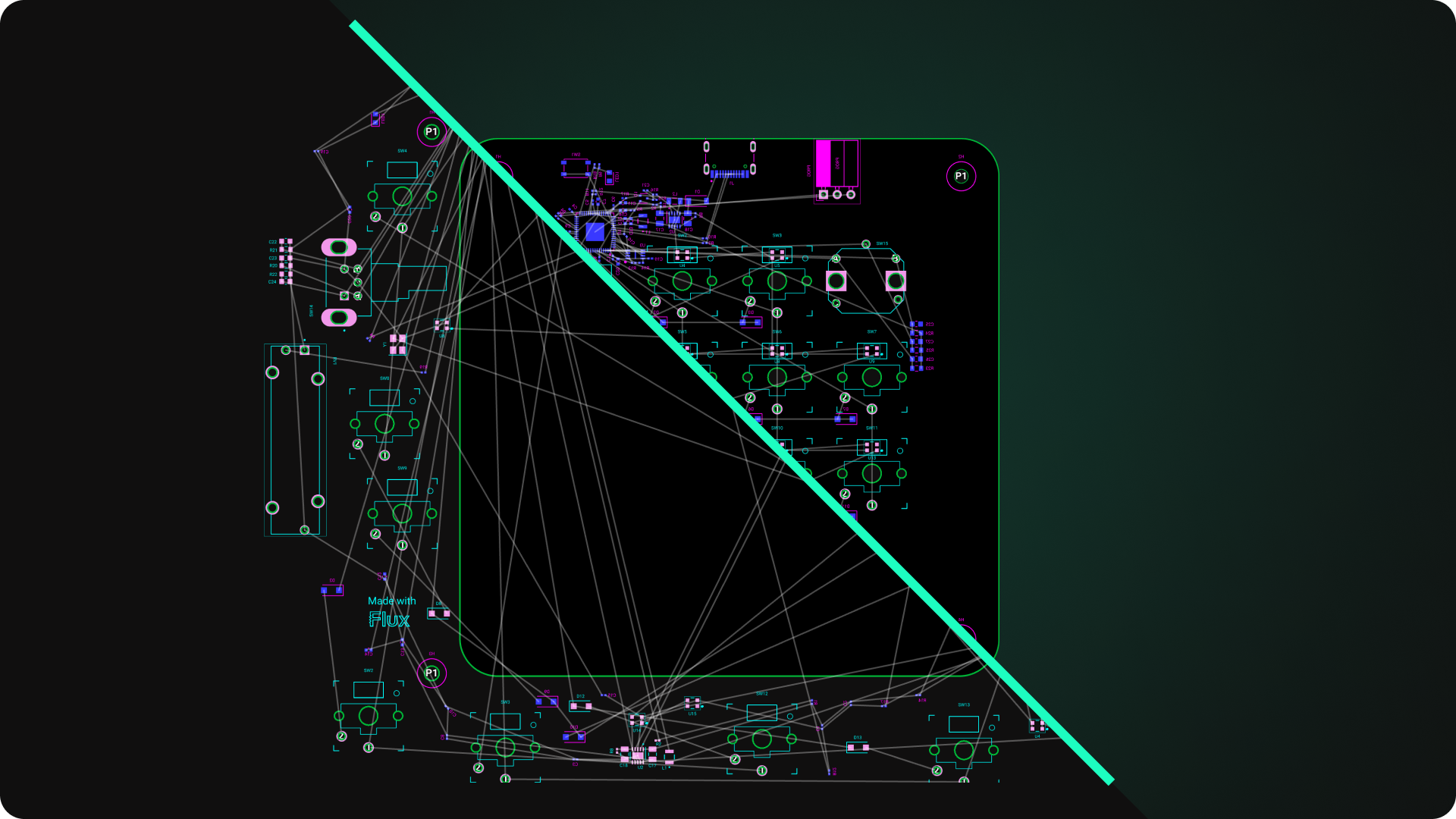
      Introducing AI Placement!
      AI Placement Demo

      AI-Powered Component Placement

      Let AI place your components intelligently. AI Placement analyzes your schematic and positions components for optimal routing, signal integrity, and board density.

      From Schematic to Layout in Seconds

      Skip the tedious manual placement. AI Placement generates a starting layout you can refine, saving hours of repetitive work on every new design.

      Works With Auto-Layout

      Pair AI Placement with Auto-Layout for a complete AI-driven PCB design flow — from component placement through trace routing, all with one click.

      Try it