PCB Design for High Current Circuits
0:25
Yes - that helps a lot.
If only 5 to 8 channels are actually 20 A, and the rest are only 5 A fused, the design becomes much more realistic than a full 16 x 20 A worst-case board.
What changed
Your board is no longer a pure 320 A worst-case distribution problem. Instead, it is a mixed-current power distribution board, which is much easier to package safely if you separate:
- high-current channels: 20 A
- medium/current-limited channels: 5 A
- main feed and return: heavy cable
- control wiring: low current
That matches the guidance that high-current routing should start from estimating net currents and then assigning routing width/geometry from those current estimates, instead of treating everything like ordinary low-current nets . The attachment workflow also emphasizes analyzing technical documents and tying the result back to the actual design constraints rather than giving a generic answer .
Practical verdict
With:
- 8 AWG for main power and ground
- 14 AWG to the loads
- 5 oz to 8 oz copper
- only 5 to 8 channels at 20 A
- the rest at 5 A fused
I’d say:
Table
| Item | Verdict |
|---|---|
| PCB as a clean mounting/distribution platform | Yes |
| Short high-current sections on the PCB | Reasonable |
| PCB carrying all total current through long copper paths alone | Still not ideal |
| Mixed-current board with reinforced main feed | Good approach |
Use the PCB for:
- holding the fuse positions
- holding the switching channels
- organizing outputs
- low-current control wiring
Use the heavy wiring for:
- the main incoming supply
- the main ground return
- any trunk path that would otherwise accumulate current from many channels
Even with 5 oz to 8 oz copper, I would still avoid long shared copper runs carrying the sum of many outputs. Heavy copper helps, but good architecture matters more than just copper thickness. The project-analysis guidance is clear that current budgeting and routing strategy should be determined up front from the power architecture .
My recommendation
This is now feasible, provided you:
- keep each 20 A path short
- use large pours/bus-style copper for shared distribution
- bring the highest current in through wire or studded connection
- do not depend on ordinary PCB geometry alone for the entire common trunk
- 5 A fused channels: easy on the same board
- 20 A channels: fine if short and reinforced
- shared common bus: this is still the critical part
If you want, I can help you next with a practical layout architecture for:
- 8 high-current + 8 low-current channels, or
- 5 high-current + 11 low-current channels
and show the safest way to arrange the power entry, fuse row, and output rows.
8 high-current layout
5 high-current layout
Size the main bus
16 days
Ready.
To get started, talk to Flux or create a New Document.
Reviews
Documents
Documents are markdown text files which describe project goals, capture details, or even simulation outputs.
Assets
kicad_mod
RELAY_SRD-12VDC-SL-C.kicad_mod
FP_RELAY_SRD-12VDC-SL-CFootprintstep
SRD-12VDC-SL-C.step
3D_SRD-12VDC-SL-C3D Model
SRD-12VDC-SL-C.png
SRD-12VDC-SL-CThumbnail
SRD-12VDC-SL-C
defaultDefaultRelay-12VDC-SL-C
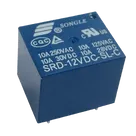
12V 15A SPDT (1 Form C) 5 Plugin,15.6x19.2mm Power Relays ROHS #Relay
Properties
Relay
Ningbo Songle Relay
SRD-12VDC-SL-C
K
Pricing & Availability
Distributor | Qty 1 |
|---|
Controls
Welcome 👋
Flux accelerates your PCB design with AI.
Create your account to start using this component and bring your ideas to life.