Schematic Design Issue Analysis
1:19
Project
Below is an analysis focused solely on the schematic’s connectivity and component assignments based on the project data and design‐rule review results:
1. Signal Interface and Net Naming
- Issue:
The sensor designated 2652 (U1) has pins labeled VIN, 3VO, GND, SCK, SDO, SDI, and CS. In the current net assignments, only VIN, SCK, SDI, and GND appear connected to nets. The SDO and CS pins are left floating, and the choice of using “SCK” on net 1 together with U3’s “SCL” creates ambiguity. - Recommendation:
• Review the intended communication interface (SPI or I²C) for U1.
• If I²C is intended, rename U1’s SCK, SDI (and SDO if applicable) to SDA/SCL as appropriate, and ensure that the pull-up network is present for these lines.
• Explicitly assign nets for U1’s 3VO, SDO, and CS (or remove unused pins if not in use).
2. Airwire (Connectivity) Errors Involving Resistors and Signal Pins
- Issue:
The design report flags errors such as: - Recommendation:
• Verify each resistor’s intended role (for example, as pull-ups on an I²C line or current‐limiting elements on a digital interface).
• Double‑check the pin numbering on U1 to confirm that the resistor connections match design intent.
• Adjust the net connections of R3 and R4 so that, for example, a pull‑up resistor connects from the SDA/SCL net to the proper power rail rather than inadvertently bridging unrelated signal pins.
3. Decoupling and Bypass Components
- Issue:
No decoupling capacitors are visible attached at the power pins of the main ICs. In addition, the battery charger module and the regulator board (U2) lack the expected input/output bypass capacitors. - Recommendation:
• Add, for each power input pin of U1, U2, and U3, a decoupling capacitor (typically a 0.1 µF close to the pin and a bulk capacitor if indicated by the datasheet).
• Ensure that the capacitor values match the manufacturer’s recommendations per datasheet.
4. Pull-Up/Pull-Down Resistors on Communication Lines
- Issue:
For an I²C bus, the SDA and SCL lines require pull-up resistors. The net assignments for U2 (using pins “11_SDA” and “12_SCL”) and the sensor lines (currently a mix of SCK and SDA for U1) do not clearly show any dedicated pull-ups. - Recommendation:
• Insert appropriate pull-up resistors (e.g., 4.7 kΩ to 10 kΩ) on the SDA and SCL nets if using an I²C interface.
• Reassign nets so that both devices share the same clearly labeled SDA and SCL lines.
5. Overlapping Copper and PCB Connectivity Interface
- Issue:
The review reports errors (e.g., overlapping copper on nets for GND, CS, SDO, SDI, VIN, 3VO) that may stem from ambiguous net assignments in the schematic or mismatches between the schematic and PCB footprint labels. - Recommendation:
• Revisit the net assignments in both the schematic and PCB layout to ensure each signal has a unique, clearly defined net name.
• Confirm that each IC’s power and signal pins are mapped to the expected physical pads and that no copper pour boundaries are inadvertently overlapping due to misassigned nets.
Summary of Corrections:
- Interface Clarity: Revisit the intended communication (I²C vs. SPI) on U1 and reassign/netrename pins so that functions (SDA/SCL vs. SCK/SDO/SDI/CS) are consistent.
- Resistor Placement: Check and correct the connections of R3 and R4 so that they serve their intended roles (e.g., pull-up networks) and do not cross-connect unrelated signals.
- Decoupling: Add bypass capacitors at the power pins of each IC and across the battery charger circuitry as per datasheet recommendations.
- Net Labeling: Ensure that every signal net is uniquely and descriptively labeled to avoid ambiguities that lead to overlapping copper or unintended connectivity.
- Pull-Up Resistors: If using I²C, include dedicated pull-up resistors on the SDA and SCL nets.
Make these adjustments to improve signal integrity, power distribution, and overall functional reliability of the design.
Verify SDA/SCL connection
Add decoupling capacitors
Correct resistor connections
374 days
Ready.
R4
Resistance
4.7k Ω
U1
U2
BME280 TEMP,HUMID
BNO085(attitude sensor)
R3
Resistance
4.7k Ω
U3
Reviews

- Wirelessly connects nets on schematic. Used to organize schematics and separate functional blocks. To wirelessly connect net portals, give them same designator. #portaljharwinbarrozo43.0M
- Wirelessly connects power nets on schematic. Identical to the net portal, but with a power symbol. Used to organize schematics and separate functional blocks. To wirelessly connect power net portals, give them the same designator. #portal #powerjharwinbarrozo11.4M
- A generic fixed resistor for rapid developing circuit topology. Save precious design time by seamlessly add more information to this part (value, footprint, etc.) as it becomes available. Standard resistor values: 1.0Ω 10Ω 100Ω 1.0kΩ 10kΩ 100kΩ 1.0MΩ 1.1Ω 11Ω 110Ω 1.1kΩ 11kΩ 110kΩ 1.1MΩ 1.2Ω 12Ω 120Ω 1.2kΩ 12kΩ 120kΩ 1.2MΩ 1.3Ω 13Ω 130Ω 1.3kΩ 13kΩ 130kΩ 1.3MΩ 1.5Ω 15Ω 150Ω 1.5kΩ 15kΩ 150kΩ 1.5MΩ 1.6Ω 16Ω 160Ω 1.6kΩ 16kΩ 160kΩ 1.6MΩ 1.8Ω 18Ω 180Ω 1.8KΩ 18kΩ 180kΩ 1.8MΩ 2.0Ω 20Ω 200Ω 2.0kΩ 20kΩ 200kΩ 2.0MΩ 2.2Ω 22Ω 220Ω 2.2kΩ 22kΩ 220kΩ 2.2MΩ 2.4Ω 24Ω 240Ω 2.4kΩ 24kΩ 240kΩ 2.4MΩ 2.7Ω 27Ω 270Ω 2.7kΩ 27kΩ 270kΩ 2.7MΩ 3.0Ω 30Ω 300Ω 3.0KΩ 30KΩ 300KΩ 3.0MΩ 3.3Ω 33Ω 330Ω 3.3kΩ 33kΩ 330kΩ 3.3MΩ 3.6Ω 36Ω 360Ω 3.6kΩ 36kΩ 360kΩ 3.6MΩ 3.9Ω 39Ω 390Ω 3.9kΩ 39kΩ 390kΩ 3.9MΩ 4.3Ω 43Ω 430Ω 4.3kΩ 43KΩ 430KΩ 4.3MΩ 4.7Ω 47Ω 470Ω 4.7kΩ 47kΩ 470kΩ 4.7MΩ 5.1Ω 51Ω 510Ω 5.1kΩ 51kΩ 510kΩ 5.1MΩ 5.6Ω 56Ω 560Ω 5.6kΩ 56kΩ 560kΩ 5.6MΩ 6.2Ω 62Ω 620Ω 6.2kΩ 62KΩ 620KΩ 6.2MΩ 6.8Ω 68Ω 680Ω 6.8kΩ 68kΩ 680kΩ 6.8MΩ 7.5Ω 75Ω 750Ω 7.5kΩ 75kΩ 750kΩ 7.5MΩ 8.2Ω 82Ω 820Ω 8.2kΩ 82kΩ 820kΩ 8.2MΩ 9.1Ω 91Ω 910Ω 9.1kΩ 91kΩ 910kΩ 9.1MΩ #generics #CommonPartsLibraryjharwinbarrozo1.5M
- A generic fixed capacitor ideal for rapid circuit topology development. You can choose between polarized and non-polarized types, its symbol and the footprint will automatically adapt based on your selection. Supported options include standard SMD sizes for ceramic capacitors (e.g., 0402, 0603, 0805), SMD sizes for aluminum electrolytic capacitors, and through-hole footprints for polarized capacitors. Save precious design time by seamlessly add more information to this part (value, footprint, etc.) as it becomes available. Standard capacitor values: 1.0pF 10pF 100pF 1000pF 0.01uF 0.1uF 1.0uF 10uF 100uF 1000uF 10,000uF 1.1pF 11pF 110pF 1100pF 1.2pF 12pF 120pF 1200pF 1.3pF 13pF 130pF 1300pF 1.5pF 15pF 150pF 1500pF 0.015uF 0.15uF 1.5uF 15uF 150uF 1500uF 1.6pF 16pF 160pF 1600pF 1.8pF 18pF 180pF 1800pF 2.0pF 20pF 200pF 2000pF 2.2pF 22pF 20pF 2200pF 0.022uF 0.22uF 2.2uF 22uF 220uF 2200uF 2.4pF 24pF 240pF 2400pF 2.7pF 27pF 270pF 2700pF 3.0pF 30pF 300pF 3000pF 3.3pF 33pF 330pF 3300pF 0.033uF 0.33uF 3.3uF 33uF 330uF 3300uF 3.6pF 36pF 360pF 3600pF 3.9pF 39pF 390pF 3900pF 4.3pF 43pF 430pF 4300pF 4.7pF 47pF 470pF 4700pF 0.047uF 0.47uF 4.7uF 47uF 470uF 4700uF 5.1pF 51pF 510pF 5100pF 5.6pF 56pF 560pF 5600pF 6.2pF 62pF 620pF 6200pF 6.8pF 68pF 680pF 6800pF 0.068uF 0.68uF 6.8uF 68uF 680uF 6800uF 7.5pF 75pF 750pF 7500pF 8.2pF 82pF 820pF 8200pF 9.1pF 91pF 910pF 9100pF #generics #CommonPartsLibraryjharwinbarrozo1.5M
- A generic fixed inductor for rapid developing circuit topology. *You can now change the footprint and 3D model at the top level anytime you want. This is the power of #genericsjharwinbarrozo15.5k
- An electrical connector acting as reusable interface to a conductor and creating a point where external circuits can be connected.Terminal
- 47 kOhms ±5% 0.125W, 1/8W Chip Resistor 0805 (2012 Metric) Automotive AEC-Q200 Thick Film #forLedBlinkjharwinbarrozo1.2M
- 10uF Capacitor Aluminum Polymer 20% 16V SMD 5x5.3mm #forLedBlink #commonpartslibrary #capacitor #aluminumpolymer #radialcanjharwinbarrozo1.2M
- Yellow 595nm LED Indication - Discrete 1.7V 1206 (3216 Metric) #forLedBlinkjharwinbarrozo1.1M


Welcome to your new project. Imagine what you can build here.
Properties
Pricing & Availability
Distributor | Qty 1 |
|---|
Assets
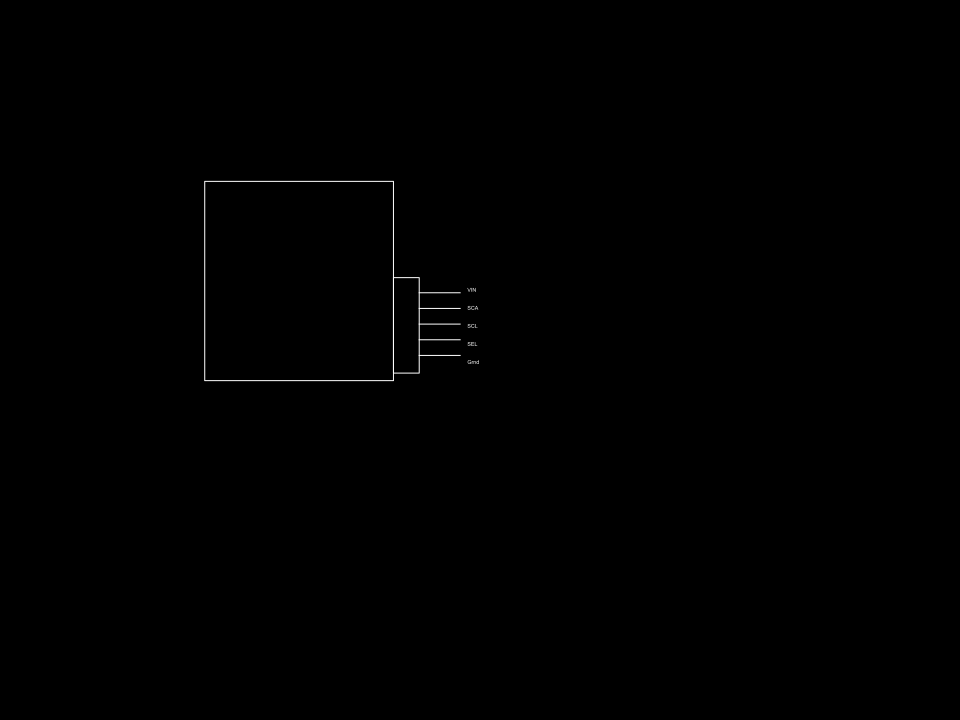
Sps30.svg
Sps30.svgDefaultControls
Welcome 👋
Flux helps you build PCBs faster with an AI teammate!
Create your account to collaborate, stay updated, fork your own version, and get instant answers from our AI agent.