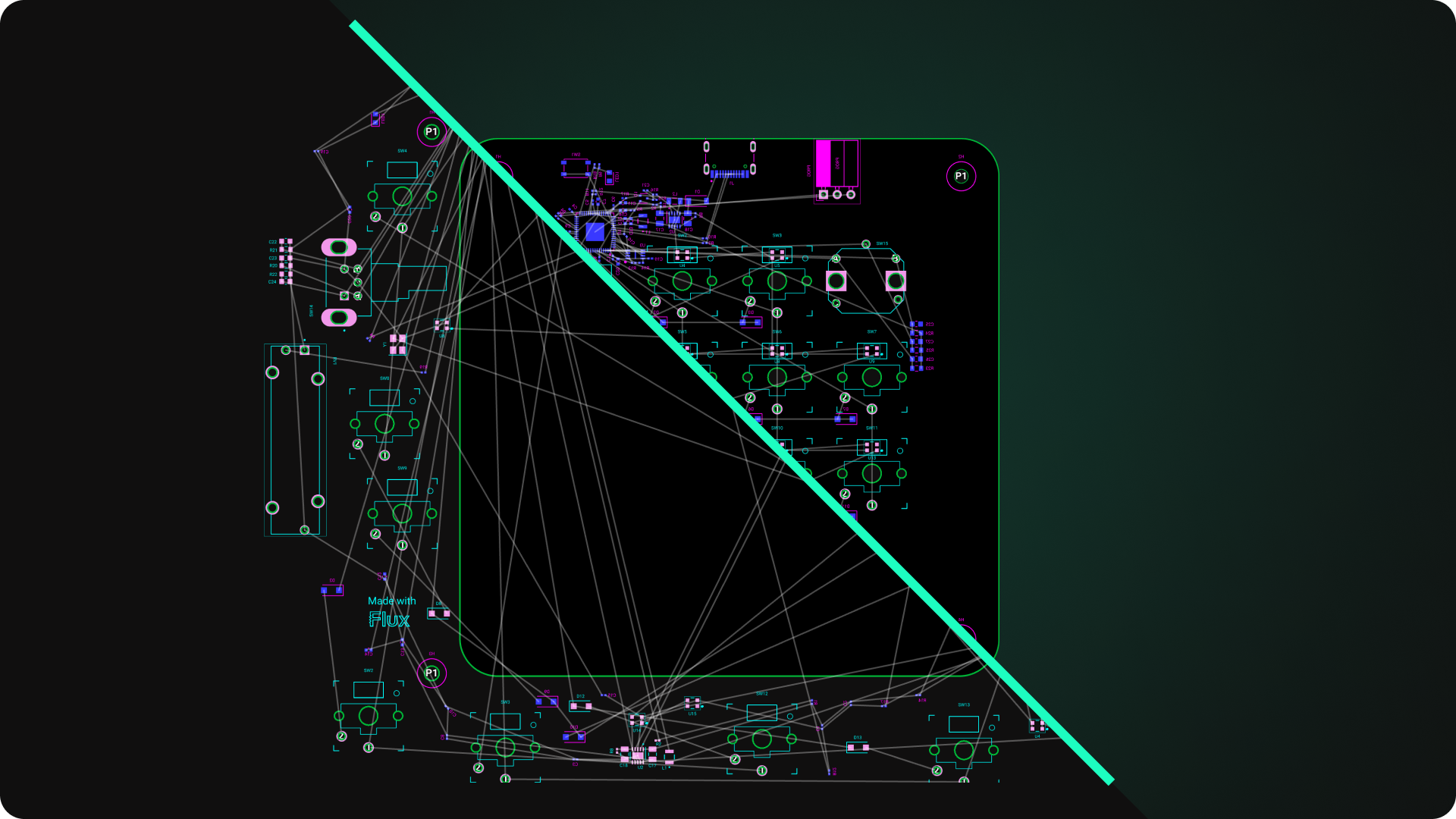
Dash Shift-Light Driver Project Overview
0:42
Here’s a detailed breakdown of your “Dash shiftlight daughter board” project.
1. Purpose
This board is a dedicated shift-light driver daughterboard for the EM Dash main unit. Its job is to receive simple serial commands (DIN/CLK/LOAD) from the dash, then drive up to nine discrete LEDs as a visual shift indicator bar, offloading multiplexing and current regulation from the main CPU.
2. Core Components
| Component | Function | Description |
|---|---|---|
| U1 MAX7219EWG+ | LED driver IC (SPI-controlled, 8×8 matrix) | Handles multiplexing and current regulation for up to 64 LEDs. Here only nine outputs are used. |
| R1 Generic Resistor | ISET resistor | Sets the segment current via U1’s ISET pin. Value chosen for desired LED brightness. |
| C1 Generic Capacitor | Decoupling capacitor (bulk) | Stabilizes VCC rail against low-frequency transients (e.g. 10 µF). |
| C2 Generic Capacitor | Decoupling capacitor (high-frequency) | Bypasses high-frequency noise on VCC (e.g. 0.1 µF), placed close to U1. |
| J1 S5B-XH-A-1(LF)(SN) | 5-pin header connector | Interface to the EM Dash: V+, GND, CLK, LOAD (CS), DIN (SDI). |
| D1, …, D9 LEDs | Shift‐light LEDs | Discrete indicator LEDs wired as individual segment loads to U1 outputs SEG_A…SEG_G plus DP and extra. |
3. How It Works: Signal Flow
-
Power & Decoupling
- J1-pin 1 → VCC rail → [C1] bulk cap → [C2] high-freq cap → [U1] V+
- J1-pin 2 → GND → [U1] GND pins
-
Control Interface (SPI-like)
- J1-pin 5 DIN → [U1] SDI (data in)
- J1-pin 3 CLK → [U1] CLK
- J1-pin 4 LOAD → [U1] CS (latch)
-
Current Setting
- [R1] between ISET pin and GND programs segment current.
-
LED Segment Outputs
- [U1] drives SEG_A…SEG_G, SEG_DP, DIG_5 as open-drain sinks.
- Each output sinks its corresponding LED’s cathode; anode goes to board V+.
-
Net Portals
- “SegX” net portals route each segment net off-board to EM Dash harness.
4. Design Choices & Trade-offs
| Decision | Benefit | Trade-off/Consideration |
|---|---|---|
| Use MAX7219 driver | Minimal MCU I/O (3 pins), built-in current regulation | Fixed max current per segment; extra silicon cost vs. simpler resistor-only driver |
| Discrete LEDs vs. bar | Custom LED selection and placement | More layout work; potential brightness mismatch vs. integrated LED bar modules |
| Bulk + HF decoupling | Stable, low-noise supply | Requires board space; component count |
| Single 5-pin connector | Small, keyed, easy harnessing | No onboard programming or diagnostics connector |
5. Potential Challenges & Considerations
- EMI & Signal Integrity
– Long harness between main dash and this board can pick up noise. Good decoupling and short traces for DIN/CLK/LOAD are critical. - Heat & Power
– At high brightness, MAX7219 and LEDs dissipate heat. Ensure adequate copper area or thermal vias if needed. - Brightness Uniformity
– Tolerance in [R1] and LED Vf variations may cause uneven illumination. Binning LEDs or adding fine-tune resistors can help. - Connector Robustness
– S5B-XH is friction-lock; ensure strain relief on the cable.
6. Real-World Applications
- Automotive dash indicators (shift lights, warning bars)
- Any SPI-driven LED bar/segment displays where MCU I/O is at a premium
- Rapid-prototyping of custom LED dashboards
7. Improvements & Future Enhancements
- Adaptive Brightness: Add an ambient-light sensor and PWM-modulated backlight to adjust LED brightness automatically.
- Color Options: Swap discrete white/red LEDs for RGB LEDs + use a more advanced driver (e.g., WS2812), removing the MAX7219 but adding MCU firmware complexity.
- Higher Power Handling: Move to a more capable LED-driver IC (e.g., constant-current sink for >40 mA per channel).
- Diagnostic Feedback: Add a status LED or register-readback via separate MCU to confirm latch/data reception.
- Modular Expansion: Break out extra MAX7219 rows (DIG_1…DIG_4) for additional indicators without redesign.
Summary: This compact daughterboard cleanly offloads LED-bar driving to the MAX7219, minimizing I/O and firmware complexity on the EM Dash. Careful decoupling and layout ensure reliable operation in the automotive environment. Future work could focus on adaptive brightness, color support, and enhanced diagnostics.
Compute segment current
Decoupling guidelines
Add thermal vias
Impedance constraints
Find ambient sensor
286 days


Welcome 👋
Flux helps you build PCBs faster with an AI teammate!
Create your account to collaborate, stay updated, fork your own version, and get instant answers from our AI agent.