ESP32 Retro PC Project Overview
1:30
Understanding user request.
Analyzing tool policy.
Interpreting mandatory procedures.
Crafting project description.
Finalizing potential enhancements.
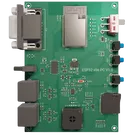
Here are the coolest highlights of your ESP32 x86 PC, plus a ready-to-use project description.
Coolest features
- Real VGA output from an ESP32 using a simple resistor DAC into the VGA connector, driven by ESP1.
- Genuine PS/2 support for keyboard and mouse via open-drain level shifting using Q3, Q5, Q6, Q7 and the KeyBoard and Mouse ports.
- Seamless USB-C power and plug-and-program over USB-UART using USB1 plus IC1, with auto-boot handled by Q1 and Q2, and manual BOOT and RESET buttons.
- Built-in speaker audio using a compact Class-D power amp U2 driving SPK1, with output filtering FB1, FB2 and supply/bead isolation L1, L2.
- microSD storage over SDIO with proper pull-ups and ESD protection on CMD, CLK and DAT lines: Card2, R56, R57, R58, R54, R50, D3, D4, D5.
- Robust power path with manual power switch POWER, reverse protection D1, and a simple 3.3 V rail via LDO U1 backed by bulk and local decoupling like C5, C9.
- USB data line protection with a dedicated TVS array D2, keeping D+/D- reliable.
Suggested project descriptions
- Short tagline: An ESP32-powered retro PC that outputs real VGA, speaks PS/2, plays audio on a built-in speaker, programs over USB-C, and loads assets from microSD.
- Full description: A self-contained retro PC platform built around ESP1 that exposes classic PC-style IO: VGA video via a resistor DAC to the VGA connector, PS/2 keyboard and mouse through open-drain level shifters Q3/Q5/Q6/Q7, microSD storage on Card2, and a Class-D audio path using U2 into SPK1. It powers and debugs over USB-C using USB1 and IC1, with auto-boot logic via Q1/Q2. The 3.3 V rail is regulated by U1, with ESD and filtering throughout for robust operation.
Key components and roles
- Compute: ESP1 drives VGA, SDIO, PS/2, and audio generation.
- USB-C and UART: USB1, IC1, D2.
- Auto-program and controls: Q1, Q2, BOOT, RESET.
- VGA output: VGA with series resistor network from ESP1.
- PS/2 IO: KeyBoard, Mouse, level shifters Q3/Q5/Q6/Q7.
- microSD storage: Card2 with pull-ups R56/R57/R58/R54/R50 and ESD D3/D4/D5.
- Audio path: U2, SPK1, beads L1/L2, chokes FB1/FB2.
- Power and protection: POWER, D1, U1, bulk caps like C5, C9.
Quick optimizations you can consider next
- Cooler, more efficient 3.3 V rail by replacing U1 with a 3.3 V Buck Regulator.
- Tougher USB data integrity by adding a USB Common Mode Choke and a Resettable Fuse 500mA on VBUS.
- Better audio UX by adding a 3.5 mm Audio Jack and optional Headphone Amplifier.
Want me to set the full description above as the project’s description field now, or tailor it to a specific audience, like makers, retro fans, or classroom use?
Shorter, casual description
Feature prioritization
Optimize for classroom use
Explain “x86 PC” angle
Highlight future expandability


Welcome 👋
Flux helps you build PCBs faster with an AI teammate!
Create your account to collaborate, stay updated, fork your own version, and get instant answers from our AI agent.