BLDC Motor Control Design Considerations
0:54
Here’s a concise technical overview and critique tailored to your stated goals.
Project intent
- Three-phase BLDC/FOC inverter around the TMC9660, operating from 24 V with up to 4 A phase current, PWM at 25 kHz.
- Power stage uses three discrete half-bridges based on Infineon IAUC45N04S6L063H MOSFETs (60 V class, very low Rds(on)).
Key functions to implement
- TMC9660 supplies the FOC control, gate driving, current/voltage sensing, SPI/UART control, protections, and integrated multiphase buck resources.
- Power stage: 3 half-bridges, phase current shunts or in-package sensing (depending on measurement topology), DC link input and bulk decoupling.
- Control and comms: SPI/UART to host, fault/wake/enable lines, GPIOs for diagnostics or peripheral features.
Potential challenges
- Gate drive and switching behavior
- 25 kHz with low-Rds(on) MOSFETs yields steep di/dt and dv/dt; careful gate resistor sizing, split turn-on/turn-off resistors, and snubbing may be required to control ringing/EMI without adding too much switching loss.
- Ensure TMC9660 gate drive voltage, peak source/sink current, and Miller clamp behavior are compatible with the IAUC45N04S6L063H’s total gate charge and reverse recovery of the body diode.
- Dead time: tune for your MOSFETs to avoid shoot-through while minimizing body-diode conduction time.
- Current sensing accuracy
- At only 4 A peak and 25 kHz, shunt placement and amplifier bandwidth/noise are critical. Verify the TMC9660 ADC/sample-and-hold timing vs the PWM blanking window to avoid desaturation/diode recovery artifacts.
- Kelvin routing from shunts, matched differential traces, and low-inductance return paths are essential.
- Supply and decoupling
- DC link: low-ESR bulk plus high-frequency ceramics (MLCCs) directly across each half-bridge (HS to LS FET supply) to contain loop current at ns edges.
- Gate-driver supply decoupling near the TMC9660 pins; observe datasheet-recommended local caps for charge pump/boost pins.
- Layout/EMI
- Minimize high di/dt loops: half-bridge switch node, gate loops, and shunt loops. Keep switch-node copper compact; avoid running signals under it.
- Provide a solid ground reference with star-point strategy between power and signal grounds at the sense/ADC reference node per datasheet guidance.
- Plan for common-mode filtering at the DC input and shielding/grounding strategy for encoder/sensor I/O.
- Thermal performance
- Even at 4 A, continuous conduction plus switching losses and diode conduction during dead time can heat devices, especially in small PCBs. Validate thermal via arrays under FET pads and the TMC9660 exposed pad, and consider copper pours/planes as heat spreaders.
- Protection features
- Ensure overcurrent thresholding, desaturation detection (if applicable), VDS monitoring, and fault handling in TMC9660 are configured. Add TVS on the 24 V bus and input reverse-polarity protection.
- MOSFET selection/capability
- IAUC45N04S6L063H is a 40–60 V class automotive device family variant. Check its exact VDS rating, Qg, Qgd, tr/tf, Rds(on) at operating temperature, and avalanche robustness vs your 24 V bus and expected transients. For a 24 V system that can see >35–45 V spikes, a solid 60 V margin is common.
Performance considerations
- Efficiency
- At 25 kHz and 4 A, conduction loss will be modest with low Rds(on); switching losses likely dominate. Gate drive tuning and dead-time optimization have outsized impact.
- Control fidelity
- 25 kHz is a reasonable PWM for acoustic/torque ripple vs switching loss. Verify the TMC9660 FOC timing, ADC sampling synchronization, and current loop bandwidth relative to your motor electrical time constants.
- Acoustic/EMI
- 25 kHz is above most audible ranges, but mechanical resonances can still excite noise. Consider experimenting with random PWM or slight frequency dithering if EMI/tonal noise becomes an issue.
- Start-up and transients
- Pre-charge or soft-start on DC link; inrush limiting; verified bootstrap pre-charge for high-side drivers before initial PWM.
Real-world applications
- Compact robotics actuators, AGVs/AMRs, pumps, fans, gimbals, and light e-mobility subsystems requiring tight torque control and good efficiency on 24 V rails.
- Any system seeking integrated FOC with reduced firmware burden and SPI configurability.
Areas for improvement
- Documented sensing topology
- Decide between low-side, phase, or inline shunt sensing, and match it to TMC9660’s recommended circuits. Inline sensing improves dynamic accuracy but raises common-mode demands; low-side is simpler but can reduce observability.
- Gate network refinement
- Provide pads for separate turn-on/turn-off resistors and optional series ferrite beads; footprint an R-C snubber per phase (unpopulated by default) to tune in validation.
- Robust power input
- Add transient suppression (SM8S or SMBJ 33–36 V TVS typical), reverse-polarity protection (ideal diode or FET-based), and input LC/π filtering to reduce conducted EMI.
- Thermal headroom
- Heatsinking strategy through copper planes and vias under FETs; consider thermistor near the power stage feeding TMC9660/host for derating.
- Safety/protections
- Add desat/VDS monitoring if supported; overcurrent fast-trip path, overtemperature monitoring, fault-latching behavior verified.
- Connectors and serviceability
- Clear phase outputs, hall/encoder input, and 24 V power connector choices with current ratings; include test points for phase currents, DC bus, 1V8/IO rails, and scope-friendly ground.
- Documentation and bring-up
- Include jumpers or zero-ohm links for measurement modes (e.g., isolate current sense, swap to external op-amp if needed), and SWD/UART access for diagnostics.
Scalability and future enhancements
- Higher current variants
- Parallel MOSFETs per switch with careful gate-drive layout and small series gate resistors; move to 2–3 oz copper; consider 4-layer with heavy copper on power planes.
- Higher bus voltage
- For 48 V systems, choose 80–100 V MOSFETs and re-validate gate charge/switching losses; strengthen input TVS and creepage/clearance.
- Integrated sensing
- Migrate to inline shunts with differential amplifiers for improved FOC at higher speeds; add sigma-delta isolated sensing if required in noisy environments.
- Functional safety
- Add redundant current sense or cross-check mechanisms, independent watchdog, and safe torque off (STO) design patterns depending on application.
- Firmware/controls
- Add field-weakening, sensorless startup, and advanced observers; log telemetry over UART/SPI; implement auto-tuning routines for new motors.
Practical next steps
- Confirm the IAUC45N04S6L063H exact ratings (VDS, Qg, Rds(on) at temperature) versus the TMC9660 gate drive capability; choose initial gate resistor values and provision variants for tuning.
- Define and freeze the current sense topology and shunt values for 4 A max with adequate headroom and ADC range; plan blanking timing.
- Allocate PCB real estate: tight half-bridge loops, local ceramics at each half-bridge, star ground at sense reference, and short, symmetric sense routing.
- Add input protections and measurement/test points to streamline bring-up and EMI debugging.
If you want, I can review or help draft the schematic power stage and sensing network around the TMC9660 and the IAUC45N04S6L063H, and propose concrete component values plus layout guidance.
Share design constraints
Pick sensing topology
Gate resistor values
Protection and input stage
Future 48V scalability
154 days
Ready.
To get started, talk to Flux or create a New Document.
Reviews
Documents
Documents are markdown text files which describe project goals, capture details, or even simulation outputs.
Assets

TMC9660ATB+_thumb.png
TMC9660ATB+_thumbThumbnailstp
TMC9660ATB+.stp
3D_TMC9660ATB+3D Model
TMC9660ATB+
TMC9660ATB+ Symbol.svgDefaultkicad_mod
QFN50P900X900X80-65N.kicad_mod
FP_QFN50P900X900X80-65NFootprintTMC9660ATB+
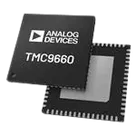
70V Smart Gate Driver with Servo (FOC) Controller in HW and Buck Converter Multiphase Motor Driver NMOS SPI, UART 64-QFN (9x9) #CommonPartsLibrary #IntegratedCircuit #PowerManagement #motor-driver #Controller #TMC9660
Properties
Analog Devices Inc./Maxim Integrated
IC
TMC9660ATB+
QFN50P900X900X80-65N
Integrated Circuit
Pricing & Availability
See prices from popular manufacturers for your project.
Controls
Welcome 👋
Flux accelerates your PCB design with AI.
Create your account to start using this component and bring your ideas to life.