Chat
Welcome to Flux
Treat Flux like your intern. Tell it what you'd like to build and it'll get to work. You can also ask it questions, brainstorm ideas, and teach it your preferences. Learn More
Explain this part
Write a part description
Describe each pin
Operating conditions
Electrical max ratings
Part Specifications
Application circuits
Verify Part Details
Recommend similar parts
Check availability & lifecycle
GND
~CS
VS
RESERVED_3
GND
GND
INT1
SDA/SDI/SDIO
INT2
SDO/ALT_ADDRESS
VDD_I/O
SCL/SCLK
NC
RESERVED_11
No files yet
Reviews
Documents
Documents are markdown text files which describe project goals, capture details, or even simulation outputs.

ADXL345TCCZ-EP
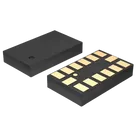
Accelerometer X, Y, Z Axis ±2g, 4g, 8g, 16g 0.05Hz ~ 1.6kHz 14-LGA (3x5)
The ADXL345-EP is an extended performance version of
the ADXL345, which is a small, thin, ultralow power, 3-axis
accelerometer with high resolution (13-bit) measurement at up to
±16 g. Digital output data is formatted as 16-bit twos complement
and is accessible through either a SPI (3- or 4-wire) or I2
C digital
interface.
The ADXL345-EP is well suited for extended temperature range
industrial and aerospace equipment. It measures the static
acceleration of gravity in tilt-sensing applications, as well as
dynamic acceleration resulting from motion or shock. Its high
resolution (3.9 mg/LSB) enables measurement of inclination
changes less than 1.0°.
Several special sensing functions are provided. Activity and
inactivity sensing detect the presence or lack of motion by
comparing the acceleration on any axis with user-set thresholds.
Tap sensing detects single and double taps in any direction. Freefall sensing detects if the device is falling. These functions can
be mapped individually to either of two interrupt output pins.
An integrated memory management system with a 32-level first in,
first out (FIFO) buffer can be used to store data to minimize host
processor activity and lower overall system power consumption.
Low power modes enable intelligent motion-based power
management with threshold sensing and active acceleration
measurement at extremely low power dissipation.
The ADXL345-EP is supplied in a small, thin, 3 mm × 5 mm ×
1 mm, 14-lead, enhanced plastic package.
Ultralow power: as low as 23 µA in measurement mode and
0.1 µA in standby mode at VS = 2.5 V (typical)
Power consumption scales automatically with bandwidth
User-selectable resolution from 10 to 13 bits
4 mg/LSB scale factor in all g ranges
32-sample FIFO minimizes host processor load
Single tap, double tap, and free-fall detection
Activity/inactivity monitoring
Supply voltage range: 2.0 V to 3.6 V
I/O voltage range: 1.7 V to VS
SPI (3- and 4-wire) and I2C digital interfaces
Flexible interrupt modes mappable to either interrupt pin
Measurement ranges selectable via serial command
Bandwidth selectable via serial command
10,000 g shock survival
Pb free/RoHS compliant
Properties
ADXL345TCCZ-EP
Analog Devices Inc.
IC
Integrated Circuit
parametric-v1
Pricing & Availability
DPN | Stock | Qty 1 |
|---|---|---|
4 | 0–130 | $14.91–$21.8379 |
1 | 0 | $0.00 |
1 | 0 | $25.5738 |
1 | 308 | $27.93 |
8 | 30–672 | $14.018–$25.9376 |
Controls
Welcome 👋
Flux accelerates your PCB design with AI.
Create your account to start using this component and bring your ideas to life.