17vrdnyk / Shrill Olive Robot Vacuum

Loaded

0

0

Files

Schematic

PCB

Log InSign Up

USB Breakout Module Design

flux

0:55

Below are step-by-step guidelines extracted from Flux documentation and best practices for wiring your USB breakout module schematic to meet the pinout and critical requirements:

1. Define Signal and Power Paths
  • USB-C Upstream Port:
    • Data Lines: Combine the A6 (D+) and B6 (D+) traces and connect them directly to the hub controller’s UPSTREAM_D+ pin. Do the same for the A7 (D–) and B7 (D–) traces feeding the UPSTREAM_D– pin.
    • Configuration (CC) Pins: Route each CC1 and CC2 pin through a 5.1kΩ resistor to GND. This configuration ensures proper role determination (UFP mode).
    • VBUS: Connect the USB-C VBUS to the hub controller’s power supply input. Include a fuse (rated for about 1A) in series to protect against overcurrent.
    • Ground: Tie the ground (GND) of the USB-C connector to the PCB ground plane.
  • USB-A Downstream Ports:
    • For each port, route the D+ and D– signal lines through a 22Ω resistor in series.
      • Connect one set (D+ and D–) to the hub controller’s DOWNSTREAM1_D+ and DOWNSTREAM1_D– pins, and the other set to DOWNSTREAM2_D+ and DOWNSTREAM2_D–.
    • Connect the VBUS output and GND to each USB-A connector.
  • Hub Controller IC Power Section:
    • Ensure the VBUS line powers the IC and, if necessary, add a 3.3V regulator with proper decoupling (using 0.1µF capacitors) near every power pin of the hub IC.
    • Place additional decoupling capacitors on other power nodes as recommended by the hub datasheet.
  • ESD Protection:
    • Install ESD protection diodes (e.g., USBLC6-4) on every D+ and D– line (both upstream and downstream) close to the connectors. This placement ensures that any electrostatic discharge is shunted away from sensitive circuitry.

2. Follow Differential Pair and Routing Best Practices
  • Impedance Matching:
    • Make sure that the paired tracing for both D+ and D– follows a differential pair layout. This means keeping the traces parallel with equal lengths and spacing calculated to achieve a 90Ω differential impedance.
    • The series 22Ω resistors help match the trace impedance by damping reflections at the source.
  • Trace Layout Considerations:
    • Keep all data lines as short as possible, with minimal turns or vias.
    • Maintain a continuous ground plane under the differential pairs to serve as a solid reference and reduce the chance of signal reflections or crosstalk.

3. Verify and Document Connections
  • Annotate the Schematic:
    • Label all nets clearly (e.g., name the combined USB-C D+ net as “UPSTREAM_D+”, etc.), so the routing team has clarity on the intended interconnections.
    • Verify that every resistor used for series impedance or CC configuration is placed according to the pinout—double-check the series resistance values against standard USB design practices.
  • Review Critical Connections:
    • Check that all power connections (VBUS, ground, and regulated outputs) meet the current capacity requirements.
    • Ensure that ESD diodes are placed ideally on each data line.

4. Reference Documentation for Additional Guidance
For more step-by-step instructions and schematic examples, please refer to the following Flux documentation pages that discuss similar wiring practices:
  • Getting Started in Flux: Schematic
    This page reviews the overall schematic design process—including power input sections and key component placement—which is similar in structure to building a USB breakout module.
  • Module Design Best Practices
    This guide covers best practices in component selection and connection routing that ensure reliable operation for modules that include USB connectivity.

By following these guidelines, you’ll wire your schematic to meet the required USB-C and USB-A pinouts while addressing critical requirements such as impedance matching, power delivery, ESD protection, and proper differential routing.
Let me know if you need further assistance or any additional details on specific connections!
Detailed wiring guide
Impedance requirements
Power and ESD considerations
404 days

​
Sign up to send

Reviews


  • Ground
    Ground
    A common return path for electric current. Commonly known as ground.
    jharwinbarrozo
    20.5M
  • Net Portal
    Net Portal
    Wirelessly connects nets on schematic. Used to organize schematics and separate functional blocks. To wirelessly connect net portals, give them same designator. #portal
    jharwinbarrozo
    43.0M
  • Power Net Portal
    Power Net Portal
    Wirelessly connects power nets on schematic. Identical to the net portal, but with a power symbol. Used to organize schematics and separate functional blocks. To wirelessly connect power net portals, give them the same designator. #portal #power
    jharwinbarrozo
    11.4M
  • Generic Resistor
    Generic Resistor
    A generic fixed resistor ideal for rapid circuit topology development. Its footprint automatically adapts based on the selected package case code—supporting 0402, 0603, 0805, 1203, and many other standard SMD packages, as well as axial horizontal and vertical configurations. Save precious design time by seamlessly add more information to this part (value, footprint, etc.) as it becomes available. Standard resistor values: 1.0 ohm, 10 ohm, 100 ohm, 1.0k ohm, 10k ohm, 100k ohm, 1.0M ohm 1.1 ohm, 11 ohm, 110 ohm, 1.1k ohm, 11k ohm, 110k ohm, 1.1M ohm 1.2 ohm, 12 ohm, 120 ohm, 1.2k ohm, 12k ohm, 120k ohm, 1.2M ohm 1.3 ohm, 13 ohm, 130 ohm, 1.3k ohm, 13k ohm, 130k ohm, 1.3M ohm 1.5 ohm, 15 ohm, 150 ohm, 1.5k ohm, 15k ohm, 150k ohm, 1.5M ohm 1.6 ohm, 16 ohm, 160 ohm, 1.6k ohm, 16k ohm, 160k ohm, 1.6M ohm 1.8 ohm, 18 ohm, 180 ohm, 1.8K ohm, 18k ohm, 180k ohm, 1.8M ohm 2.0 ohm, 20 ohm, 200 ohm, 2.0k ohm, 20k ohm, 200k ohm, 2.0M ohm 2.2 ohm, 22 ohm, 220 ohm, 2.2k ohm, 22k ohm, 220k ohm, 2.2M ohm 2.4 ohm, 24 ohm, 240 ohm, 2.4k ohm, 24k ohm, 240k ohm, 2.4M ohm 2.7 ohm, 27 ohm, 270 ohm, 2.7k ohm, 27k ohm, 270k ohm, 2.7M ohm 3.0 ohm, 30 ohm, 300 ohm, 3.0K ohm, 30K ohm, 300K ohm, 3.0M ohm 3.3 ohm, 33 ohm, 330 ohm, 3.3k ohm, 33k ohm, 330k ohm, 3.3M ohm 3.6 ohm, 36 ohm, 360 ohm, 3.6k ohm, 36k ohm, 360k ohm, 3.6M ohm 3.9 ohm, 39 ohm, 390 ohm, 3.9k ohm, 39k ohm, 390k ohm, 3.9M ohm 4.3 ohm, 43 ohm, 430 ohm, 4.3k ohm, 43K ohm, 430K ohm, 4.3M ohm 4.7 ohm, 47 ohm, 470 ohm, 4.7k ohm, 47k ohm, 470k ohm, 4.7M ohm 5.1 ohm, 51 ohm, 510 ohm, 5.1k ohm, 51k ohm, 510k ohm, 5.1M ohm 5.6 ohm, 56 ohm, 560 ohm, 5.6k ohm, 56k ohm, 560k ohm, 5.6M ohm 6.2 ohm, 62 ohm, 620 ohm, 6.2k ohm, 62K ohm, 620K ohm, 6.2M ohm 6.8 ohm, 68 ohm, 680 ohm, 6.8k ohm, 68k ohm, 680k ohm, 6.8M ohm 7.5 ohm, 75 ohm, 750 ohm, 7.5k ohm, 75k ohm, 750k ohm, 7.5M ohm 8.2 ohm, 82 ohm, 820 ohm, 8.2k ohm, 82k ohm, 820k ohm, 8.2M ohm 9.1 ohm, 91 ohm, 910 ohm, 9.1k ohm, 91k ohm, 910k ohm, 9.1M ohm #generics #CommonPartsLibrary
    jharwinbarrozo
    1.5M
  • Generic Capacitor
    Generic Capacitor
    A generic fixed capacitor ideal for rapid circuit topology development. You can choose between polarized and non-polarized types, its symbol and the footprint will automatically adapt based on your selection. Supported options include standard SMD sizes for ceramic capacitors (e.g., 0402, 0603, 0805), SMD sizes for aluminum electrolytic capacitors, and through-hole footprints for polarized capacitors. Save precious design time by seamlessly add more information to this part (value, footprint, etc.) as it becomes available. Standard capacitor values: 1.0pF, 10pF, 100pF, 1000pF, 0.01uF, 0.1uF, 1.0uF, 10uF, 100uF, 1000uF, 10000uF 1.1pF, 11pF, 110pF, 1100pF 1.2pF, 12pF, 120pF, 1200pF 1.3pF, 13pF, 130pF, 1300pF 1.5pF, 15pF, 150pF, 1500pF, 0.015uF, 0.15uF, 1.5uF, 15uF, 150uF, 1500uF 1.6pF, 16pF, 160pF, 1600pF 1.8pF, 18pF, 180pF, 1800pF 2.0pF, 20pF, 200pF, 2000pF 2.2pF, 22pF, 220pF, 2200pF, 0.022uF, 0.22uF, 2.2uF, 22uF, 220uF, 2200uF 2.4pF, 24pF, 240pF, 2400pF 2.7pF, 27pF, 270pF, 2700pF 3.0pF, 30pF, 300pF, 3000pF 3.3pF, 33pF, 330pF, 3300pF, 0.033uF, 0.33uF, 3.3uF, 33uF, 330uF, 3300uF 3.6pF, 36pF, 360pF, 3600pF 3.9pF, 39pF, 390pF, 3900pF 4.3pF, 43pF, 430pF, 4300pF 4.7pF, 47pF, 470pF, 4700pF, 0.047uF, 0.47uF, 4.7uF, 47uF, 470uF, 4700uF 5.1pF, 51pF, 510pF, 5100pF 5.6pF, 56pF, 560pF, 5600pF 6.2pF, 62pF, 620pF, 6200pF 6.8pF, 68pF, 680pF, 6800pF, 0.068uF, 0.68uF, 6.8uF, 68uF, 680uF, 6800uF 7.5pF, 75pF, 750pF, 7500pF 8.2pF, 82pF, 820pF, 8200pF 9.1pF, 91pF, 910pF, 9100pF #generics #CommonPartsLibrary
    jharwinbarrozo
    1.5M
  • Generic Inductor
    Generic Inductor
    A generic fixed inductor suitable for rapid circuit topology development. The footprint automatically adapts based on the selected package, supporting standard SMD sizes (e.g., 0402, 0603, 0805) as well as well-known inductor packages such as SDR1806, PA4320, SRN6028, and SRR1260. Standard inductor values: 1.0 nH, 10 nH, 100 nH, 1.0 µH, 10 µH, 100 µH, 1.0 mH 1.2 nH, 12 nH, 120 nH, 1.2 µH, 12 µH, 120 µH, 1.2 mH 1.5 nH, 15 nH, 150 nH, 1.5 µH, 15 µH, 150 µH, 1.5 mH 1.8 nH, 18 nH, 180 nH, 1.8 µH, 18 µH, 180 µH, 1.8 mH 2.2 nH, 22 nH, 220 nH, 2.2 µH, 22 µH, 220 µH, 2.2 mH 2.7 nH, 27 nH, 270 nH, 2.7 µH, 27 µH, 270 µH, 2.7 mH 3.3 nH, 33 nH, 330 nH, 3.3 µH, 33 µH, 330 µH, 3.3 mH 3.9 nH, 39 nH, 390 nH, 3.9 µH, 39 µH, 390 µH, 3.9 mH 4.7 nH, 47 nH, 470 nH, 4.7 µH, 47 µH, 470 µH, 4.7 mH 5.6 nH, 56 nH, 560 nH, 5.6 µH, 56 µH, 560 µH, 5.6 mH 6.8 nH, 68 nH, 680 nH, 6.8 µH, 68 µH, 680 µH, 6.8 mH 8.2 nH, 82 nH, 820 nH, 8.2 µH, 82 µH, 820 µH, 8.2 mH #generics #CommonPartsLibrary
    jharwinbarrozo
    15.8k
  • Terminal
    Terminal
    An electrical connector acting as reusable interface to a conductor and creating a point where external circuits can be connected.
    natarius
  • RMCF0805JT47K0
    RMCF0805JT47K0
    General Purpose Thick Film Standard Power and High-Power Chip Resistor 47 kOhms ±5% 0.125W, 1/8W Chip Resistor 0805 (2012 Metric) Automotive AEC-Q200 Thick Film Features: - RMCF – standard power ratings - RMCP – high power ratings - Nickel barrier terminations standard - Power derating from 100% at 70ºC to zero at +155ºC - RoHS compliant, REACH compliant, and halogen free - AEC-Q200 compliant
    jharwinbarrozo
    1.2M
  • 875105359001
    875105359001
    10 µF 16 V Aluminum - Polymer Capacitors Radial, Can - SMD 30mOhm 2000 Hrs @ 105°C #commonpartslibrary #capacitor #aluminumpolymer #radialcan
    jharwinbarrozo
    1.2M
  • CTL1206FYW1T
    CTL1206FYW1T
    Yellow 595nm LED Indication - Discrete 1.7V 1206 (3216 Metric)
    jharwinbarrozo
    1.1M

Shrill Olive Robot Vacuum

Shrill Olive Robot Vacuum thumbnail
Welcome to your new project. Imagine what you can build here.

Properties

Properties describe core aspects of the project.

Pricing & Availability

Distributor

Qty 1

Controls

Welcome 👋

Flux helps you build PCBs faster with an AI teammate!

Create your account to collaborate, stay updated, fork your own version, and get instant answers from our AI agent.
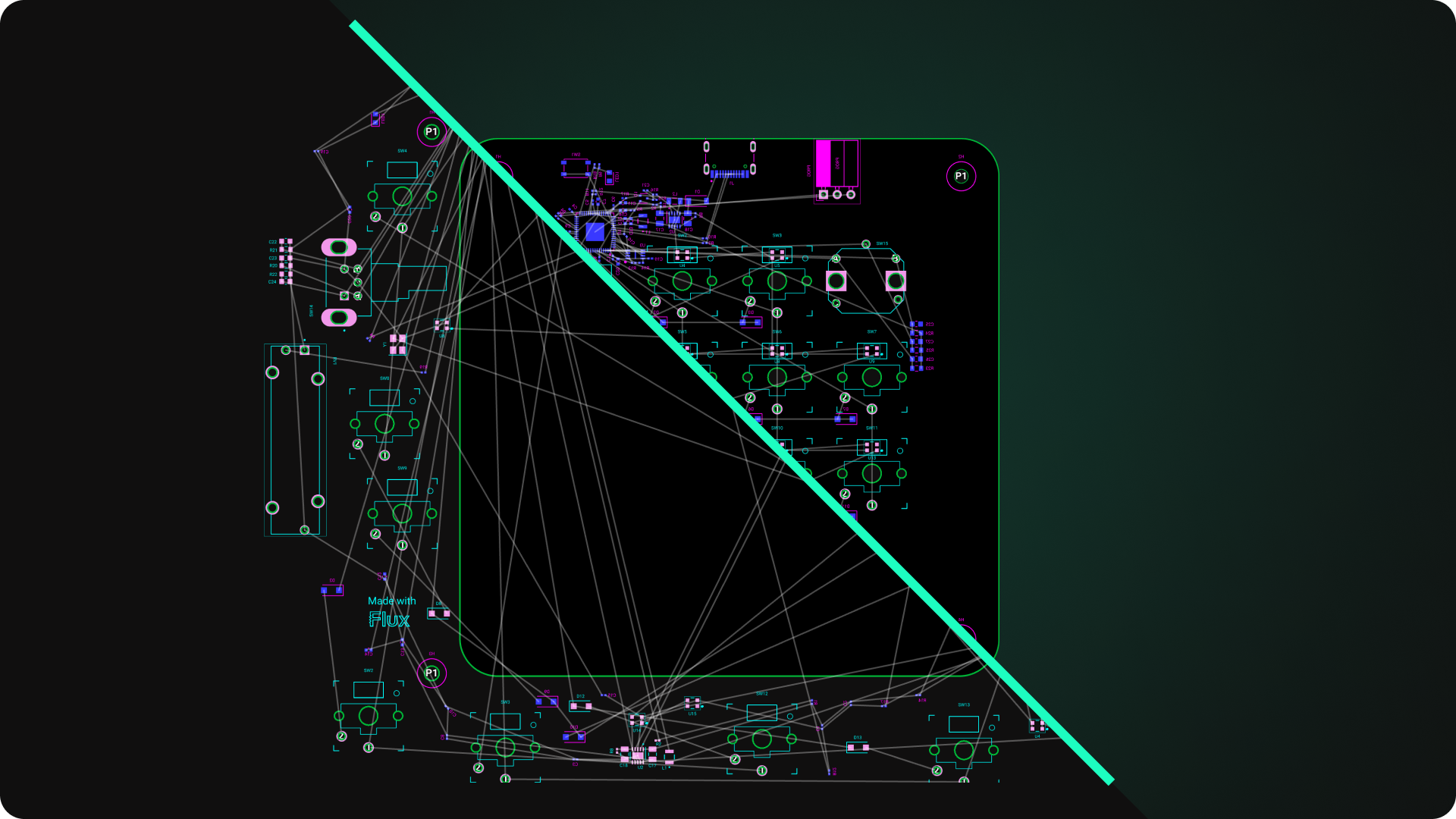
      Introducing AI Placement!
      AI Placement Demo

      AI-Powered Component Placement

      Let AI place your components intelligently. AI Placement analyzes your schematic and positions components for optimal routing, signal integrity, and board density.

      From Schematic to Layout in Seconds

      Skip the tedious manual placement. AI Placement generates a starting layout you can refine, saving hours of repetitive work on every new design.

      Works With Auto-Layout

      Pair AI Placement with Auto-Layout for a complete AI-driven PCB design flow — from component placement through trace routing, all with one click.

      Try it