Temperature and Humidity Sensor Node Design

1:11
Thinking deeply.
Creating a high-level execution plan.
Working on your request.
Looking up docs on Flux workflow for creating a PCB project: requirements, schematic capture, component selection, PCB layout, reviews/ERC/DRC, BOM, documentation and collaboration.
Reviewing developer guidelines.
Working on your request.
Looking up docs on How to create a PCB design in Flux from requirements through parts, schematic, layout, rules, checks, BOM, manufacturing export.
Planning a Generative AI response.
Considering USB-C design considerations.
Planning power requirements.
- Design a USB-C powered temperature and humidity environmental sensor node for consumer use. The node will include a digital temperature/RH sensor, an ultra-low-power MCU with dual Wi-Fi (802.11 b/g/n) and BLE (5.x) radios, and a power input designed for 5 V USB-C with reverse polarity, OVP, UVLO, and OCP protection, capable of handling 0.5–3 A sources.
-
System Architecture and Component Selection
- Define the overall block diagram with a USB-C power input, a protection chain, voltage regulation stages, the Wi-Fi/BLE MCU, and the digital T/RH sensor.
- Select and add a USB-C receptacle and protection circuitry from the Flux library that provides reverse polarity, OV, UVLO, and OCP protection for 5 V inputs.
- Select and add an ultra-low-power MCU with integrated dual-radio Wi-Fi and BLE capability (e.g., an ESP32 or similar part available in the library).
- Select and add a digital temperature/RH sensor that communicates via a digital bus (I2C or similar).
-
Schematic Design and Interconnections
- Add the selected MCU and sensor to the schematic, ensuring power, ground, and digital interface connections.
- Wire the USB-C input through the protection chain to the 5 V rail, and further use decoupling and voltage regulation as needed for the MCU and sensor.
- Incorporate necessary passive components (resistors, capacitors, inductors) to support the power integrity and RF performance, and add pull-ups/strap components for MCU reset/boot programming.
-
**PCB Layout Configuration
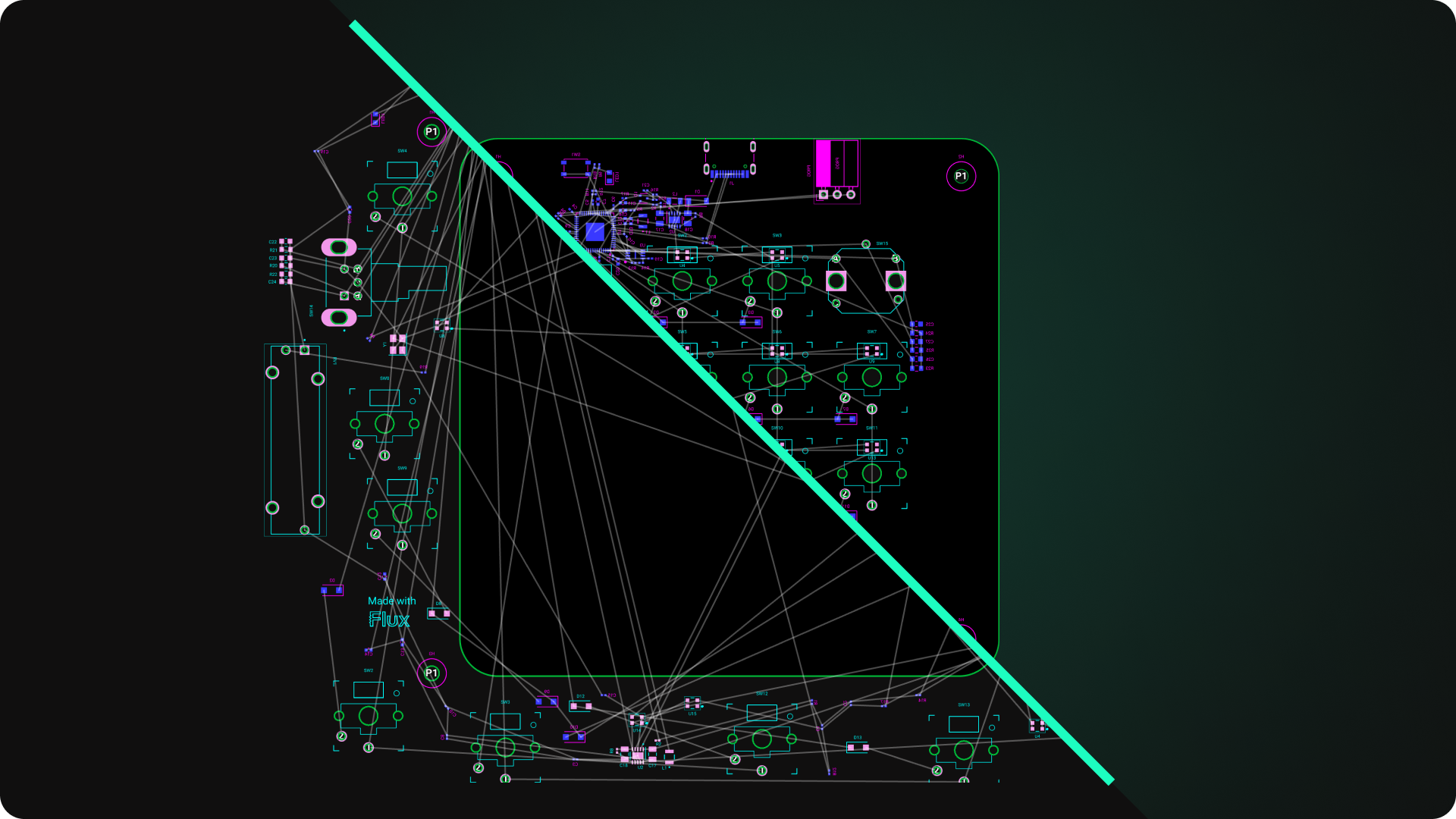
- Configure the PCB with a 4-layer stackup to ensure optimal power integrity and RF performance for the Wi-Fi/BLE sections.
- Set RF antenna placement and keepout zones near the MCU and signal paths, ensuring interference minimization and compliance with 2.4 GHz performance requirements.
- Define board outlines and placement constraints targeting a compact footprint suitable for consumer use.
-
**Design Review and Validation
- Run ERC/DRC on the schematic and layout, making iterative adjustments to address any issues.
- Validate the power subsystem and RF design against datasheet requirements, ensuring successful operations under 0.5–3 A conditions.
- The schematic includes a properly designed USB-C input with required protection that meets reverse, OVP, UVLO, and OCP requirements.
- The selected MCU and sensor are correctly integrated with proper signal and power connections.
- The PCB layout utilizes a 4-layer stackup with defined RF keepout areas, and all design rules pass ERC/DRC checks.
- The complete project design is ready for routing and manufacturing preparation.
To get started, talk to Flux or create a New Document.

Welcome 👋
Flux helps you build PCBs faster with an AI teammate!
Create your account to collaborate, stay updated, fork your own version, and get instant answers from our AI agent.