DC Bus Location Explained

Explain this project.
Describe its purpose, core components, and how they interact.
Break down the design, implementation, and functionality. Highlight key technologies, dependencies, and design choices, including trade-offs and optimizations.
Discuss potential challenges, performance considerations, and real-world applications. If applicable, suggest areas for improvement, scalability, and future enhancements.
70 days

0:59

70 days
where is the DC bus?
70 days

0:51

Inspecting DC Bus Connections.

Clarifying DC Bus Location.

Mapping Component Connections.

Analyzing the schematic.

Accessing knowledge base.

Locating the DC Bus.

DC bus location in this design:
  • DC+ (positive bus): Net 4. It is the + output of the rectifier at D1+, goes to the bulk capacitor C1 pin 1, and feeds the high-side device sources on Q1, Q2, and Q3.
  • DC- (negative bus): GND net. It is the - output of the rectifier at D1-, connects to C1 pin 2, and the low-side device drains on Q4, Q5, and Q6.
Context:
  • AC input enters at J3 and feeds the three-phase bridge D1 (AC1/AC2/AC3). The bridge’s + and - form the DC bus across the bulk cap C1.
Label DC bus nets
Check bus connections
Add DC-link decoupling
Review capacitor sizing
70 days

To get started, talk to Flux or create a New Document.

Documents

    Documents are markdown text files which describe project goals, capture details, or even simulation outputs.

    Assets

    Variable Frequency Drive (VFD).png

    Variable Frequency Drive (VFD).png

    Variable Frequency Drive (VFD)Thumbnail

    Variable Frequency Drive (VFD)

    Variable Frequency Drive (VFD) thumbnail
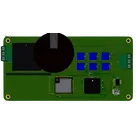
    This is a project of a variable frequency drive controlled by a PWM signal from ESP32, which is located on the board #AC #ESP32 #VDF #WiFi

    Pricing & Availability

    Distributor

    Qty 1

    Digi-Key

    $37.32–$37.67

    LCSC

    $0.33–$0.44

    Mouser

    $50.24

    Controls