Treat Flux like your intern. Tell it what you'd like to build and it'll get to work. You can also ask it questions, brainstorm ideas, and teach it your preferences. Learn More
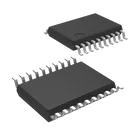
This project involves designing a circuit around the STM32F030F4P6 microcontroller, a 32-bit ARM® Cortex®-M0 device operating at 48MHz, equipped with 16KB of flash memory. This microcontroller is packaged in a 20-TSSOP (Thin Shrink Small Outline Package) with a width of 4.40mm. The project description lists various pins and their designations, reflecting the functionality and terminal types for each.
Here is a summary based on the provided information:
Microcontroller at the Core: The STM32F030F4P6 from STMicroelectronics is the centerpiece. This is a low-power, high-performance microcontroller suitable for a wide range of applications, reflecting common use in embedded systems.
Pin Designations & Types:
INPUT Pins: Certain pins (NRST, BOOT0, PF1, and PF0) are designated as input types, indicating they are meant to receive signals. NRST is typically used for resetting the microcontroller, BOOT0 for boot configuration, and PF1 and PF0 might serve specific functionalities as dictated by the application requirements.
PowerIn Pins: VDD, VDDA, and VSS are power-related pins. VDD and VDDA are for power supply inputs, with VDDA likely being the analog supply voltage if the microcontroller supports separate domains for analog and digital circuits. VSS is generally connected to ground.
Bi-directional (bidi) Pins: Several pins (PA0-PA10, PA13, PA14, PB1, and PA7) are marked as having bi-directional terminal types, suggesting they can be configured as either input or output depending on the application requirement. These pins are flexible and can be utilized for a multitude of purposes including GPIO (General Purpose Input/Output), analog inputs, UARTs, SPI, I2C, etc.
Unspecified Pin Type: All listed pins have an unspecified type, implying that specific configurations (e.g., analog, digital output, digital input) would depend on the application's requirements and the microcontroller's configuration capabilities.
No Electrical Connections Yet: It's stated that no electrical connections have been made in the project thus far. This means the project is still in its initial planning or setup phase, and the detailed schematic design with interconnections between these pins and other external components is yet to be established.
Based on this description, the next steps would likely include defining the project's specific use case (e.g., sensor interfacing, motor control, communication applications) and then proceeding with the detailed schematic design. This will involve deciding on the functionality of each bi-directional pin, connecting power and ground properly, implementing any necessary external circuitry (e.g., for signal conditioning, interfacing), and considering how to program and interact with the microcontroller (e.g., through NRST, BOOT0, and the bi-directional pins).
2y
Someone is typing...
2
PB1
PA9
NRST
VDD
PA6
VDDA
PA3
BOOT0
PA7
PF1
PA14
VSS
PA4
PA13
PA5
PA10
PA1
PA0
PF0
PA2
No files yet
Reviews
Documents
Documents are markdown text files which describe project goals, capture details, or even simulation outputs.
rayans
copilot