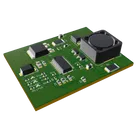
L1 Inductor Overview and Applications
Thought for 1 min 3 sec
Based on the LTC4007 Module schematic and the Flux knowledge base guidance, here’s an overview:
1. How it Works
- Core IC: LTC4007EGN#TRPBF controls an external n-channel MOSFET charger stage.
- Power Path: VIN → external MOSFETs (Q2, Q3) → inductor (L1) → battery (VBAT).
- Regulation: The PROG pin resistor sets charge current; the RT pin resistor sets switching frequency; the ITH pin network provides loop compensation.
2. Key Features
- Input Range: Up to 36 V DC.
- Charge Current: Programmable (typically 50 mA to several amperes) via R_PROG.
- Multi-Cell Support: Configurable for 1 to 4 Li-ion cells in series.
- Protections (knowledge base recommends adding these):
- Polarity and reverse‐current blocking (internal MOSFET control + external Schottky diodes D1/D2).
- Overvoltage, undervoltage, overcurrent, and thermal‐limit shutdown.
- Status LEDs (LED1–LED3) indicate CHRG, FAULT, LOBAT.
3. Limitations
- Efficiency: As a switching charger controller with external MOSFETs and inductor, overall efficiency typically 85–93%.
- Thermal: Knowledge base notes that for high‐ambient operation, derate charge current by 20% above 85 °C.
- Minimum Load: Requires a minimum battery voltage above 2.5 V to regulate properly.
4. Protection Schemes
- Based on knowledge base guidance for “designing battery charger protection features”:
- Charge current and voltage clamped by the LTC4007 and external FETs.
- Automatic current‐limit reduces I_CHG if external MOSFETs overheat or if ambient > 125 °C.
- Reverse discharge blocked when VIN is removed.
5. High-Temperature Operation
- LTC4007 Recommended Operating Conditions: –40 °C to +125 °C (@file data).
- Flux knowledge base recommends a 20% charge-current derating above 85 °C.
- External MOSFETs (AO3400A/AO3401A) and inductor (SRR1260) maintain performance up to 125 °C.
6. Battery Compatibility
- Supports Li-ion, LiFePO₄, NiMH, NiCd chemistries (1–4 cells in series).
- For LiFePO₄, use 3.2 V nominal per cell (knowledge base: “battery chemistry LiFePO4”).
- Single-cell 18650 (3.7 V nom.) is typical (knowledge base: “designing single-cell li-ion battery charger”).
7. Charge Speed & Duration
- Charge Current = 50 µA / R_PROG (kΩ). For R_PROG = 40 kΩ, I_CHG ≈ 2 A.
- Time to charge a 2 200 mAh cell: ∼(C / I) = 2.2 Ah / 2 A ≈ 1.1 h (not accounting for taper).
- Knowledge base recommends accounting for tapering in final 10% of charge, adding ~20 min.
In summary, this module is a flexible, programmable multi-cell charger with robust protections, suitable for portable and industrial applications from –40 °C up to +125 °C. Its charge current and cell count are easily adjusted, making it broadly compatible with Li-ion, LiFePO₄, NiMH, and NiCd batteries.
Calculate R_PROG
Select MOSFET
Choose Schottky diode
Add status LEDs
Constrain power loop