Arduino GIGA R1 WiFi Overview
Thought for 32 sec
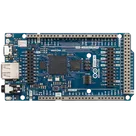
This project appears to represent the Arduino GIGA R1 WiFi, specifically as a shield/template-style board with its exposed headers/pads rather than a fully wired schematic.
Part purpose
The Arduino GIGA R1 WiFi is a high-performance Arduino development board intended for advanced embedded, IoT, robotics, audio/vision, industrial, and connectivity projects. It combines a powerful dual-core STM32H7 microcontroller with onboard wireless connectivity.
Its purpose is to provide a more capable alternative to classic Arduino boards when a project needs:
- Much higher processing performance
- More memory
- Many GPIOs
- Wi-Fi and Bluetooth connectivity
- Camera/display/audio-capable interfaces
- Real-time control plus higher-level application logic
The board is centered around an STM32H747XI dual-core microcontroller:
- Arm Cortex-M7 core for high-performance processing
- Arm Cortex-M4 core for real-time or lower-priority tasks
- Digital GPIO
- Analog inputs
- PWM outputs
- UART, SPI, I²C, CAN, USB, and other embedded interfaces
- External memory support
- Timers, ADCs, DAC-related functions depending on board routing
The wireless function is provided by a Murata-style radio module, referenced in the project description as LBEE5KL1DX-883, supporting:
- Wi-Fi 802.11 b/g/n
- Bluetooth 5
- 2.4 GHz operation
In a circuit, the Arduino GIGA R1 WiFi usually acts as the main controller board. External circuitry connects to its header pins for power, control, sensing, and communication.
Typical connections include:
- VIN / +5V / +3V3 for power distribution
- GND as the shared reference
- Digital I/O pins for switches, LEDs, relays, logic, or chip-select lines
- Analog inputs AD0–AD15 for sensors
- I²C pins SDA/SCL for sensors, expanders, RTCs, displays, etc.
- SPI/UART pins for faster peripherals or serial modules
- RESET / IOREF / AREF for Arduino shield compatibility
The current schematic in this project contains the exposed terminals/pads but no internal nets, so it is best understood as a board/header template for building shields or compatible external circuitry around the GIGA R1 WiFi.
Notable characteristics
- Significantly more powerful than classic Arduino Uno/Mega-class boards
- Dual-core MCU architecture
- Built-in Wi-Fi and Bluetooth
- Large number of I/O pins
- 3.3 V logic domain for the main MCU
- Arduino-style header compatibility, but not electrically identical to older 5 V Arduino boards
- Better suited for high-throughput, connected, or multimedia-capable embedded applications
Important design note: external circuitry should generally treat the GPIO as 3.3 V logic, not 5 V tolerant unless the specific pin capability is verified.
Family / series context
This board belongs to the broader Arduino board ecosystem, and more specifically the higher-performance Arduino GIGA class.
Compared with related Arduino families:
Table
| Board family | Typical MCU class | Wireless | Best use case |
|---|---|---|---|
| Arduino Uno | 8-bit AVR or modern compatible MCU | Usually no | Basic learning, simple GPIO/control |
| Arduino Mega | 8-bit AVR, many pins | No | Many-I/O beginner/intermediate projects |
| Arduino Nano / Nano 33 | Compact MCU boards | Some variants | Small embedded/wearable projects |
| Arduino MKR | SAMD-class, IoT-focused | Many variants | Compact IoT/product prototypes |
| Arduino Portenta | High-end STM32H7 modules | Often yes | Industrial/professional embedded systems |
| Arduino GIGA R1 WiFi | STM32H747 dual-core | Wi-Fi + Bluetooth | Advanced Arduino projects needing many I/O and high performance |
The GIGA R1 WiFi sits between hobby-friendly Arduino boards and more industrial/professional modules like Portenta.
- Compared to Uno/Mega, it is much faster, has more advanced peripherals, and supports wireless connectivity.
- Compared to Nano/MKR, it is physically larger and exposes many more I/O pins.
- Compared to Portenta H7, it is more accessible in Arduino-shield-style workflows, while Portenta is more module/industrial-product oriented.
- Compared to ESP32-based boards, it usually offers stronger MCU performance and more I/O, while ESP32 boards are often cheaper and more wireless-centric.
In short: the Arduino GIGA R1 WiFi is a high-end Arduino development board for projects that need serious processing power, many external connections, and built-in wireless communication.
Verify pin voltages
Run design review
Create shield spec
Map header pins
Add protection guidance
To get started, talk to Flux or create a New Document.


Welcome 👋
Flux accelerates your PCB design with AI.
Create your account to start using this component and bring your ideas to life.