Switches
A switch is a device that allows electricity to flow through a circuit by completing or interrupting the connection. It is a common component in electrical and electronic systems and is used in a variety of applications, such as controlling the flow of electricity in a circuit, turning devices on and off, and routing electrical signals. One of the primary use cases for switches is to control the flow of electricity in a circuit. This can be done by manually flipping the switch or by using a control mechanism, such as a timer or a sensor. Another common use for switches is to turn devices on and off. This can be done using a switch that is built into the device or by using a separate switch that is connected to the device. In addition to these basic use cases, switches can also be used to route electrical signals. For example, a switch can be used to route a signal from one device to another or to direct a signal to a specific circuit or component. If you're looking for a wide variety of switches for your projects, flux.ai has the world's largest community-driven public library of them. The library includes footprints, symbols, datasheets, and simulation models for a wide range of switches, making it easy to find the right switch for your needs.
1730405
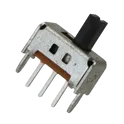
SPDT Right-Angle Through-Hole Toggle Switch – Miniature Single-Pole Double-Throw (SPDT) toggle switch designed for industrial controls, instrumentation, communication equipment, consumer electronics, embedded systems, test equipment, and general-purpose PCB switching applications. The NKK Switches AS11CH is part of the A Series, featuring a right-angle through-hole PCB mount with a maintained ON–ON switching function. It utilizes gold-plated contacts for reliable low-level signal switching, making it suitable for logic-level and control circuits. The switch is rated for 0.4 VA (AC/DC) at 28 V, provides non-shorting (break-before-make) contacts, epoxy-sealed terminals to prevent flux contamination during soldering, and is designed for 50,000 mechanical and electrical operating cycles. Operating over a −30°C to +85°C temperature range, it is ideal for compact embedded and industrial electronic designs. #NKKSwitches #AS11CH #ASeries #ToggleSwitch #SPDT #RightAngleSwitch #ThroughHole #GoldContacts #SignalSwitch #IndustrialElectronics #EmbeddedSystems #PCBSwitch
774 Uses1 StarsTPS48110AQDGXRQ1
Automotive Smart High-Side Power Switch – Single-channel 100 V smart high-side N-channel power switch for automotive power distribution, electronic fuse (eFuse), load protection, and battery-connected applications. Operates from a 3.5 V to 80 V supply, drives up to 4 A continuous output current, and features an ultra-low 10 mΩ typical RDS(on) for high-efficiency load switching. Includes adjustable current limiting, reverse current blocking, reverse battery protection, overvoltage protection, undervoltage lockout (UVLO), short-circuit protection, thermal shutdown, slew-rate control, open-load diagnostics, status flag output, and differential input control. Qualified to AEC-Q100 Grade 1, specified for operation over a −40°C to +125°C ambient temperature range, and housed in a 19-pin VSSOP (DGX) package. #TexasInstruments #TPS48110AQDGXRQ1 #TPS48110Q1 #SmartHighSideSwitch #HighSidePowerSwitch #EFuse #LoadSwitch #PowerDistribution #Automotive #CurrentLimiting #ReverseBatteryProtection #AECQ100 #EmbeddedSystems
180 Uses1 StarsSTM32MP257FAI3
MPU with Dual Arm Cortex-A35 @1.5GHz, Cortex-M33 @400MHz, 3xEthernet (2+1 switch), 3xFD-CAN, LVDS/DSI, H.264, 3D GPU, AI/NN, Secure Boot, Cryptography, DRAM enc/dec, PKA The STM32MP257FAI3 is a high-performance microprocessor from STMicroelectronics' STM32MP2 series, integrating dual 64-bit Arm Cortex-A35 cores running at up to 1.5 GHz, a Cortex-M33 real-time core, and a Cortex-M0+ low-power management core. It is designed for advanced industrial, edge AI, machine vision, HMI, IoT gateway, and multimedia applications requiring Linux-class processing alongside deterministic real-time control. The device features AI acceleration, 3D graphics, video encoding/decoding, extensive connectivity, advanced security, and support for high-speed external memory. Key Features Dual-core 64-bit Arm Cortex-A35 CPU operating up to 1.5 GHz Arm Cortex-M33 real-time processor with TrustZone and FPU support Arm Cortex-M0+ low-power coprocessor for autonomous operation Integrated NPU (Neural Processing Unit) delivering up to 1.35 TOPS AI performance 3D GPU and hardware video encoder/decoder acceleration Supports DDR3L, DDR4, and LPDDR4 external memory up to 4 GB Multiple display interfaces including MIPI-DSI, LVDS, and parallel RGB USB 2.0 Host and USB 3.0 Dual-Role with embedded PHYs PCI Express interface with integrated 5 Gbps PHY Up to three Gigabit Ethernet interfaces with TSN and IEEE 1588 support Extensive connectivity: I2C, I3C, SPI, UART, USART, CAN FD, SDMMC, SAI, and SPDIF Hardware cryptographic accelerators including AES, SHA, RSA, ECC, PKA, and True RNG Secure boot, TrustZone security, tamper detection, and resource isolation framework Multiple low-power operating modes for energy-efficient designs Available in fine-pitch BGA packages for high-density embedded systems. #STM32MP257FAI3 #STM32MP2 #STMicroelectronics #CortexA35 #CortexM33 #EdgeAI #EmbeddedLinux #IndustrialAutomation #MachineVision #HMI #IoTGateway #MPU #PCIe #USB3 #GigabitEthernet #TrustZone #EmbeddedSystems #ArtificialIntelligence #LinuxProcessor #IndustrialIoT #CommonPartsLibrary #IntegratedCircuit #Microprocessor #STM32MP2
35 Uses1 Stars