Switches
A switch is a device that allows electricity to flow through a circuit by completing or interrupting the connection. It is a common component in electrical and electronic systems and is used in a variety of applications, such as controlling the flow of electricity in a circuit, turning devices on and off, and routing electrical signals. One of the primary use cases for switches is to control the flow of electricity in a circuit. This can be done by manually flipping the switch or by using a control mechanism, such as a timer or a sensor. Another common use for switches is to turn devices on and off. This can be done using a switch that is built into the device or by using a separate switch that is connected to the device. In addition to these basic use cases, switches can also be used to route electrical signals. For example, a switch can be used to route a signal from one device to another or to direct a signal to a specific circuit or component. If you're looking for a wide variety of switches for your projects, flux.ai has the world's largest community-driven public library of them. The library includes footprints, symbols, datasheets, and simulation models for a wide range of switches, making it easy to find the right switch for your needs.
MR-0-102-A01-0000-RS
SPDT miniature rocker switch with straight PC-pin through-hole termination. Rated 3 A at 125 VAC and 1.5 A at 250 VAC, with <20 mΩ contact resistance and ≥1000 MΩ insulation resistance at 500 VDC. Suitable for power selection, control panels, and general equipment switching. Operating temperature: -30°C to +85°C; electrical life ≥10,000 cycles and mechanical life ≥40,000 cycles. #RockerSwitch #SPDT #ThroughHole #3A #250VAC #YUENFUNG
12 Uses0 StarsAONS66614
N-Channel 60 V 34.5A (Ta), 85A (Tc) 6.2W (Ta), 78W (Tc) Surface Mount 8-DFN (5x6) N-channel power MOSFET for high-frequency switching and synchronous rectification, rated for 60 V drain-to-source voltage and 85 A continuous drain current (at VGS = 10 V, TC = 25°C). Features a maximum RDS(on) of 2.9 mΩ at VGS = 10 V and 4.1 mΩ at VGS = 4.5 V, utilizes AlphaSGT™ trench technology, supports logic-level drive, and is housed in an 8-pin DFN 5×6 package. #N-ChannelMOSFET #PowerMOSFET #60V #85A #LowRDSon #LogicLevel #DFN5x6 #AlphaOmegaSemiconductor
990 Uses0 StarsLMR33630-Q1
3 A Synchronous Step-Down (Buck) DC/DC Converter – The Texas Instruments LMR33630AQRNXRQ1 converts a 3.8 V to 36 V input to an adjustable 1 V to 24 V output at up to 3 A, with a 400 kHz switching frequency. It integrates synchronous rectification, cycle-by-cycle current limiting, thermal shutdown, undervoltage lockout, and hiccup short-circuit protection. The device is housed in a 12-pin 3 × 2 mm VQFN-HR package and operates from −40°C to +125°C. #TexasInstruments #LMR33630AQRNXRQ1 #BuckConverter #DCDCConverter #PowerManagement #VoltageRegulator #SynchronousBuck #AutomotiveElectronics #EmbeddedSystems
540 Uses0 StarsTPS61088RHLR
TPS61088RHLR — Texas Instruments 10-A synchronous boost converter in RHL 20-pin VQFN package with exposed thermal pad. PCB footprint uses 21 pads: 20 perimeter terminals plus the exposed PGND thermal pad. Features 2.7 V to 12 V input, 4.5 V to 12.6 V adjustable output, 200 kHz to 2.2 MHz programmable switching frequency, programmable soft start, adjustable switch peak-current limit, 13.2 V output overvoltage protection, cycle-by-cycle overcurrent protection, and thermal shutdown. #commonpartslibrary #integratedcircuit #powermanagement #voltageregulator
793 Uses0 StarsSTUSB4500QTR
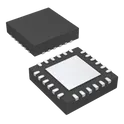
USB Controller USB 2.0 I2C Interface 24-QFN (4x4) The STUSB4500QTR is a standalone USB Type-C Power Delivery (PD) controller from STMicroelectronics designed for power sink applications (devices that receive power, like chargers, IoT devices, or battery-powered systems). It enables automatic negotiation of USB Power Delivery contracts (up to 100 W: 20 V / 5 A) without requiring an external microcontroller, thanks to its built-in auto-run algorithm. Power profiles (PDOs) can be pre-configured and stored in internal non-volatile memory, simplifying system design and reducing component count. The device is optimized for modern USB-C designs, offering robust protection, high-voltage tolerance, and support for operation even from a dead battery state. Key Features Power Delivery & Control Standalone USB Type-C™ and USB PD sink controller Supports up to 100 W (20 V, 5 A) power negotiation Auto-run mode (no MCU required) for PD negotiation Up to 3 configurable sink PDO profiles stored in NVM Power Management Dead battery mode support (can start with no battery power) Dual power supply inputs: V<sub>SYS</sub>: 3.0 V – 5.5 V V<sub>DD</sub>: 4.1 V – 22 V Integrated VBUS monitoring and control Integrated Functions Built-in VBUS switch gate drivers (PMOS) Internal/external VBUS discharge paths I²C interface for configuration and monitoring Protection & Reliability Short-to-VBUS protection on CC pins (up to 22 V) High-voltage tolerance: Up to 28 V on VBUS pins ESD protection: 3 kV HBM / 1.5 kV CDM Physical & Environmental Package: QFN-24 (4×4 mm) Operating temperature: –40°C to +105°C Industrial-grade reliability Compliance & Compatibility Certified for: USB Type-C Rev 1.2 USB PD Rev 2.0 Interoperable with USB PD 3.0 #commonpartslibrary #integratedcircuit #usbcontroller
651 Uses0 StarsFSM1LP
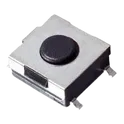
Tactile Switch SPST-NO Top Actuated Surface Mount The FSM1LP is a surface-mount tactile (momentary) switch manufactured by TE Connectivity under the ALCOSWITCH series. It is a low-profile, top-actuated pushbutton switch designed for compact PCB applications requiring reliable user input. This switch operates as a momentary SPST-NO (Single Pole Single Throw – Normally Open) device, meaning it only conducts when pressed and returns to open when released. Key Features Switch Type Tactile momentary (OFF–(ON)) pushbutton Contact Configuration SPST-NO (Normally Open) Mounting Type Surface Mount (SMD) with gull-wing leads Actuation Style Top-actuated round button Electrical Rating 50 mA @ 24 VDC Operating Force Approximately 1.57 N (~160 gf) Low Profile Design Compact height (~3–3.5 mm typical), suitable for slim devices Mechanical Life Around 100,000 cycles Contact Material Copper alloy with silver plating for reliable conductivity Compact Size Typically ~6 × 6 mm footprint RoHS Compliant Lead-free and environmentally compliant tactile switch momentary 4 pin smd #CommonPartsLibrary #Switch
3.8k Uses0 StarsTPS62840DLCR
Buck Switching Regulator IC Positive Adjustable 1.8V 1 Output 750mA 8-VFDFN The TPS62840 is a high-efficiency step-down converter with ultra-low operating quiescent current of typically 60 nA. The device contains special circuitry to achieve just 120 nA IQ in 100% mode to further extend battery life near the end of discharge. The device uses DCS-Control to cleanly power radios and operates with a typical switching frequency of 1.8 MHz. In Power-Save Mode, the device extends the light load efficiency down to a load current range of 1 μA and below. 16 predefined output voltages can be selected by connecting a resistor to pin VSET, making the device flexible for various applications with a minimum amount of external components. The STOP pin of the device immediately eliminates any switching noise in order to take a noise-free measurement in test and measurement systems. The TPS62840 provides an output current of up to 750 mA. With an input voltage of 1.8 V to 6.5 V, the device supports multiple power sources such as 2S to 4S Alkaline, 1S to 2S Li-MnO2 , or 1S Li-Ion/LiSOCl2 Features 1• 60-nA operating quiescent current • 100% duty-cycle mode with 120-nA IQ • Input voltage range VIN from 1.8 V to 6.5 V • Output current up to 750 mA • RF friendly DCS-Control™ • 80% efficiency at 1 µA IOUT (3.6 VIN to 1.8 VOUT) • 16 selectable output voltages via VSET pin • Auto transition PFM/PWM or forced-PWM mode • Selectable forced PWM and STOP modes • Output discharge function • 25-nA shutdown current #commonpartslibrary #integratedcircuit #powermanagement #voltageregulator
301 Uses0 StarsLM74700QDDFRQ1
OR Controller N+1 ORing Controller N-Channel 1:1 TSOT-23-8 The LM74700QDDFRQ1 is an automotive-qualified ideal diode controller designed to provide reverse polarity protection, reverse current blocking, and input power path management in low-voltage DC power systems. The device controls an external N-channel MOSFET to emulate an ideal diode with very low forward voltage drop and reduced power dissipation compared to conventional Schottky diodes. It is optimized for automotive and industrial applications requiring robust protection against negative supply voltages, load dump conditions, and reverse battery events. The controller supports wide input voltage operation and integrates fast response circuitry for fault handling and transient protection. The device is suitable for power OR-ing, hot-swap, redundant power supply systems, and battery-connected applications where efficiency, reliability, and thermal performance are critical. Engineering Specification Device Type Automotive ideal diode controller with reverse battery and reverse current protection Qualification Standard AEC-Q100 qualified for automotive applications Control Topology External N-channel MOSFET controller for ideal diode operation Input Voltage Range Supports wide automotive and industrial supply voltage ranges Reverse Polarity Protection Provides protection against negative input voltage conditions and reverse battery connection Reverse Current Blocking Actively prevents reverse current flow during output-to-input fault conditions Forward Voltage Drop Low conduction losses through external MOSFET control for high-efficiency power delivery Transient Protection Capable of handling automotive transient events including load dump conditions Gate Drive Control Integrated gate driver optimized for fast MOSFET switching and protection response Power Path Management Supports power OR-ing and redundant supply architectures Fault Response Fast turn-off during reverse current and fault events Current Consumption Low operating quiescent current suitable for always-on systems Thermal Performance Designed for efficient thermal operation with external MOSFET-based power dissipation Operating Temperature Range Automotive-grade extended temperature operation Package Type Small-outline automotive package suitable for compact PCB layouts #commonpartsLibrary #integratedcircuit #powermanagement #orcontroller
1.6k Uses0 Stars