Switches
A switch is a device that allows electricity to flow through a circuit by completing or interrupting the connection. It is a common component in electrical and electronic systems and is used in a variety of applications, such as controlling the flow of electricity in a circuit, turning devices on and off, and routing electrical signals. One of the primary use cases for switches is to control the flow of electricity in a circuit. This can be done by manually flipping the switch or by using a control mechanism, such as a timer or a sensor. Another common use for switches is to turn devices on and off. This can be done using a switch that is built into the device or by using a separate switch that is connected to the device. In addition to these basic use cases, switches can also be used to route electrical signals. For example, a switch can be used to route a signal from one device to another or to direct a signal to a specific circuit or component. If you're looking for a wide variety of switches for your projects, flux.ai has the world's largest community-driven public library of them. The library includes footprints, symbols, datasheets, and simulation models for a wide range of switches, making it easy to find the right switch for your needs.
NCP81428MNTXG
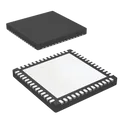
Hot Swap Controller 1 Channel General Purpose 32-LQFN (5x5) The NCP81428MNTXG is a high-performance multi-phase synchronous buck controller designed for CPU, GPU, FPGA, ASIC, and high-current core power applications requiring accurate voltage regulation, fast transient response, and high efficiency. The device supports multi-phase operation with integrated gate drivers and advanced control architecture optimized for modern low-voltage, high-current power rails. It is intended for applications requiring dynamic voltage scaling, precise load-line regulation, and reliable system power management in computing, networking, telecommunications, and industrial platforms. The controller operates with external MOSFET stages and supports flexible power stage configuration for optimized thermal and efficiency performance. It incorporates differential voltage sensing, programmable protection features, current balancing between phases, and high-speed transient compensation to maintain stable operation under rapidly changing load conditions. Engineering Specification Manufacturer onsemi Manufacturer Part Number NCP81428MNTXG Device Type Multi-Phase Synchronous Buck Controller with Integrated Gate Drivers Control Topology Voltage Mode Multi-Phase PWM Control Phase Configuration Dual-Phase Controller Architecture Application Focus CPU Core Power GPU Core Regulation FPGA Power Rails ASIC Core Supplies High-Current DC-DC Regulation Input Supply Range Supports Low-Voltage Bias Supply Operation for Digital Power Systems Output Voltage Regulation Programmable Low-Voltage Output Regulation with Differential Remote Sense Capability Switching Frequency Programmable PWM Switching Frequency with Multi-Phase Interleaving Gate Driver Integration Integrated High-Side and Low-Side MOSFET Gate Drivers Current Sensing Supports Inductor DCR Sensing and Sense Resistor Current Monitoring Load-Line Support Programmable Load-Line Regulation and Droop Compensation Voltage Positioning Adaptive Voltage Positioning for Improved Transient Performance Protection Features Overcurrent Protection Overvoltage Protection Undervoltage Protection Thermal Protection Short-Circuit Protection Power-Good Monitoring Power Management Features Soft-Start Control Enable Functionality Phase Balancing Fault Monitoring Sequencing Support Compensation External Compensation Network Support for Loop Stability Optimization Efficiency Features Synchronous Rectification Support Multi-Phase Interleaving for Reduced Ripple Current Optimized Gate Drive Timing Package Type QFN Surface-Mount Package Mounting Type Surface Mount Technology Temperature Range Industrial Operating Temperature Range Target Applications Server Motherboards High-Performance Embedded Computing Networking Equipment Telecommunications Infrastructure Industrial Processing Systems Graphics and Accelerator Platforms #commonpartslibrary #integratedcircuit #powermanagement #hotswapcontrollers
2 Uses0 StarsTPS16850VMAR
Hot Swap Controller 1 Channel General Purpose 23-LQFN-CLIP (6x5) The TPS16850VMAR is an automotive-grade integrated hot-swap and protection controller designed for robust power-path management in low-voltage DC systems. The device provides comprehensive protection features including overvoltage protection, undervoltage protection, reverse current blocking, inrush current control, overcurrent protection, and short-circuit protection. It is intended for applications requiring controlled power delivery and fault isolation in harsh electrical environments. The device integrates dual back-to-back MOSFET control to support bidirectional current blocking and safe power switching. Adjustable protection thresholds and timing parameters allow flexible system configuration for various power rail requirements. The TPS16850VMAR supports operation across a wide supply voltage range and is optimized for automotive and industrial systems requiring high reliability and transient immunity. The controller includes fault reporting and system status monitoring functions to support intelligent power management architectures. Soft-start capability minimizes inrush current during startup, reducing stress on connectors, power supplies, and downstream circuitry. Integrated thermal protection enhances system safety during abnormal operating conditions. The TPS16850VMAR is qualified for automotive applications and complies with AEC-Q100 requirements. The device is provided in a compact VQFN package suitable for space-constrained designs and high-density PCB layouts. Key Features Automotive-qualified hot-swap and eFuse controller Wide operating input voltage range Adjustable overvoltage and undervoltage protection Reverse current and reverse polarity protection Inrush current control with programmable soft-start Adjustable overcurrent and short-circuit protection Fault monitoring and reporting outputs Integrated thermal shutdown protection Back-to-back MOSFET control architecture Fast fault response and isolation Support for controlled power sequencing Designed for harsh automotive electrical environments AEC-Q100 qualified for automotive applications Compact VQFN surface-mount package Applications Automotive electronic control units Infotainment and telematics systems ADAS and camera modules Industrial power distribution Hot-swappable system power rails Battery-powered embedded systems Power-path management systems Protection for sensitive downstream electronics Electrical Characteristics Operates from low-voltage DC power rails Supports programmable protection thresholds Integrated current sensing and fault detection High transient immunity for automotive environments Low standby current operation Fast response to overload and fault conditions Mechanical Characteristics Surface-mount VQFN package Compact footprint for dense PCB layouts RoHS-compliant package construction Suitable for automated assembly processes Environmental and Reliability Specifications Automotive AEC-Q100 qualified Extended operating temperature range ESD protection on interface pins Designed for high-reliability applications Supports operation in electrically noisy environments #commonpartslibrary #integratedcircuit #powermanagement #hotswapcontrollers
62 Uses0 StarsTPS6593C3A0RWERQ1
Power Management Specialized - PMIC Automotive 2.8-V to 5.5-V PMIC The TPS6593C3A0RWERQ1 is an automotive-grade power management integrated circuit (PMIC) designed by Texas Instruments for advanced processor and system-on-chip power architectures. The device integrates multiple high-efficiency DC/DC buck converters, low-dropout regulators, power sequencing, safety monitoring, and diagnostic functions into a single compact package. It is optimized for use in automotive ADAS, digital cockpit, gateway, radar, vision, and domain controller applications requiring functional safety compliance and high power density. The device supports complex multi-rail power management for high-performance processors and includes configurable startup and shutdown sequencing, voltage monitoring, watchdog functionality, error signaling, and fault protection mechanisms. Integrated communication interfaces enable configuration and monitoring by an external host processor. The PMIC is qualified for automotive applications and supports operation across extended temperature ranges suitable for harsh automotive environments. Key Features Automotive AEC-Q100 qualified power management IC for processor power systems Integrated multi-phase step-down buck converters for high-current rails Integrated low-dropout linear regulators for analog and auxiliary rails Programmable power sequencing and rail management Functional safety support suitable for ASIL-oriented system architectures Integrated watchdog timer and safety monitoring functions Voltage supervision and fault detection for all major rails I2C and SPI communication interface support Power-good outputs and interrupt signaling Thermal shutdown and overtemperature protection Overcurrent and short-circuit protection Undervoltage and overvoltage monitoring Configurable GPIO functionality Low-power standby and sleep mode support Optimized for automotive SoCs and processors High-efficiency switching regulator architecture Compact VQFN package with thermal enhancement Electrical Characteristics Input supply voltage range supports automotive battery-powered systems Multiple programmable buck converter output voltages Integrated LDO outputs for precision analog and digital domains High switching frequency operation for reduced external component size Wide operating junction temperature range suitable for automotive environments Low shutdown current for standby operation High-current capability for processor core supplies Accurate voltage regulation and monitoring Protection and Safety Features Thermal shutdown protection Buck converter cycle-by-cycle current limiting Short-circuit protection on power rails Undervoltage lockout protection Power sequencing fault management Watchdog monitoring for processor supervision Diagnostic interrupt and fault reporting capability Safe-state transition support during fault conditions Package Information Package type: VQFN Package option: RWE Automotive-grade Q1 qualified device RoHS compliant Surface-mount package optimized for thermal performance Typical Applications Automotive domain controllers ADAS processing modules Digital cockpit systems Automotive gateway and networking platforms Radar and vision systems Processor and FPGA power management Industrial high-performance embedded systems #commonpartslibrary #integratedcircuit #powermanagement
1 Uses0 StarsTQ2SA-L2-3V-Z
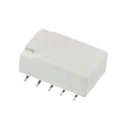
Flat, 5 mm 2 Form C, 2 A, relays Telecom Relay DPDT (2 Form C) Surface Mount The TQ2SA-L2-3V-Z is a compact surface-mount DPDT (2 Form C) telecom/signal relay from Panasonic Industry designed for low-power switching applications. It features a dual-coil latching mechanism, allowing the relay to maintain its state without continuous coil power, making it suitable for battery-powered and energy-efficient systems. This relay is commonly used in telecommunications equipment, industrial controls, measurement devices, and embedded electronic systems. Key Features DPDT (2 Form C) contact configuration 3V DC dual-coil latching relay Low power consumption: approximately 140 mW Compact SMD package: only 5.6 mm height Surface-mount gull-wing terminals Sealed construction for automatic washing compatibility High switching capability: up to 2 A Wide switching voltage range: up to 125 VAC / 220 VDC Fast operate/release time: approx. 4 ms High dielectric strength and surge resistance Wide operating temperature: −40°C to +85°C Gold-clad AgNi contacts for reliable low-level signal switching Tape-and-reel packaging (“Z” suffix) for automated assembly #CommonPartsLibrary #relay
3 Uses0 StarsLMR33630-Q1
3.8-V to 36-V, 3-A synchronous step-down voltage converter Buck Switching Regulator IC Positive Adjustable 1V 1 Output 3A 12-PowerVFQFN The LMR33630-Q1 automotive-qualified regulator is an easy-to-use, synchronous, step-down DC/DC converter that delivers best-in-class efficiency for rugged applications. The LMR33630-Q1 drives up to 3 A of load current from an input of up to 36 V. The LMR33630-Q1 provides high light load efficiency and output accuracy in a very small solution size. Features such as a power-good flag and precision enable provide both flexible and easy-touse solutions for a wide range of applications. The LMR33630-Q1 automatically folds back frequency at light load to improve efficiency. Integration eliminates most external components and provides a pinout designed for simple PCB layout. Protection features include thermal shutdown, input undervoltage lockout, cycle-by-cycle current limit, and hiccup short-circuit protection. The LMR33630-Q1 is available in a 12-pin 3 mm × 2 mm next generation VQFN package with wettable flanks • AEC-Q100 qualified for automotive applications: – Temperature grade 1: –40°C to +125°C, TA • Functional Safety-Capable – Documentation available to aid functional safety system design • Configured for rugged automotive applications – Input voltage range: 3.8 V to 36 V – Output voltage range: 1 V to 24 V – Output current: 3 A – 75-mΩ/50-mΩ RDS-ON power MOSFETs – Peak-current-mode control – Short minimum on-time of 68 ns – Frequency: 400 kHz, 1.4 MHz, 2.1 MHz – Integrated compensation network • Low EMI and switching noise – HotRod™ package – Parallel input current paths • High power conversion at all loads – Peak efficiency > 95% – Low shutdown quiescent current of 5 µA – Low operating quiescent current of 25 µA #CommonPartsLibrary #IntegratedCircuit #PowerManagement #LMR33630
273 Uses0 StarsMAX77960EFV06+
- Converter, Battery Powered Devices Voltage Regulator IC 1 Output 30-FC2QFN (4x4) The MAX77960EFV06+ is a fully integrated switching charger and power management IC that supports both step-up (boost) and step-down (buck) operation, making it suitable for USB-C PD applications where input voltage can be higher or lower than the battery voltage. It includes an internal Smart Power Selector™, which intelligently manages power flow between the input source, battery, and system load, enabling smooth system startup even with deeply discharged batteries. This device is widely used in portable electronics, battery-powered systems, drones, cameras, and USB-C PD devices requiring high power efficiency and compact design. Key Features Power & Electrical Specs Input voltage range: 3.5 V to 25.4 V High-efficiency buck-boost operation (up to ~97% peak efficiency) Programmable charging current: 100 mA to 3.15 A (MAX77960 version) Supports 2-cell and 3-cell Li-ion battery charging #CommonPartsLibrary #IntegratedCircuit #PowerManagement
0 Uses0 Stars