Interface ICs
An interface IC is a type of integrated circuit that is designed to facilitate communication between two devices or systems. These devices are commonly used in electronic systems to enable the transfer of data and control signals between different components or subsystems. Some common use cases for interface ICs include connecting microcontrollers to peripherals such as sensors or displays, linking multiple processors together in a network, and enabling communication between devices using different communication protocols. Flux.ai has the world's largest community-driven public library of interface ICs, with footprints, symbols, datasheets, and simulation models. This library is a valuable resource for engineers and designers who need access to accurate and up-to-date information on these important components. Whether you are working on a new design project or simply looking to learn more about interface ICs, Flux.ai is an excellent resource to help you find the information you need.
USB4155-03-C
USB-C (USB TYPE-C) USB 3.2 Gen 2 (USB 3.1 Gen 2, Superspeed + (USB 3.1)) Plug Connector 24 Position Board Edge, Surface Mount; Through Hole, Right Angle Global Connector Technology (GCT) USB4155-03-C is a USB Type-C Plug Connector designed for USB 3.2 Gen 2 (USB 3.1 Gen 2 SuperSpeed+) high-speed data applications. It is a right-angle, horizontal SMT connector with a 24-contact configuration, suitable for PCB edge mounting. The connector supports high-speed signal transmission, power delivery, and durable mechanical connection for embedded systems, portable devices, and consumer electronics. Key Features: Connector Type: USB Type-C Plug Connector USB Standard: USB 3.2 Gen 2 / USB 3.1 Gen 2 SuperSpeed+ Number of Contacts: 24 positions Mounting Type: Surface Mount Technology (SMT), right-angle horizontal PCB mounting Data Transfer Rate: Supports high-speed USB 3.2 Gen 2 communication (up to 10 Gbps) Current Rating: Up to 5 A for power delivery applications Voltage Rating: Up to 48 VDC Durability: Rated for approximately 10,000 mating cycles Shielding: Metal shielded housing for EMI protection Contact Finish: Gold-plated contacts for reliable conductivity Operating Temperature: -30°C to +85°C Application: Embedded systems, laptops, tablets, mobile devices, storage devices, and USB-C interface boards Component Classification: Category: Connector / Interconnect Component Subcategory: USB Type-C Connector Not an IC or semiconductor component PCB Footprint Required: Yes Mechanical Part: No (it is an electromechanical connector with soldered electrical terminals) #CommonPartsLibrary #Connector #USBTypeC #USBConnector #USB32Gen2 #USB31Gen2 #SuperSpeedPlus #GCT #BoardMountConnector #SMTConnector #HighSpeedInterface #PCBDesign #ElectronicComponents #InterconnectTechnology
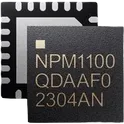
4 Uses0 StarsNPM1100-QDAA-R7
Battery Power Management IC Lithium Ion/Polymer 24-QFN (4x4) nPM1100 is an integrated Power Management IC (PMIC) with a linear-mode lithium-ion/lithium-polymer battery charger in a compact 2.1x2.1 mm WLCSP package. It has a highly efficient, dual-mode configurable output DC/DC buck regulator. nPM1100 is an extremely compact PMIC device, created for space constrained applications with a small lithium-ion or lithium-polymer battery. It is compatible with all nRF52 and nRF53 Series SoCs and supports charging batteries at up to 500 mA through USB, and also delivers up to 150 mA of current to power external components with regulated voltage. A minimum of five passive components are required for operation and the device functions without a control interface. It is the perfect companion for nRF52 and nRF53 multiprotocol SoCs in battery powered designs. Low quiescent current (IQ) extends battery life during shipping and storage with Ship mode, or in operation using auto-controlled hysteretic buck mode for high efficiency down to 1 µA loads. Charge and error indication LED drivers are built in. Charge profile limits are configurable and VBUS current limits can be fixed or auto-controlled with on-chip USB port detection. • 400 mA linear battery charger • Linear charger for lithium-ion/lithium-polymer batteries • Adjustable charge current from 20 mA to 400 mA • Selectable termination voltage of 4.1 V or 4.2 V • Automatic trickle, constant current, and constant voltage charging • Battery thermal protection • Discharge current limitation • JEITA compliant • Li-ion/Li-polymer USB battery charger with a high efficiency buck regulator • 800 nA - Typical quiescent current • 460 nA - Shipping mode quiescent current • Thermal protection • Input regulator • USB compatible current limit of 100 mA and 500 mA • 4.1 V to 6.7 V input voltage range for normal operation • 20 V overvoltage protection • Reverse current protection • 3.0 V to 5.5 V system voltage output • USB port detection supporting the following types: • SDP • CDP/DCP • 1.8 V to 3.0 V, 150 mA step-down buck regulator • Step-down buck regulator with up to 92% efficiency • Automatic transition between hysteretic and pulse width modulation (PWM) modes • Forced PWM mode for clean power operation • Pin-selectable output voltage (1.8 V, 2.1 V, 2.7 V, 3.0 V) • Soft start-up • LED drivers for charger state indication • 5 mA low side LED driver for charging indication • 5 mA low side LED driver for error indication • 2.3 V to 4.35 V battery operating input range • 2.1x2.1 mm WLCSP package • Suitable for two layer PCB design #CommonPartsLibrary #IntegratedCircuit #NordicSemiconductor #nPM1100 #PMIC #BatteryCharger #PowerManagement #LiIon #LiPolymer #BuckConverter #Wearables #IoT #WirelessSensor #LowPowerDesign #USBCharging #EmbeddedSystems #nRF52 #nRF53 #PortableElectronics
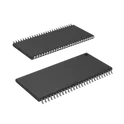
17 Uses0 StarsAS4C32M16SB-7TCN
SDRAM Memory IC 512Mbit Parallel 143 MHz 5.4 ns 54-TSOP II The AS4C32M16SB-7TCN is a single-data-rate synchronous dynamic random-access memory (SDR SDRAM) device manufactured by Alliance Memory. It is organized internally as a multi-bank array, allowing concurrent access operations across banks to improve effective memory bandwidth compared to simpler asynchronous DRAM architectures. The device is intended for general-purpose embedded memory applications where a synchronous, clock-driven memory interface is required, including embedded systems, industrial controllers, consumer electronics, networking equipment, and other designs that rely on a parallel SDRAM interface for working memory or buffering. As a drop-in style component within Alliance Memory's broader memory portfolio, this part is designed to be pin- and function-compatible with legacy SDR SDRAM devices originally offered by other manufacturers, allowing designers to source a continued-availability alternative for designs that depend on this memory architecture even as some original suppliers have discontinued production. This makes the device particularly useful in long-lifecycle industrial, embedded, and legacy system designs where a guaranteed supply of a specific memory interface and timing profile is critical to sustaining production over many years. The "B" designation in the part family indicates a specific die revision within the AS4C32M16S product line, reflecting a particular generation of internal silicon design while maintaining functional and pinout compatibility with related die revisions in the same footprint. The device communicates over a standard synchronous SDRAM command interface, using a clock-synchronized protocol for row and column addressing, data burst transfers, and bank management, and it supports the auto-refresh and self-refresh mechanisms typical of SDRAM devices to maintain stored data integrity without requiring constant external refresh management by the host controller. Mechanically, the device is housed in a thin small-outline package suited to space-constrained PCB layouts, and it is built for standard surface-mount assembly processes. The "-7TCN" suffix on this part number reflects a specific speed grade, package style, and temperature grade combination within the product family, with this particular variant intended for commercial temperature range operation. The device is supplied in tray packaging for surface-mount assembly and is compliant with RoHS material restrictions, supporting standard environmental and regulatory requirements for electronic components. Spec Sheet Identification Part Number: AS4C32M16SB-7TCN Device Family: AS4C32M16SB Manufacturer: Alliance Memory, Inc. Die Revision: B-die Functional Classification Device Type: Synchronous DRAM (SDR SDRAM) Memory Organization: Multi-bank array architecture Interface Type: Parallel, clock-synchronous command interface Refresh Capability: Supports auto-refresh and self-refresh modes Electrical Characteristics Supply Voltage: Standard 3.3V-class SDRAM supply rating Clock Frequency: Mid-range SDR SDRAM clock speed class Access Timing: Standard SDR SDRAM access time class for its speed grade Environmental & Qualification Temperature Grade: Commercial ("C" suffix designation) RoHS Compliance: Yes Product Positioning: Long-lifecycle, drop-in replacement memory device Package Package Type: Thin Small Outline Package, TSOP-II style Mounting: Surface mount technology (SMT) Packaging Format Supply Format: Tray packaging #AS4C32M16SB #AllianceMemory #SDRAM #SDRSDRAM #MemoryIC #EmbeddedMemory #TSOP #SurfaceMount #LegacyMemory #DropInReplacement #DRAM #EmbeddedSystems #IndustrialElectronics #SemiconductorIC #EngineeringSpec #ComponentLibrary #CommonPartsLibrary #RoHSCompliant #MemoryComponent #PCBDesign #CommonPartsLibrary #IntegratedCircuit #Memory #AS4C32
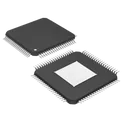
8 Uses0 StarsLAN9254-I/JRX
Ethernet Controller 10/100 Base-T/TX Bus Interface 80-TQFP-EP (12x12) The LAN9254-I/JRX is an EtherCAT SubDevice (slave) controller developed by Microchip Technology, designed to serve as the communication backbone for industrial automation devices participating in an EtherCAT network. The device integrates dual Ethernet physical layer transceivers directly on-chip, eliminating the need for external PHY components and simplifying the design of EtherCAT-enabled equipment such as servo drives, sensors, I/O modules, and other field devices used in real-time industrial control systems. Architecturally, the controller can operate as either a two-port or three-port node, depending on the network topology required. In its standard configuration it functions as a two-port device supporting daisy-chain connections typical of EtherCAT line topologies. When configured as a three-port device, it gains an additional management interface port that can connect to an external PHY or to another LAN9254, enabling star or tree network topologies and allowing the device to act as a branching point within a larger EtherCAT installation. Each integrated Ethernet PHY operates in full-duplex mode and supports automatic crossover detection, so the device can use either straight-through or crossover cabling without requiring manual configuration. Beyond pure protocol handling, the LAN9254 includes a substantial set of general-purpose digital input and output lines, allowing it to be used in simple field devices without requiring a separate microcontroller. For more complex applications, the device communicates with an external host processor through an integrated host bus interface that behaves like simple memory-mapped SRAM, supporting both 8-bit and 16-bit data widths along with multiple byte-ordering conventions, which makes it straightforward to interface with a wide range of microcontroller and microprocessor architectures. Internally, dual process data RAM buffers manage the exchange of real-time process data between the host application and the EtherCAT communication engine, while a dedicated interrupt line notifies the host of relevant internal events. A key feature of the device is its built-in distributed clock mechanism, which provides high-precision timing synchronization across all nodes in an EtherCAT network. This capability is essential for motion control and other applications where multiple devices must act in tight temporal coordination. The controller also provides configurable status indication through standard network activity and link LEDs, along with optional error and run-state indicators that give visibility into the health and operational state of the device at a glance. Power architecture on the LAN9254 is simplified through an integrated linear regulator, allowing the device to be operated from a single primary supply rail while internally generating the lower voltage needed for its core logic. This reduces the external power supply complexity that would otherwise be required to support separate core and I/O voltage domains. The "-I" designation on this particular part number indicates an industrial-grade temperature rating, making it suitable for deployment in factory floor and other demanding industrial environments where extended thermal range and long-term reliability are required. The device is housed in a surface-mount package consistent with dense industrial control board layouts and is compliant with RoHS material restrictions. Spec Sheet Identification Part Number: LAN9254-I/JRX Device Family: LAN9254 Manufacturer: Microchip Technology Functional Classification Device Type: EtherCAT SubDevice (slave) controller Network Role: Two/three-port configurable node Integrated PHYs: Dual Ethernet physical layer transceivers, on-chip Auto-MDIX Support: Yes, supports direct and crossover cabling Communication & Protocol Features Protocol: EtherCAT Topology Support: Daisy-chain (line), star, and tree topologies Additional Port Mode: Optional third port for branching/tap configurations Clock Synchronization: Integrated distributed clock for high-precision timing Host Interface Interface Type: SRAM-like host bus interface Data Width Support: Selectable bit-width host bus operation Endianness Support: Multiple byte-ordering modes Process Data Handling: Dual process data RAM buffers Interrupt Support: Configurable host interrupt line Digital I/O General-Purpose I/O: Integrated digital I/O lines for microcontroller-less operation Standalone Mode: Supports operation without external microcontroller for simple device designs Power Architecture Supply Configuration: Single primary supply rail Internal Regulation: Integrated linear regulator for core voltage generation Status Indication LED Support: Standard run and link/activity indicators per port Optional Indicators: Configurable error and run-state status indicators Environmental & Qualification Temperature Grade: Industrial ("-I" suffix) RoHS Compliance: Yes Package Package Type: Surface-mount, quad flat package style Mounting: Surface mount technology (SMT) Packaging Format Supply Format: Tape-and-reel, per part suffix designation #LAN9254 #Microchip #EtherCAT #SlaveController #SubDeviceController #IndustrialEthernet #IndustrialAutomation #MotionControl #EmbeddedSystems #FieldDevice #DigitalIO #HostBusInterface #DistributedClock #TQFP #RoHSCompliant #IndustrialGrade #EngineeringSpec #ComponentLibrary #CommonPartsLibrary #SemiconductorIC
1 Uses0 Stars